New Caledonia: Big, Booming
pp. 49-50 · Read in the full issue
And (Sometimes) Bursting
From HELEN ROUSSEAU , in Noumea A record number of new companies registered in New Caledonia for the first half of this year . . . cost of living index up 12 per cent, in 17 months . . . strike of commerce employees . . . three new bank offices just opened in Noumea . . . and their interest rate on savings deposits increased from 4 per cent, to 4.25 per cent. . . .
These are some of the latest expansionist and inflationary develop ments in the French territory, coupled with attempts to cope with them.
There were 46 new companies registered in the first six months of this year. This compares with 18 new companies for the corresponding period of last year and 52 for the whole of 1969.
Main new investment is centred on the mining and transportation fields as well as construction indus tries. Capital of the new companies ranges from around $A4,000 to $A300,000 per enterprise.
As greater demands are placed upon the supply of labour, materials, housing and such public necessities as port facilities, the cost of living index in August had risen 12 per cent, since the basic figure defined in March, 1969.
While workers battled to keep up with rising costs, commerce em ployees staged an intermittent strike in early August. This affected the operations of banks and stores to varying degrees, as their employees demanded wage increases up to 24 per cent.
During July-August, three new bank offices were opened in Noumea.
Two were branches of the long established Banque de I’lndochine. (This bank has now also opened an office in Sydney.) At the same time, the more-recently installed Banque Nationale de Paris opened its second branch in the territory, in a Noumea suburb.
In a bid to encourage savings and curb the rising spiral of inflation, banks in the territory increased their interest rate on savings deposits to 4.25 per cent., dating from July 1.
And here are other landmarks in a rising tide of economic activity: The ever-growing rows of newly landed cars on the Noumea water front are a constant reminder of the territory’s expanding automobile fleet.
In the first half of 1970 3,655 vehicles have been registered on the
island. This is more than the total number of registrations for 1968 (3,646 vehicles) and still points to an increasing trend over 1969 (5,733 vehicles for the whole year). Most vehicles were for private use.
Motorcycle registrations remain more at the old level: In the first half of 1970 they reached 442, com pared with 799 for all 1969 and 795 throughout 1968.
The new registrations were chiefly of French manufacture (2,294); foreign makes accounted for 1,361 vehicles.
Assuming the average Caledonian family to be of four persons, then pre sumably one family in seven had bought a new vehicle in the first half of 1970.
Caledonians travelling overseas have had their currency restrictions slightly improved since mid-August.
Under new laws passed by the Paris government, French residents may now take out SA24O worth of foreign currency on each of two trips per year. Previously the foreign currency allowance for tourist trips was only SA24O for the whole year.
Caledonian businessmen are now permitted a daily allowance of SA64, up to a maximum of SA64O per trip.
French currency, which is not always satisfactorily convertible out side France, is available up to SABO worth.
On returning to the territory, a resident must surrender to the authorities any foreign currency he carries, above a SAI6 limit.
Under the new laws, the French authorities no longer require Cale donians’ foreign currency transactions to be recorded on the “carnet d’echange” exchange card. Applicants for this card, before gaining their SA24O, were obliged to have their fingerprints recorded by the Noumea police—a practice which many Cale-
donians are now relieved to see abolished.
And where is the prosperity coming from?
Well, New Caledonian nickel ex ports—which constitute 99 per cent, of the territory’s total exports—were up 34 per cent, in tonnage over the first six months of this year. By comparison with the same period last year, this shows a 56 per cent, in crease in their value in francs. Due to the intervening 12i per cent.
French currency devaluation in August, 1969, however, this repre sents a 40 per cent, increase in their dollar value. Total nickel exports for the first half of this year reached a record SA72 m. compared with SAS2 m. for the same period last year.
Nickel ore exports (almost ex clusively to Japan) reached 1.7 million tons and sold for SA3O m.
This volume of ore was nearly 500,000 tons more than in the first six months of 1969. Ferro-nickel exports were up 7,000 tons to reach 51,381 tons and sold for SA2B m.
Nickel matte production rose insignifi cantly to export 8,289 tons, selling at
Sai3 M.
Meanwhile, to further define the
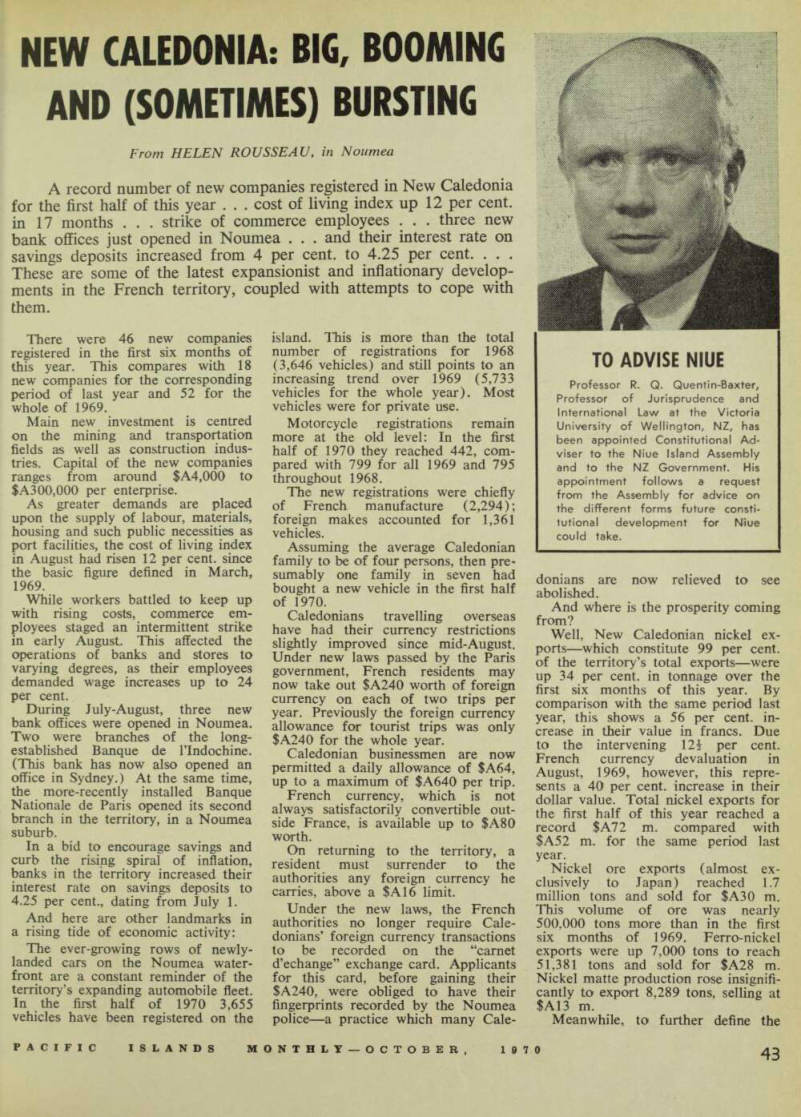
To Advise Niue
Professor R. Q. Quentin-Baxter, Professor of Jurisprudence and International Law at the Victoria University of Wellington, NZ, has been appointed Constitutional Ad viser to the Niue Island Assembly and to the NZ Government. His appointment follows a request from the Assembly for advice on the different forms future consti tutional development for Niue could take.
Paris government policy on nickel exploitation in New Caledonia, a four-man mining mission visited the territory in August.
The Paris officials held talks with members of the Administration and with independent Caledonian mine operators. The Caledonian Indepen dent Mining Union (SIM) sought a meeting with the mission and met the four members, led by Mr. A.
Bourrelier, head of the Service des Mines in Paris.
The SIM deputation said after wards that they repeated their re quests for (1) the abolition of the quotas Paris imposed on Caledonian mine owners’ nickel ore exports to Japan; (2) the repeal of the “Billotte” laws affecting Caledonian nickel ex ploitation; and (3) the speeding-up of replies from the Noumea Mines De partment, concerning Caledonians’ applications for mining permits, etc.
To explain recent Paris policy re garding Caledonian nickel, Mr.
Bourrelier said: “New Caledonia must be industrialised. Thus Cale donian mining claims must belong to large companies, for only they are capable of industrialising the terri tory.”
After this explanation of Paris policy towards the territory’s de velopment, the Caledonian Indepen dent Mining Union (SIM) was planning further public meetings among its members.