They whale
p. 46 · Read in the full issue
Two Stories
Of Tonga
They whale the hard way...
From a Nukualofa correspondent
The whaling season is on again in the Kingdom of Tonga— whaling the hard way, by hand, in small boats. And this season looks better than last.
The first whale of the season was caught on August 7, appropriately enough by 69-year-old Mr. W. Cook, of Fasi, Nukualofa, with the assistance of his three fishermen sons, Mr. Cook is a descendant of the Cook who left his New Zealand-based whaling boat in 1888 for a life of whaling in Tonga.
The whale he caught was 39 ft long and it took three hours for Mr.
Cook and his sons to kill it. During that time the whale towed their small boat towards the Ha’apai Group, until finally they lost sight of Tongatapu. The whale’s carcase was towed back to Nukualofa by the Fukave, which was summoned by portable radio. A week later, 52 ft and 42 ft whales were caught off Ha’apai by Feleti Ketika and were cut up and sold off a beach near Pangai in Ha’apai.
The first whaling in Tonga was originally based in the Ha’apai Group and was carried out by the original Cook, who was formerly a crew member on a New Zealand-based whaler. Cook arrived in Ha’apai in 1888 and made a business from whaling there until 1912. However, he found it difficult to sell his whale oil from so remote a place and so in 1912 he moved to Nukualofa, where his descendants still live.
There is no tradition of whaling by the Tongans before the arrival of Cook, although by 1888 a great many Tongans must have had experience as crew members on the many whalers operating in the Pacific area.
Whaling is still practised today in the same way as when Cook first
introduced it to the Tongans in 1888.
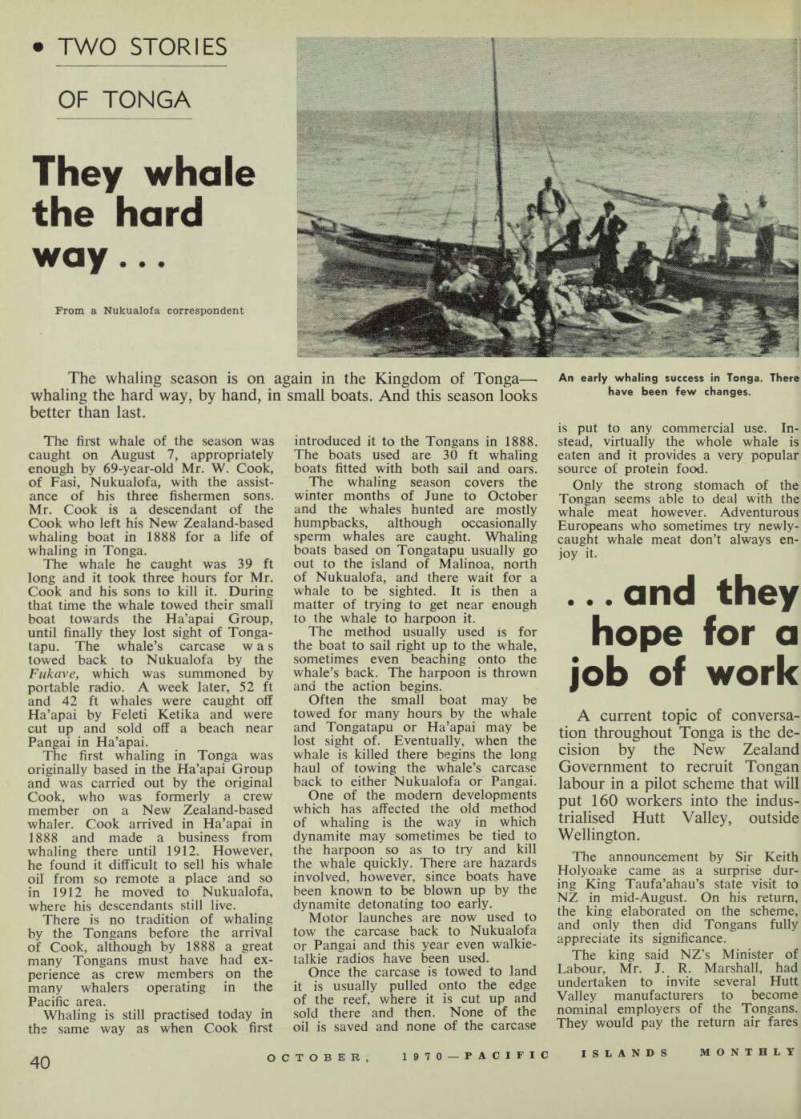
The boats used are 30 ft whaling boats fitted with both sail and oars, The whaling season covers the winter months of June to October and the whales hunted are mostly humpbacks, although occasionally sperm whales are caught. Whaling boats based on Tongatapu usually go out to the island of Malinoa, north of Nukualofa, and there wait for a whale to be sighted. It is then a matter of trying to get near enough to the whale to harpoon it.
The method usually used is for the boat to sail right up to the whale, sometimes even beaching onto the whale’s back. The harpoon is thrown and the action begins, Often the small boat may be towed for many hours by the whale and Tongatapu or Ha’apai may be lost sight of. Eventually, when the whale is killed there begins the long haul of towing the whale’s carcase back to either Nukualofa or Pangai.
One of the modern developments which has affected the old method of whaling is the way in which dynamite may sometimes be tied to the harpoon so as to try and kill the whale quickly. There are hazards involved, however, since boats have been known to be blown up by the dynamite detonating too early.
Motor launches are now used to tow the carcase back to Nukualofa or Pangai and this year even walkie talkie radios have been used, Once the carcase is towed to land it is usually pulled onto the edge of the reef, where it is cut up and sold there and then. None of the oil is saved and none of the carcase
is put to any commercial use. In stead, virtually the whole whale is eaten and it provides a very popular source of protein food.
Only the strong stomach of the Tongan seems able to deal with the whale meat however. Adventurous Europeans who sometimes try newly caught whale meat don’t always en joy it.
An early whaling success in Tonga. There have been few changes.