Were These Left 400 Years Ago By
p. 43 · Read in the full issue
Alvaro De Mendana?
Prom a Honiara correspondent
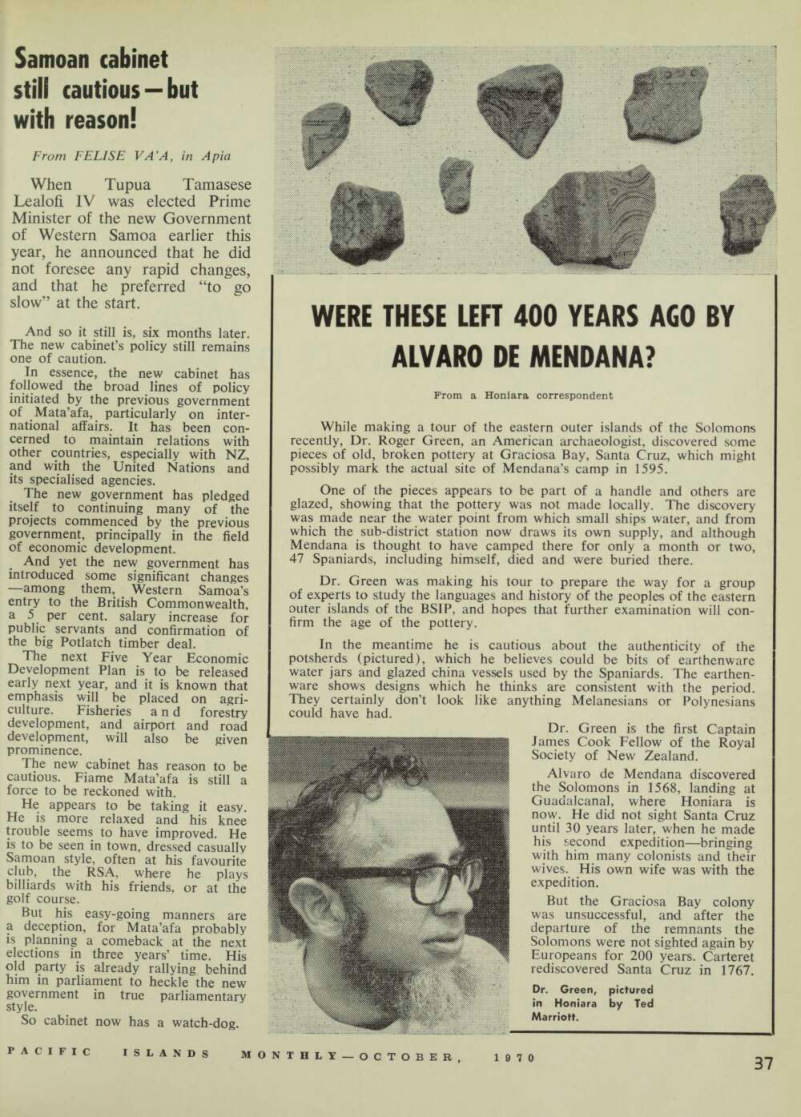
While making a tour of the eastern outer islands of the Solomons recently, Dr. Roger Green, an American archaeologist, discovered some pieces of old, broken pottery at Graciosa Bay, Santa Cruz, which might possibly mark the actual site of Mendana’s camp in 1595.
One of the pieces appears to be part of a handle and others are glazed, showing that the pottery was not made locally. The discovery was made near the water point from which small ships water, and from which the sub-district station now draws its own supply, and although Mendana is thought to have camped there for only a month or two, 47 Spaniards, including himself, died and were buried there.
Dr. Green was making his tour to prepare the way for a group of experts to study the languages and history of the peoples of the eastern outer islands of the BSIP, and hopes that further examination will con firm the age of the pottery.
In the meantime he is cautious about the authenticity of the potsherds (pictured), which he believes could be bits of earthenware water jars and glazed china vessels used by the Spaniards. The earthen ware shows designs which he thinks are consistent with the period.
They certainly don’t look like anything Melanesians or Polynesians could have had.
Dr. Green is the first Captain James Cook Fellow of the Royal Society of New Zealand.
Alvaro de Mendana discovered the Solomons in 1568, landing at Guadalcanal, where Honiara is now. He did not sight Santa Cruz until 30 years later, when he made his second expedition—bringing with him many colonists and their wives. His own wife was with the expedition.
But the Graciosa Bay colony was unsuccessful, and after the departure of the remnants the Solomons were not sighted again by Europeans for 200 years. Carteret rediscovered Santa Cruz in 1767.
Dr. Green, pictured in Honiara by Ted Marriott,