Too close to home, even in their dreams
p. 37 · Read in the full issue
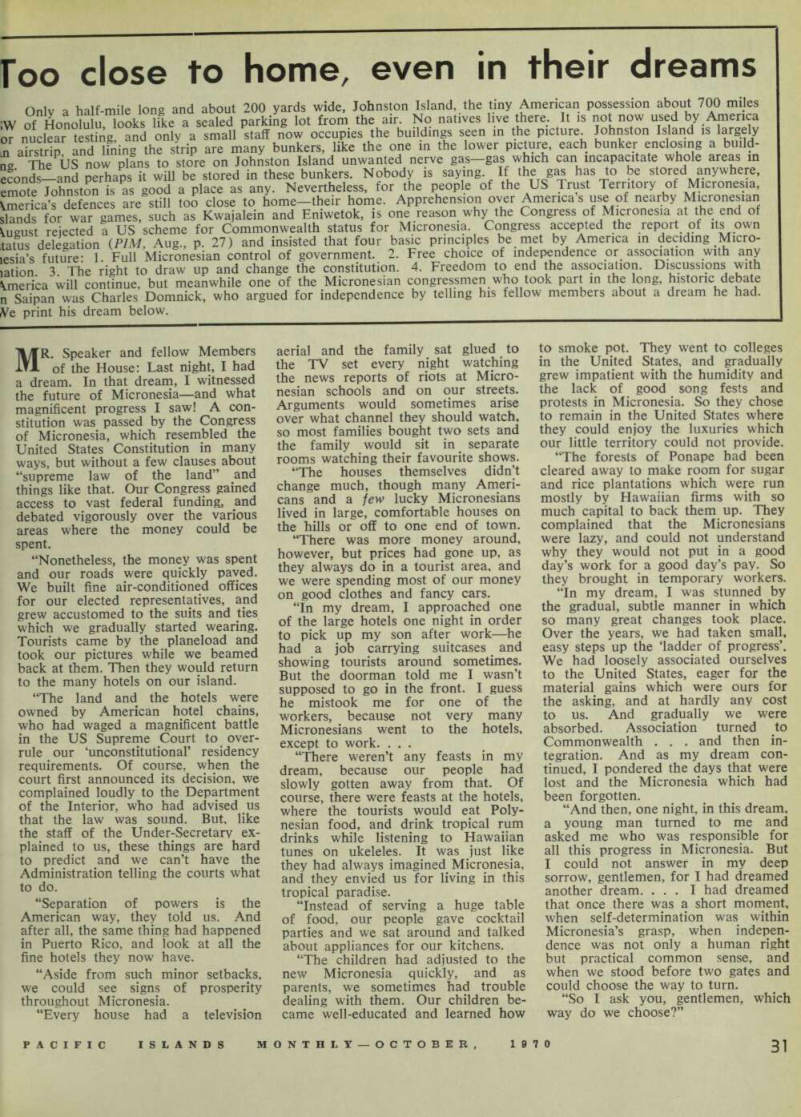
Onlv a half-mile long and about 200 yards wide. Johnston Island, the tiny American possession about 700 miles iW of Honolulu looks like a sealed parking lot from the air. No natives live there. It is not now used by America „ nuclear testing and only a small staff now occupies the buildings seen ,n the picture Johnston Island is largely ° airstrip 1 and lining the strip are many bunkers, like the one in the lower picture, each bunker enclosing a build n„ The US now plans to store on lohnston Island unwanted nerve gas—gas which can incapacitate whole areas in efonds-and perhaps it will be stored in these bunkers. Nobody is saying If the gas has to be stored anywhere, Imote Johnston is as good a place as any. Nevertheless, for the people of the US Trust Territory of Micronesia, America’s defences are still too close to home-their home. Apprehension over Americas use of nearby Micronesian stands for war games, such as Kwajalein and Eniwetok, is one reason why the Congress of Micronesia at the end of Vugust rejected a US scheme for Commonwealth status for Micronesia. Congress accepted the report of its own talus delegation (PIM, Aug., p. 27) and insisted that four basic principles be met by America in deciding Micro lesia’s future: 1. Full Micronesian control of government. 2. Free choice of independence or association with any lation 3 The right to draw up and change the constitution. 4. Freedom to end the association. Discussions with America will continue, but meanwhile one of the Micronesian congressmen who took part in the long, historic debate n Saipan was Charles Domnick, who argued for independence by telling his fellow members about a dream he had.
Ne print his dream below.
MR. Speaker and fellow Members of the House: Last night, I had a dream. In that dream, I witnessed the future of Micronesia—and what magnificent progress I saw! A con stitution was passed by the Congress of Micronesia, which resembled the United States Constitution in many ways, but without a few clauses about “supreme law of the land” and things like that. Our Congress gained access to vast federal funding, and debated vigorously over the various areas where the money could be spent.
“Nonetheless, the money was spent and our roads were quickly paved.
We built fine air-conditioned offices for our elected representatives, and grew accustomed to the suits and ties which we gradually started wearing.
Tourists came by the planeload and took our pictures while we beamed back at them. Then they would return to the many hotels on our island.
“The land and the hotels were owned by American hotel chains, who had waged a magnificent battle in the US Supreme Court to over rule our ‘unconstitutional’ residency requirements. Of course, when the court first announced its decision, we complained loudly to the Department of the Interior, who had advised us that the law was sound. But, like the staff of the Under-Secretary ex plained to us, these things are hard to predict and we can’t have the Administration telling the courts what to do.
“Separation of powers is the American way, they told us. And after all, the same thing had happened in Puerto Rico, and look at all the fine hotels they now have.
“Aside from such minor setbacks, we could see signs of prosperity throughout Micronesia.
“Every house had a television
aerial and the family sat glued to the TV set every night watching the news reports of riots at Micro nesian schools and on our streets.
Arguments would sometimes arise over what channel they should watch, so most families bought two sets and the family would sit in separate rooms watching their favourite shows.
“The houses themselves didn’t change much, though many Ameri cans and a few lucky Micronesians lived in large, comfortable houses on the hills or off to one end of town.
“There was more money around, however, but prices had gone up, as they always do in a tourist area, and we were spending most of our money on good clothes and fancy cars.
“In my dream, I approached one of the large hotels one night in order to pick up my son after work—he had a job carrying suitcases and showing tourists around sometimes.
But the doorman told me I wasn’t supposed to go in the front. I guess he mistook me for one of the workers, because not very many Micronesians went to the hotels, except to work. . . .
“There weren’t any feasts in my dream, because our people had slowly gotten away from that. Of course, there were feasts at the hotels, where the tourists would eat Poly nesian food, and drink tropical rum drinks while listening to Hawaiian tunes on ukeleles. It was just like they had always imagined Micronesia, and they envied us for living in this tropical paradise.
“Instead of serving a huge table of food, our people gave cocktail parties and we sat around and talked about appliances for our kitchens.
“The children had adjusted to the new Micronesia quickly, and as parents, we sometimes had trouble dealing with them. Our children be came well-educated and learned how
to smoke pot. They went to colleges in the United States, and gradually grew impatient with the humidity and the lack of good song fests and protests in Micronesia. So they chose to remain in the United States where they could enjoy the luxuries which our little territory could not provide.
“The forests of Ponape had been cleared away to make room for sugar and rice plantations which were run mostly by Hawaiian firms with so much capital to back them up. They complained that the Micronesians were lazy, and could not understand why they would not put in a good day’s work for a good day’s pay. So they brought in temporary workers.
“In my dream, I was stunned by the gradual, subtle manner in which so many great changes took place.
Over the years, we had taken small, easy steps up the ‘ladder of progress’.
We had loosely associated ourselves to the United States, eager for the material gains which were ours for the asking, and at hardly any cost to us. And gradually we were absorbed. Association turned to Commonwealth . . . and then in tegration. And as my dream con tinued, I pondered the days that were lost and the Micronesia which had been forgotten.
“And then, one night, in this dream, a young man turned to me and asked me who was responsible for all this progress in Micronesia. But I could not answer in my deep sorrow, gentlemen, for I had dreamed another dream. ... I had dreamed that once there was a short moment, when self-determination was within Micronesia’s grasp, when indepen dence was not only a human right but practical common sense, and when we stood before two gates and could choose the way to turn.
“So I ask you, gentlemen, which way do we choose?”