Independence: Fiji Makes
pp. 31-32 · Read in the full issue
It After 96 Years
From SUE WENDT in Suva In late September, Fiji was progressing smoothly along the path to independence, nary a cloud of dissent on the horizon. Aside from any incidents arising during the heat and excitement of the October 10 celebrations, there seemed little likelihood of the trouble predicted by sceptics who still find it hard to see any real parallel between Fijian-Indian aims.
To minimise the possibility of over-ebullience and to encourage maximum attendance at the huge celebrations, it was expected that all Fiji hotels would be closed until 6 p.m. on October 10. It was hoped that social clubs would be closed too.
In terms of public exposure, Sep tember was Opposition Leader Mr.
S. M. Koya’s month. As chairman of the South Pacific Conference he had a field day, peering owlishly over his spectacles and taking a firm hand during sessions, living it up with the merriest of them during social functions.
The Chief Minister, Ratu Sir Kamisese Mara, took a back seat in SPC affairs, attending most of the social functions with Adi Lady Lala, but generally keeping out of the limelight.
This state of affairs gave even more credence to the new mood of Government-Opposition co-operation —a mood that seems to have affected all levels of the community, at least for the present.
Absent from the scene after work ing hard as head of the committee organising the celebrations was Ratu Penaia Ganilau, manager of the Fiji Rugby team touring Britain—but he was due to return home in time for the big day.
A government statement issued in September said that estimated gov ernment expenditure on the celebra tions had so far reached $F268,800 —well within the original control figure of $300,000.
Some of the biggest single items in the budget were $23,000 for new national flags; $27,000 on stands, stages, temporary lavatories, rope barriers and duckboards in Suva, Levuka and Nausori Airport; $20,000 on production of the official film, including the air fares and accommo dation for the film team from the Australian Commonwealth Film Unit; $19,000 for the accommodation,
meals and domestic air fares for about 130 official guests of the gov ernment; and $13,000 for special expenditure of the Police Force, in cluding pay for the Special Constabu lary and provision of food or sub sistence allowances.
Even the children were not for gotten. The Education Department was planning to distribute sweets and refreshments to Fiji’s 150,000 school children at an estimated cost of
$Lb,Ooo.
About $3OO was to be spent on ex penses for the large contingent of Press representatives expected to cover the celebrations.
Fireworks displays in Suva and at Lautoka, Labasa and Levuka were to cost about $9,000. The expenses for Fijian ceremonies and mekes would be about $8,000; Indian ceremonies and entertainment would cost a further $5,500.
Most commercial firms employing large numbers of people said that they intended to follow the govern ment’s example in granting full pay to employees for holidays during the celebrations.
The holidays were to be October 10 and October 12 throughout Fiji,
with various divisions granting an extra holiday on the 9th, 13th or 14th.
The decision by commercial firms to pay full wages followed a request by the Minister for Labour, Ratu Edward Cakobau, who had an nounced the government’s intention of doing so.
Although the biggest crowds and celebrations were to be in Suva, a big share in the festivities was re served for the first capital, Levuka, where it all started 96 years ago, when the Fijian chiefs ceded Fiji to Britain.
Prince Charles’s visit there on October 12 was to be the second royal visit to Levuka; he would be following in the footsteps of his great - grandfather, the late King George V. The king visited Levuka in 1881, when he was Prince George.
He was accompanied by Prince Albert Victor.
Fiji’s independence festivities were not to be confined to the home ground. Fiji people living in Britain, India, Australia, Canada, New Zealand, the British Solomon Islands and the New Hebrides were planning
some impressive get-togethers of theii own.
In Britain, Fiji students were tc hold a function at the Royal Lan caster Hotel, where Fiji’s newly appointed representative in London Mr. Josua Rabukawaqa, was to bf the main speaker. About 500 people were expected to attend.
Among the Islands leaders invitee to attend the Fiji celebration are the Governor of American Samoa, Mr John M. Hay don; Mr. Edward E Johnston, High Commissioner of the US Trust Territory; Mr. Alber Henry, Premier of the Cook Islands Prince Tuipelehake, Premier o: Tonga; Tupua Tamasese Lealofi IV Prime Minister of Western Samoa Afioga Afoafouvale Misimoa, sec retary-general of the South Pacifi< Commission; Mr. John Guise, Speake: of the House of Assembly, Papua New Guinea; Mr. R. R. Rex, Leade: of Government Business, Niue; am Mr. B. Detudamo, Nauru’s Ministei for Works and Tourism.
Non-Islands leaders to be at th< celebrations included Sir Keitl Holyoake, NZ Prime Minister; Mr J. D. Anthony, Australia’s Ministe] for Primary Industry; Mr. Michae Collins, US Assistant Secretary o: State for Public Affairs; Sarda] Gurdial Singh Dhillon, Speaker o: the Indian Lok Sabha, and Mr Joseph Godber, UK Minister o State, Foreign Office. Many of th( guests brought their wives.
Picture story, p. 45.
Landmark Goes
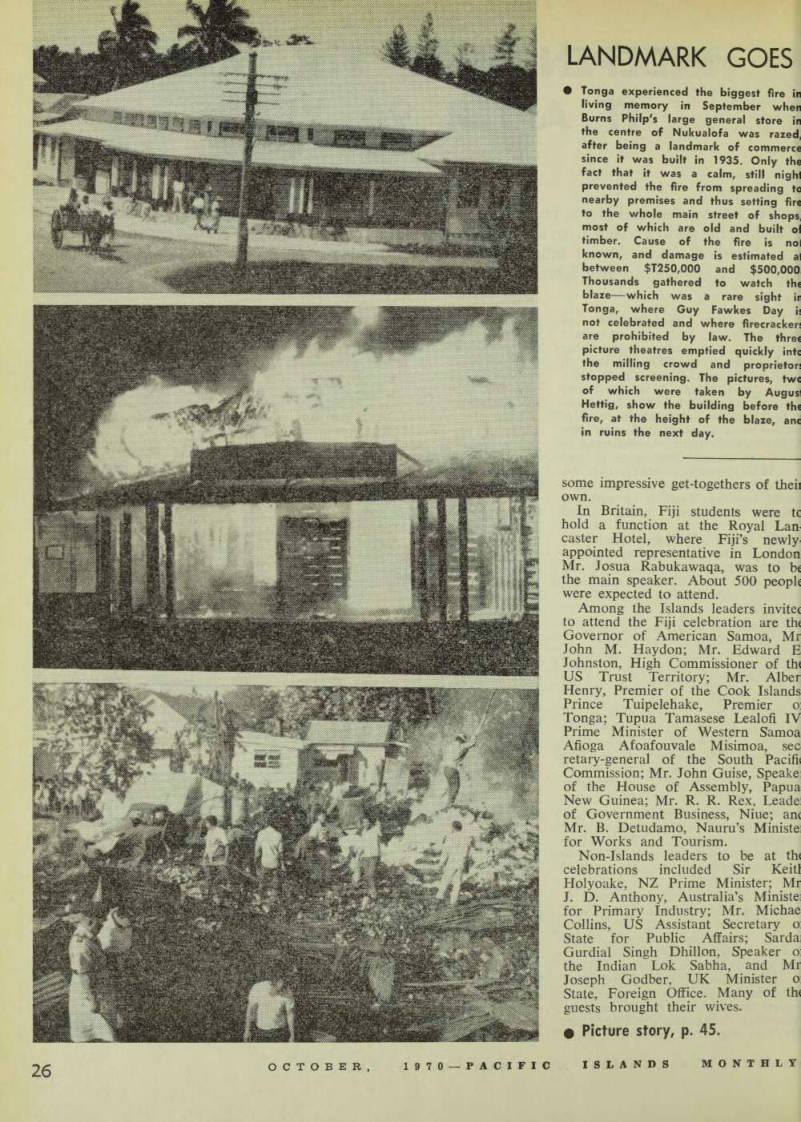
Tonga experienced the biggest fire in living memory in September when Burns Philp's large general store in the centre of Nukualofa was razed, after being a landmark of commerce since it was built in 1935. Only the fact that it was a calm, still night prevented the fire from spreading to nearby premises and thus setting fire to the whole main street of shops, most of which are old and built of timber. Cause of the fire is not known, and damage is estimated at between $T250,000 and $500,000 Thousands gathered to watch the blaze —which was a rare sight in Tonga, where Guy Fawkes Day is not celebrated and where firecrackers are prohibited by law. The three picture theatres emptied quickly into the milling crowd and proprietors stopped screening. The pictures, two of which were taken by August Hettig, show the building before the fire, at the height of the blaze, and in ruins the next day.