P-Ng's Problems
pp. 28-30 · Read in the full issue
Are 'Too
Great' For Spc
The South Pacific Commission was not capable of meeting New Guinea’s needs or solving its problems, because with a popula tion of 2.3 million and with over 700 languages the territory was one “of the most problematic areas in the world”.
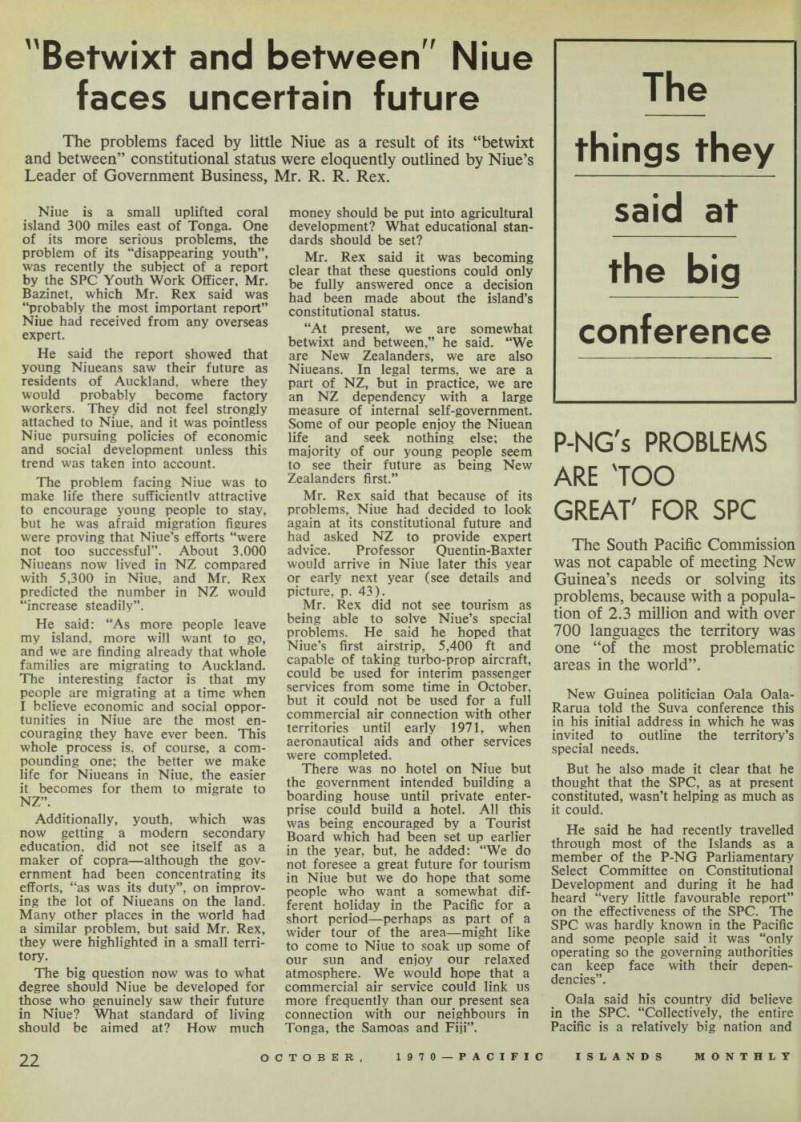
New Guinea politician Oala Oala- Rarua told the Suva conference this in his initial address in which he was invited to outline the territory’s special needs.
But he also made it clear that he thought that the SPC, as at present constituted, wasn’t helping as much as it could.
He said he had recently travelled through most of the Islands as a member of the P-NG Parliamentary Select Committee on Constitutional Development and during it he had heard “very little favourable report” on the effectiveness of the SPC. The SPC was hardly known in the Pacific and some people said > it was “only operating so the governing authorities can keep face with their depen dencies”.
Oala said his country did believe in the SPC. “Collectively, the entire Pacific is a relatively big nation and
should be paid more attention to by the big powers of the world”. He added: “It needs more attention than what it now has . . . this is the Pacific of the ’7o’s and not of the ’3o’s or ’4o’s. Metropolitan countries must change their attitudes towards us Islanders quite voluntarily and not wait until we tell them to do so”.
There was “a tropical storm loom ing” in the Pacific and the SPC umbrella in its present form was rather inadequate protection.
But he commended the SPC for having established the regular con ferences, which he described as miniature parliaments where leaders could get together, and which allowed the metropolitan countries to assess needs.
He added: “Some time or other, the SPC will have to allow political discussions in these gatherings. It is both unrealistic and absurd, to some extent, to expect the various terri torial delegations to divorce them selves from political discussion or considerations, when the majority of us happen to be politicians. The fact of life is that you cannot stop politicians from getting into politics”.
Cook Islands
For the Cook Islands, Dr. Joseph Williams, Director of Health, said.
Islands territories were still reluctant to trade with one another.
As most other islands, the Cooks relied mainly on agriculture for economic fulfilment although it did not give them economic fulfilment.
The Cooks, he believed, were now ready to export citrus fruits, but the people were reluctant to produce crops which were not absorbed by ready markets. He continued: “Strangely enough our neighbours require our products and they have the commodities we want, but we are unable to effect any permanent trade agreements with them”.
T , * j , x It was a tragedy that representahves of territorial governments cw? me , etm ? eVer /- y a ar ,™ d ",.*Sf SPC and yet. as friends and neighhours, were still reluctant to trade with one another.
He understood the SPC had arranged a conference on trade for November, but it had been postponed because of a lack of response by the territories. He urged the SPC to arrange the meeting soon.
He said the marketing of primary products deserved similar co-ordination and forward planning as was now proposed for tourist industries.
The Cooks needed technical expertise, especially to train agricultural extension officers. Immediate courses on Islanders’ home ground were needed in vegetable production and pig husbandry.
Dr. Williams said as another developing country, the Cooks suffered, in three basic ways, the “developing countries syndrome”. First, poverty characterised by a low annual income per capita; a low rate of economic
growth and industrialisation and poor communications.
Second, ignorance characterised by a high rate of illiteracy, lack of understanding and appreciation of needs and problems and the absence of those technological skills necessary for modern industrial growth.
Thirdly, disease, particularly mal nutrition and the problems related to population pressures and en viron^ntal sani £ tion , The Cooks did not envisage any immediate need for help in tourism from h SPC what wanted be . sides agricultural assist ance, was some help in education. The teach ing of English and mathematics needed help in particular. Research was also needed into child and adult health, emerging diseases and man power facilities.
Solomons
, „ ... , Gordon Siama, of the British Solomon Islands, member for North West Solomons, referring to the new gSIP Governing Council, told the conference: “TThis is a most unusual constitution, a constitution designed to draw us politicians into the main stream of government. Politicians are sometimes renowned for talking: we must now get down to the busi ness of working.”
He said overseas companies were now negotiating to start mining in the protectorate. One had only to look at Bougainville to see the im-
Oala Oala-Rarua, Assistant Minister for the Treasury in P-NG's House of Assembly, is next year's chairman of the South Pacific Conference, to be held in Noumea in September. Dr. J. Williams, of the Cooks, will be the conference's first deputy chairman. The 1972 conference will probably be held in Rarotonga.
pact it had on the islands. Timber companies were increasing their activities, an oil palm industry was being established and there were hopes that economic development was keeping pace with political develop- Changes in the Solomons way of life would have to be accepted as they came: “We must try to keep what is best of the old but we cannot avoid shifting our ground and accepting the best of the new,” he said.
SPC proposals in educational and agricultural fields were particularly welcome in the Solomons and “my government feels that even if there has been little progress in updating tile SPC Canberra Agreement, at least in its practical work the commission is keeping abreast of the times. And it is this that really matters”.
Gilbert And Ellice Islands
V7Ildcki Clliv.C Ijlaiiuj
With phosphate deposits running out and the population rapidly increasing, the Gilbert and Ellice Islanders would be earning per capita in six years about half of their income in 1968, Mr. Reuben Uatioa told the conference. Phosphate mining would be finished in six years while the population would have grown from 53,000 to 67,000 at the present rate. About s4i million extra would be needed to bridge this deficit in 1976.
The total land area of his territory was only 283 square miles and yet these 37 islands were scattered over two million square miles of ocean. Soils of GEIC atolls were
desperately poor, crops grown were severely restricted and the land was subject to periodic long droughts, Above all, huge distances hampered communications and development The GEICs problems did not stop
F C ? Eic
o, abundance of natural re th,e.r v e w e re no forests, no Pt dwmdlmg Phos p ’ ° ° • In terms of a ssets the GEIC had coc °nut tree which provided food, shelter, drink, clothing, fuel and copra. There was also an untapped source of wealth, the sea.
There was a need to move fer ward in two spheres in the GEIC • • • economically and constitutionally, Economically, the new development P) al was a strong force. It was aiming at a big drive in agriculture, particularly copra production, a fi . sh f ries sur Y e y and a possibility of timber production at least great enough to supply internal needs, There were also schemes to improve groves, start new plantings, control rats, reclaim land and develop planta tions.
A key to a prosperous future was control of population growth. Top priority had been given to the family planning campaign at present in operation throughout the islands, Gilbert and Ellice Islanders made natural seamen and the Mercantile Marine Training School was expand ing to teach up to 300 cadets a year, He thanked shipping lines and Nauru for using GEIC sailors and hoped other territories and lines might follow suit.
Constitutionally 1970 had been a forward looking year. The British Government was expected to accept recommendations that the Islanders have greater responsibility in new executive and legislative councils. The people of the GEIC were not a politicially experienced people, he added, but they felt strongly that the best way to learn politics was to do the job as soon as possible and thus gain experience.
New Hebrides
For the New Hebrides, Mr. lolu Abbil, member of the New Hebrides Advisory Council representing Tanna, said his territoiy had most of the problems associated with develop ing countries but, at least, didn’t suffer from over-population. But 78,000 New Hebrideans still had an urgent need to develop the economy and communications between the islands. Major expenses for educa tion and medical service were met by France and Britain, but there would come a time when the New Hebrides would have to stand on its own feet economically.
Present economy was based on agri culture, particularly the traditional production of copra, but the infant cattle industry was making strides and was already exporting to New Caledonia. However, unless there were “startling developments” through mineral discoveries, the economy would have to continue re lying on agriculture.
Tourism—“which carries its own problems in an essentially conserv ative and cautious society like ours” —held some prospects.
The lack of an effective com munications system, added Mr. Abbil, held up virtually every field of pro gress—administration and govern ment control, helping in emergency medical cases, the price and range of consumer goods, the export of local products, etc.
The co-operative movement, how ever, continued to be successful and there were now 131 such organisa tions in the New Hebrides.
Mr. Abbil finished with perhaps his most important message; educa tionally the New Hebrideans were still not able to produce sufficiently qualified people to represent them at seminars and meetings which might benefit the territory.
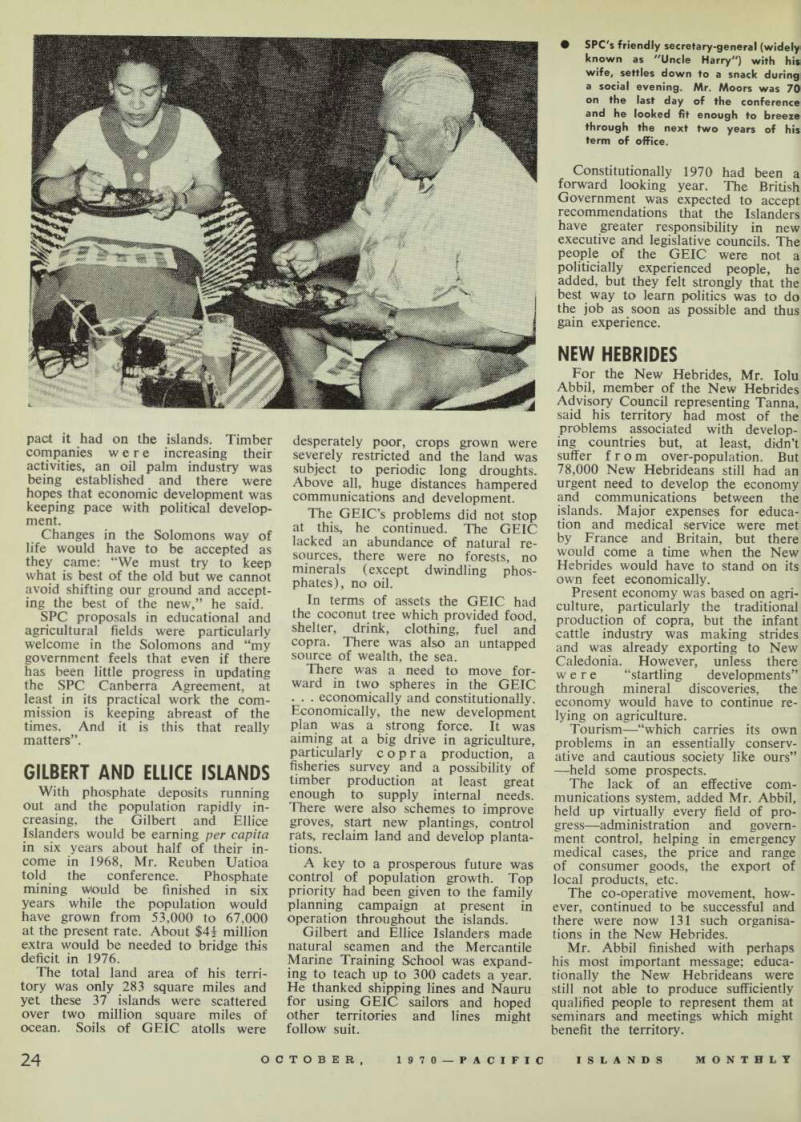
SPC's friendly secretary-general (widely
known as "Uncle Harry") with his wife, settles down to a snack during a social evening. Mr. Moors was 70 on the last day of the conference and he looked fit enough to breeze through the next two years of his term of office.