togetherness
pp. 24-27 · Read in the full issue
Not so much togetherness now
Staff writer JOHN ECCLES reports on the South Pacific Conference
Has the South Pacific Commission a future? Possibly not, but certainly not in its present form.
In that form it is showing signs of coming apart at the seams. All the signs were in evidence at the 10th South Pacific Conference which concluded in Suva on September 25.
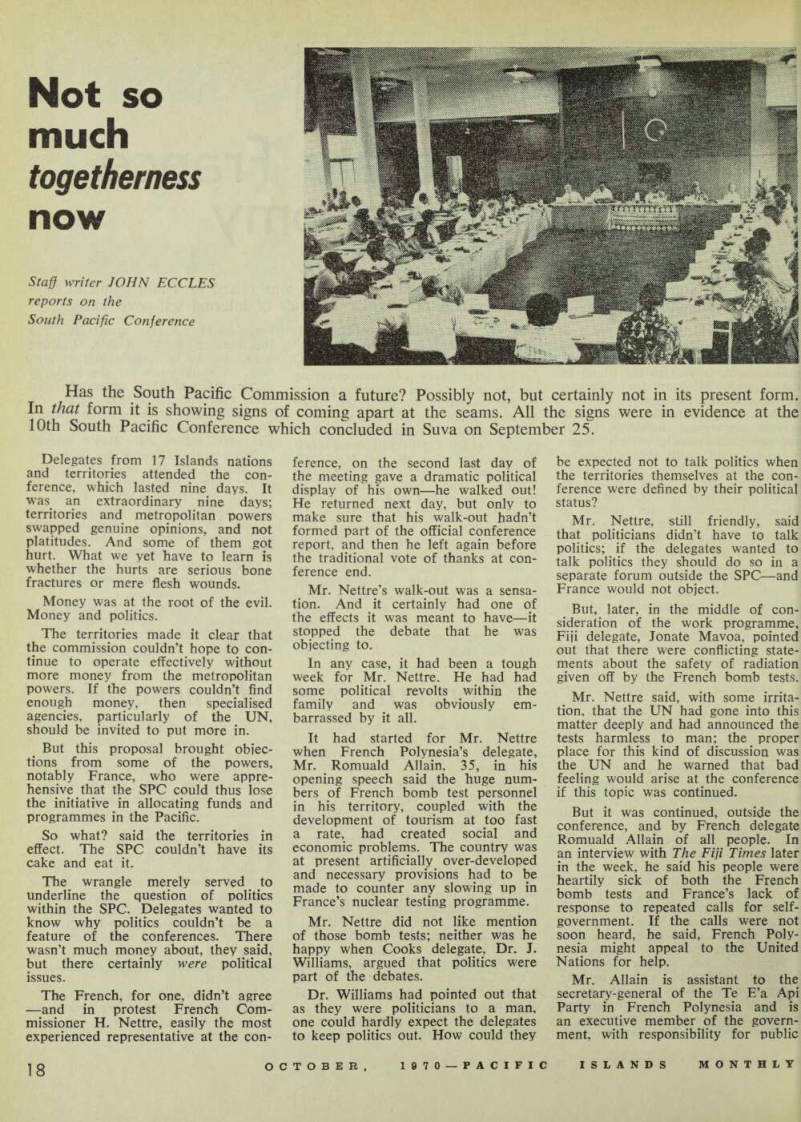
Delegates from 17 Islands nations and territories attended the con ference, which lasted nine days. It an extraordinary nine days; territories and metropolitan powers swapped genuine opinions, and not platitudes. And some of them got hurt. What we yet have to learn is whether the hurts are serious bone fractures or mere flesh wounds.
Money was at the root of the evil.
Money and politics.
The territories made it clear that the commission couldn’t hope to con tinue to operate effectively without more money from the metropolitan powers. If the powers couldn’t find enough money, then specialised agencies, particularly of the UN, should be invited to put more in.
But this proposal brought objec tions from some of the powers, notably France, who were appre hensive that the SPC could thus lose the initiative in allocating funds and programmes in the Pacific.
So what? said the territories in effect. The SPC couldn’t have its cake and eat it.
The wrangle merely served to underline the question of politics within the SPC. Delegates wanted to know why politics couldn’t be a feature of the conferences. There wasn’t much money about, they said, but there certainly were political issues.
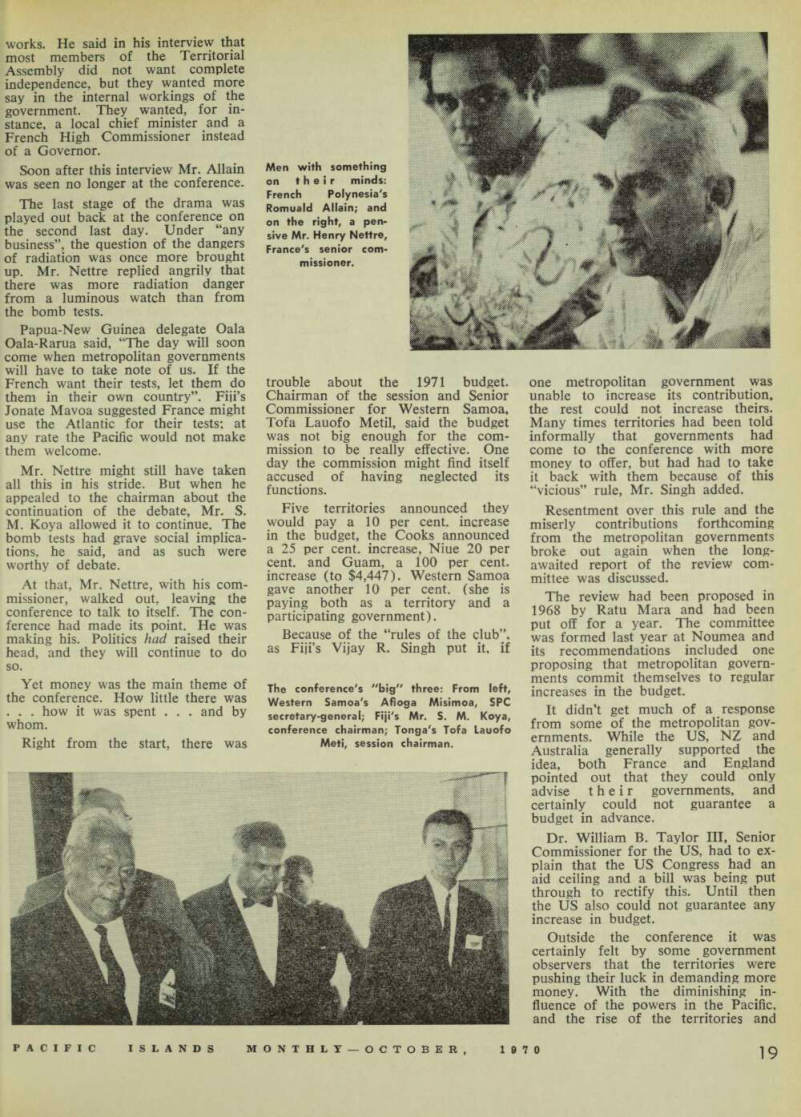
The French, for one, didn’t agree —and in protest French Com missioner H. Nettre, easily the most experienced representative at the con
ference, on the second last day of the meeting gave a dramatic political display of his own—he walked out!
He returned next day, but only to make sure that his walk-out hadn’t formed part of the official conference report, and then he left again before the traditional vote of thanks at con ference end.
Mr. Nettre’s walk-out was a sensa tion. And it certainly had one of the effects it was meant to have—it stopped the debate that he was objecting to.
In any case, it had been a tough week for Mr. Nettre. He had had some political revolts within the family and was obviously em barrassed by it all.
It had started for Mr. Nettre when French Polynesia’s delegate, Mr. Romuald Allain, 35, in his opening speech said the huge num bers of French bomb test personnel in his territory, coupled with the development of tourism at too fast a rate, had created social and economic problems. The country was at present artificially over-developed and necessary provisions had to be made to counter any slowing up in France’s nuclear testing programme.
Mr. Nettre did not like mention of those bomb tests; neither was he happy when Cooks delegate, Dr. J.
Williams, argued that politics were part of the debates.
Dr. Williams had pointed out that as they were politicians to a man, one could hardly expect the delegates to keep politics out. How could they
be expected not to talk politics when the territories themselves at the con ference were defined by their political status?
Mr. Nettre, still friendly, said that politicians didn’t have to talk politics; if the delegates wanted to talk politics they should do so in a separate forum outside the SPC—and France would not object.
But, later, in the middle of con sideration of the work programme, Fiji delegate, Jonate Mavoa, pointed out that there were conflicting state ments about the safety of radiation given off by the French bomb tests.
Mr. Nettre said, with some irrita tion, that the UN had gone into this matter deeply and had announced the tests harmless to man; the proper place for this kind of discussion was the UN and he warned that bad feeling would arise at the conference if this topic was continued.
But it was continued, outside the conference, and by French delegate Romuald Allain of all people. In an interview with The Fiji Times later in the week, he said his people were heartily sick of both the French bomb tests and France’s lack of response to repeated calls for self government. If the calls were not soon heard, he said, French Poly nesia might appeal to the United Nations for help.
Mr. Allain is assistant to the secretary-general of the Te E’a Api Party in French Polynesia and is an executive member of the govern ment, with responsibility for public
works. He said in his interview that most members of the Territorial Assembly did not want complete independence, but they wanted more say in the internal workings of the government. They wanted, for in stance, a local chief minister and a French High Commissioner instead of a Governor.
Soon after this interview Mr. Allain was seen no longer at the conference.
The last stage of the drama was played out back at the conference on the second last day. Under “any business”, the question of the dangers of radiation was once more brought up. Mr. Nettre replied angrily that there was more radiation danger from a luminous watch than from the bomb tests.
Papua-New Guinea delegate Oala Oala-Rarua said, “The day will soon come when metropolitan governments will have to take note of us. If the French want their tests, let them do them in their own country”. Fiji’s Jonate Mavoa suggested France might use the Atlantic for their tests; at any rate the Pacific would not make them welcome.
Mr. Nettre might still have taken all this in his stride. But when he appealed to the chairman about the continuation of the debate, Mr. S.
M. Koya allowed it to continue. The bomb tests had grave social implica tions, he said, and as such were worthy of debate.
At that, Mr. Nettre, with his com missioner, walked out, leaving the conference to talk to itself. The con ference had made its point. He was making his. Politics had raised their head, and they will continue to do so.
Yet money was the main theme of the conference. How little there was . . . how it was spent . . . and by whom.
Right from the start, there was
trouble about the 1971 budget.
Chairman of the session and Senior Commissioner for Western Samoa, Tofa Lauofo Metil, said the budget was not big enough for the com mission to be really effective. One day the commission might find itself accused of having neglected its functions.
Five territories announced they would pay a 10 per cent, increase in the budget, the Cooks announced a 25 per cent, increase, Niue 20 per cent, and Guam, a 100 per cent, increase (to $4,447). Western Samoa gave another 10 per cent, (she is paying both as a territory and a participating government).
Because of the “rules of the club”, as Fiji’s Vijay R. Singh put it, if
one metropolitan government was unable to increase its contribution, the rest could not increase theirs.
Many times territories had been told informally that governments had come to the conference with more money to offer, but had had to take it back with them because of this “vicious” rule, Mr. Singh added.
Resentment over this rule and the miserly contributions forthcoming from the metropolitan governments broke out again when the long awaited report of the review com mittee was discussed.
The review had been proposed in 1968 by Ratu Mara and had been put off for a year. The committee was formed last year at Noumea and its recommendations included one proposing that metropolitan govern ments commit themselves to regular increases in the budget.
It didn’t get much of a response from some of the metropolitan gov ernments. While the US, NZ and Australia generally supported the idea, both France and England pointed out that they could only advise their governments, and certainly could not guarantee a budget in advance.
Dr. William B. Taylor 111, Senior Commissioner for the US, had to ex plain that the US Congress had an aid ceiling and a bill was being put through to rectify this. Until then the US also could not guarantee any increase in budget.
Outside the conference it was certainly felt by some government observers that the territories were pushing their luck in demanding more money. With the diminishing in fluence of the powers in the Pacific, and the rise of the territories and
Men with something on their minds: French Polynesia's Romuald Allain; and on the right, a pen sive Mr. Henry Nettre, France's senior com missioner.
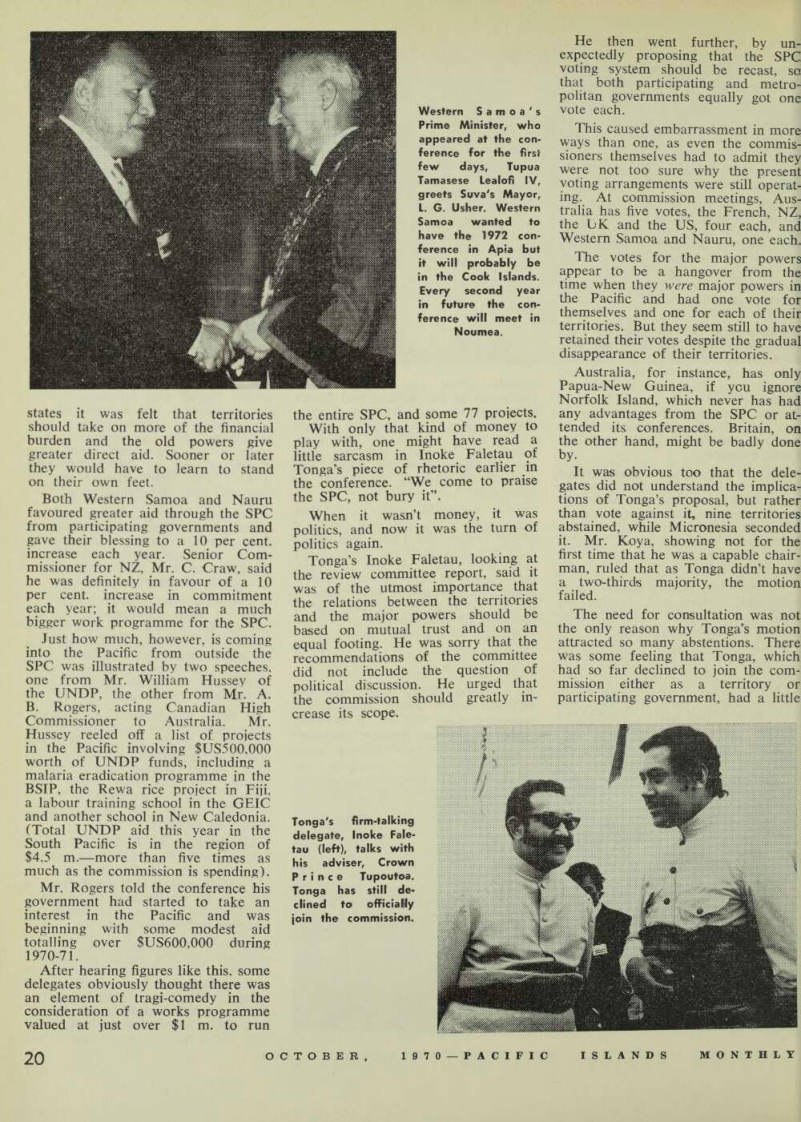
The conference's "big" three: From left, Western Samoa's Afioga Misimoa, SPC secretary-general; Fiji's Mr. S. M. Koya, conference chairman; Tonga's Tofa Lauofo Meti, session chairman.
states it was felt that territories should take on more of the financial burden and the old powers give greater direct aid. Sooner or later they would have to learn to stand on their own feet.
Both Western Samoa and Nauru favoured greater aid through the SPC from participating governments and gave their blessing to a 10 per cent, increase each year. Senior Com missioner for NZ, Mr. C. Craw, said he was definitely in favour of a 10 per cent, increase in commitment each year; it would mean a much bigger work programme for the SPC.
Just how much, however, is coming into the Pacific from outside the SPC was illustrated by two speeches, one from Mr. William Hussey of the UNDP, the other from Mr. A.
B. Rogers, acting Canadian High Commissioner to Australia. Mr.
Hussey reeled off a list of projects in the Pacific involving SUSSOO.OOO worth of UNDP funds, including a malaria eradication programme in the BSIP, the Rewa rice project in Fiji, a labour training school in the GEIC and another school in New Caledonia. (Total UNDP aid this year in the South Pacific is in the region of $4.5 m.—more than five times as much as the commission is spending).
Mr. Rogers told the conference his government had started to take an interest in the Pacific and was beginning with some modest aid totalling over SUS6OO,OOO during 1970-71.
After hearing figures like this, some delegates obviously thought there was an element of tragi-comedy in the consideration of a works programme valued at just over $1 m. to run
the entire SPC, and some 77 projects.
With only that kind of money to play with, one might have read a little sarcasm in Inoke Faletau of Tonga’s piece of rhetoric earlier in the conference. “We come to praise the SPC, not bury it”.
When it wasn’t money, it was politics, and now it was the turn of politics again.
Tonga’s Inoke Faletau, looking at the review committee report, said it was of the utmost importance that the relations between the territories and the major powers should be based on mutual trust and on an equal footing. He was sorry that the recommendations of the committee did not include the question of political discussion. He urged that the commission should greatly in crease its scope.
He then went further, by un expectedly proposing that the SPC voting system should be recast, so that both participating and metro politan governments equally got one vote each.
This caused embarrassment in more ways than one, as even the commis sioners themselves had to admit they were not too sure why the present voting arrangements were still operat ing. At commission meetings, Aus tralia has five votes, the French, NZ, the IjK and the US, four each, and Western Samoa and Nauru, one each.
The votes for the major powers appear to be a hangover from the time when they were major powers in the Pacific and had one vote for themselves and one for each of their territories. But they seem still to have retained their votes despite the gradual disappearance of their territories.
Australia, for instance, has only Papua-New Guinea, if you ignore Norfolk Island, which never has had any advantages from the SPC or at tended its conferences. Britain, on the other hand, might be badly done by.
It was obvious too that the dele gates did not understand the implica tions of Tonga’s proposal, but rather than vote against it, nine territories abstained, while Micronesia seconded it. Mr. Koya, showing not for the first time that he was a capable chair man, ruled that as Tonga didn’t have a two-thirds majority, the motion failed.
The need for consultation was not the only reason why Tonga’s motion attracted so many abstentions. There was some feeling that Tonga, which had so far declined to join the com mission either as a territory or participating government, had a little
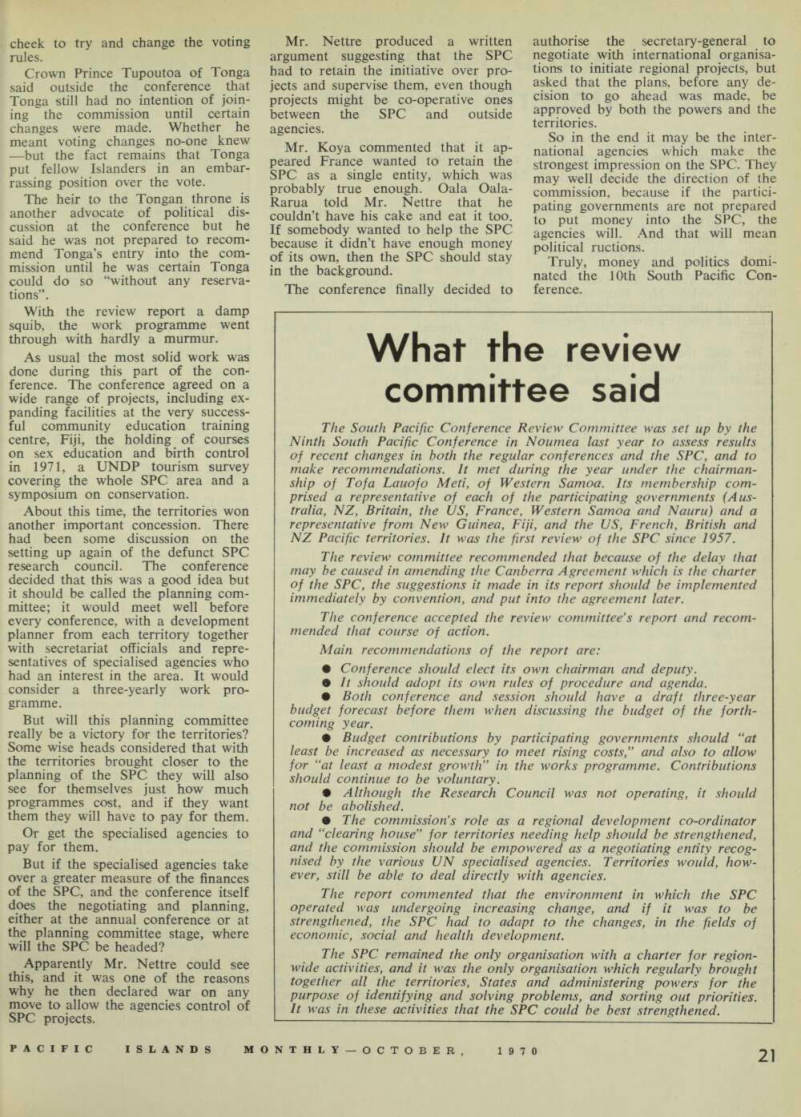
Western Samoa's Prime Minister, who appeared at the con ference for the first few days, Tupua Tamasese Lealofi IV, greets Suva's Mayor, L. G. Usher. Western Samoa wanted to have the 1972 con ference in Apia but it will probably be in the Cook Islands.
Every second year in future the con ference will meet in Noumea.
Tonga's firm-talking delegate, Inoke Fale tau (left), talks with his adviser, Crown Prince Tupoutoa.
Tonga has still de clined to officially join the commission.
cheek to try and change the voting rules.
Crown Prince Tupoutoa of Tonga said outside the conference that Tonga still had no intention of join ing the commission until certain changes were made. Whether he meant voting changes no-one knew —but the fact remains that Tonga put fellow Islanders in an embar rassing position over the vote.
The heir to the Tongan throne is another advocate of political dis cussion at the conference but he said he was not prepared to recom mend Tonga’s entry into the com mission until he was certain Tonga could do so “without any reserva tions”.
With the review report a damp squib, the work programme went through with hardly a murmur.
As usual the most solid work was done during this part of the con ference. The conference agreed on a wide range of projects, including ex panding facilities at the very success ful community education training centre, Fiji, the holding of courses on sex education and birth control in 1971, a UNDP tourism survey covering the whole SPC area and a symposium on conservation.
About this time, the territories won another important concession. There had been some discussion on the setting up again of the defunct SPC research council. The conference decided that this was a good idea but it should be called the planning com mittee; it would meet well before every conference, with a development planner from each territory together with secretariat officials and repre sentatives of specialised agencies who had an interest in the area. It would consider a three-yearly work pro gramme.
But will this planning committee really be a victory for the territories?
Some wise heads considered that with the territories brought closer to the planning of the SPC they will also see for themselves just how much programmes cost, and if they want them they will have to pay for them.
Or get the specialised agencies to pay for them.
But if the specialised agencies take over a greater measure of the finances of the SPC, and the conference itself does the negotiating and planning, either at the annual conference or at the planning committee stage, where will the SPC be headed?
Apparently Mr. Nettre could see this, and it was one of the reasons why he then declared war on any move to allow the agencies control of SPC projects.
Mr. Nettre produced a written argument suggesting that the SPC had to retain the initiative over pro jects and supervise them, even though projects might be co-operative ones between the SPC and outside agencies.
Mr. Koya commented that it ap peared France wanted to retain the SPC as a single entity, which was probably true enough. Gala Oala- Rarua told Mr. Nettre that he couldn’t have his cake and eat it too.
If somebody wanted to help the SPC because it didn’t have enough money of its own, then the SPC should stay in the background.
The conference finally decided to
authorise the secretary-general to negotiate with international organisa tions to initiate regional projects, but asked that the plans, before any de cision to go ahead was made, be approved by both the powers and the territories.
So in the end it may be the inter national agencies which make the strongest impression on the SPC. They may well decide the direction of the commission, because if the partici pating governments are not prepared to put money into the SPC, the agencies will. And that will mean political ructions.
Truly, money and politics domi nated the 10th South Pacific Con ference.