Cash (even for Nambas) talks
pp. 127-129 · Read in the full issue
Both the Big Nambas, remotest of primitive peoples living in windowless and chimneyless huts on the ridges of jungle-clad mountains in the New Hebrides, and fat self-satisfied government em ployees in Vila, who have just reached the level of pay (until very recently reserved for expatriates) which enables them to drive a car, are alike in that they are on the threshold of a cash economy. They are just finding out about money matters, and some of their reactions are not what the money-conscious outsider would expect.
The first problem that they had to solve on entering the money economy was how to price what they had for sale.
An early solution, their sales of land, is generally admitted to have been pretty disastrous. However that experience, although they have learnt from it never to sell land, has not been sufficient to put them really in touch with their markets.
In the 1950’s when the Big Nambas made some of their first contacts with Europeans, they learnt two words in English “one pound” and “ten pounds” and the unwary visitor had to pay one or the other to take photographs, to drink kava, to talk about native customs or to buy carvings.
Unfortunately some one then earned instant success by teaching them the words “one hundred pounds” and quite soon that was the price of most of the activities possible in Big Nambas country.
The market women of Vila have found a simple solution to the prob lem of pricing: Prices are fixed ac cording to size. Pawpaws which are about as scarce as water in these raindrenched islands, are big and expensive; grapefruit and passion fruit are fairly cheap although very hard to come by.
Of course this pricing policy is hardly likely to be the high road to success but at least Vila’s market women have avoided competition and have not driven the price down to the point where only the people who make an effort can make a living.
Vila market is a jolly experience for buyers and sellers, the market women sit under the trees beside the sea, smiling, plump, placid and motionless and so lazy that Vila market, held out of doors in the most primitive conditions, is extremely modern in being completely self service.
Oddly enough prices are also in variable. Price is an essential
characteristic: in the New Hebrides, oranges are always three for a shilling just as they are always round.
Money is so new a custom that New Hebrideans have not learnt to
From TESSA FOWLER, in Vila
distinguish price and value. It’s simply meaningless to say that any com modity is overpriced and this notion cannot be expressed in pidgin.
The idea that one might want something at one price and refuse it at another price is simply incompre hensible. Either you want it or you don’t. And if you want it you pay the price, and price, like colour and shape, is fixed quite independently of supply and demand.
In these circumstances, bargaining is impossible. It’s like talking in order to make oranges square.
What a picture of bewildered frustration is a Fiji-Indian newly arrived in Vila! For him, bargaining is an innocent pastime and a way of life. He would find it unthinkable to pay the first price asked, yet none of the market women will play his game.
General agreement that prices cannot change does not make it easier for New Hebrideans to accept the alienation of land.
The first Europeans to arrive in the New Hebrides were able to buy hundreds of acres for a few yards of cloth, some axes and some tobacco.
It was probably a fairly just bargain if one remembers that it took three months to make a stone axe, a day to make half a yard of matting, many days to make a grass skirt and that virgin jungle is not very ex pensive. Even today there are places
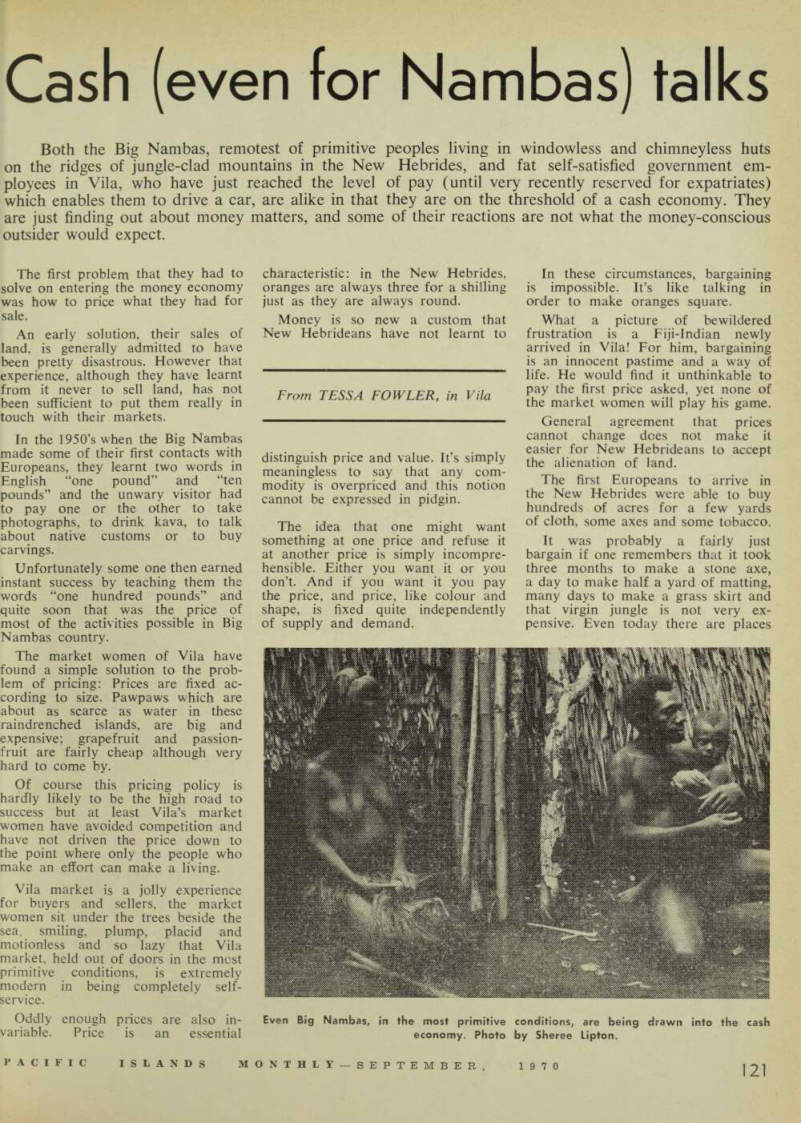
Even Big Nambas, in the most primitive conditions, are being drawn into the cash economy. Photo by Sheree Upton.
The idea is to sell a little for a lot
where one can buy a square mile of virgin jungle for about $lOO.
Today, land in Vila is worth about $lO a square foot in a good com mercial location. The difference between the price and the few yards of calico paid to the original owner, makes a strong contrast if the des :endant of the original owner also believes that prices cannot change.
Then, in his view, buyers knew in 1870 the land was worth $lO a sq. ft, is in 1970, which makes him feel ;hat the original sellers were out rageously cheated.
The only reason for not buying ;omething you want is that you have 10 money. Price is not a factor in he decision. The only gambit that a Hebridean will put forward if le does attempt to bargain is that he las no money. If the buyer does not >uy something he apparently wants, t must be because he has not enough noney. Then what triumph for the rader. He has something so rare nd wonderful that even the white nan has not money enough to buy it.
In the Western world, where money 5 the standard of success, a trader an only triumph if he succeeds in laking a sale. In the New Hebrides e only boasts if he has something o marvellous that no one will buy —at the price he has set. The real bject of a commercial deal in fact » NOT to make a sale.
The traveller who visits the islands f the New Hebrides to buy objects f primitive art will find this point mply illustrated. For instance, the eople of Ambrym had some trouble itting on the right price to ask for le very beautiful slit gongs and tree jrn figures which are their tradi onal symbols of rank.
One of the local chiefs, finally riced a slit gong at $l,OOO, which ven the owner of a gallery of rimitive art in New York refused to ay. His triumph was not yet com lete, he reached the peak of prestige y giving the gong to the Queen.
In fact, to most New Hebrideans loney simply means power. In the Id days pigs, which are usually escribed by Europeans as wealth, r ere really latent power, which be ame real power when the pigs were illed.
Economic textbooks tell us that eonomic man tries to maximise his
profits or his income. It’s another way of saying high turnover and low profits will make you rich.
Purchasers and government officers go blue in the face trying to persuade New Hebrideans that they would make more money if they reduced their prices.
Most New Hebrideans would much rather sell one carving for £2O than three for £55. The carver is perfectly consistent in his preference because, of course, he does not want to get rich, he wants to obtain the very small money income he needs with the minimum effort—a choice show ing great good sense.
Most New Hebrideans only visit the money economy for brief periods, which usually gives them a rather different point of view on how to spend their money. They come to the money economy to buy clothes, get drunk and go to the cinema and find some one of the other sex who doesn’t have a father to breathe down a young couple’s neck.
If all your life you had the amount you want of the food you like best and a nice cool leaf village on a beautiful site without spending money, you would grudge money spent on mere food and lodging. Most people spend a quarter of the family in come on clothes, another quarter at
least on high living (such as it is in Vila), leaving only about $lO a month for the family’s food, and the only way to avoid hunger is to live on nothing but rice.
If all New Hebrideans returned home at the end of a few weeks for a decent meal there would be nothing wrong with this pattern. Un fortunately the white community— both business and government—is making serious efforts to ensure permanent residents in the towns. The results are obvious in the slums of Vila and in the first cases, reported recently, of malnutrition amongst the children of Vila.
New Hebrideans have understood the Western world well enough to believe that money is the beginning and the end of Western culture. It’s generally agreed that the chief dif ference between life today and life in traditional times is that now one needs money—and this is definitely a deterioration.