Pacific Shipping
pp. 99-103 · Read in the full issue
Matson departs South Pacific but its ships sail on
The announcement in San Francisco on August 13 (August 14 in the western Pacific), that Pacific Far East Line Inc. had purchased Matson Lines’ Pacific passenger and freight service came as a sur prise, even to those connected with Matson in the South Pacific.
The deal awaits the necessary US governmental approval although it was expected in Sydney that this would be pretty much of a formality.
Matson services from San Francisco to Sydney via Islands ports are sub sidised; and the two container ships at present under construction for Matson-Oceanic were also being subsidised.
The container ships are part of the PFEL deal and should go into service in 1972. The US Government was to pay 46.5 per cent of their cost to keep the work in US shipyards— in the yards of Bethlehem Steel Corp. at Sparrows Point, Maryland, in this case.
Because of these subsidies as well as the matter of routes, approval of a number of US maritime instrumen talities is necessary but it is expected that the change of ownership will be effective from October 1.
The purchase, the terms of which were not disclosed, includes the two luxury liners Mariposa and Monterey as well as the freighters Sonoma and Ventura, all of them well known in Pacific and Australasian ports.
The acquisition by PFEL will not affect Matson services—for example, the schedules of Mariposa and Monterey will be as already advertised for at least the next 18 months. The new owners will also retain Matson freight and passenger agents for the time being.
Not much was known in Sydney in mid-August about PFEL except that it operates container ships and passenger/freighters from the US West Coast to the Far East.
It is understood that Matson will in future concentrate on its container
services from the US West Coast to Hawaii. With the sale of Mariposa and Monterey it is now right out of passenger services.
China Navigation's New
Ships For Tourists
The China Navigation Company has purchased another liner to com pete for a share of the growing Pacific tourist trade.
The 10,700 ton Princess Leopoldina has been bought from a Brazilian national line and is a sister ship of the Dominion Far East Line’s Marco Polo, which arrived in Sydney in July on its maiden voyage.
The China Navigation Company took delivery of the Princess Leopol dina on June 30. In July she was in Hong Kong for conversion at Taikoo Dockyard. She will be a one class liner with a capacity of about 500 passengers.
The company intends to operate the ship on service and charter work with Japan as her base.
Passenger manager, Mr. G. C. H.
Shakerley of Hong Kong said the purchase of the ship was made in line with the company’s policy to “diversify more into the tourist trade”.
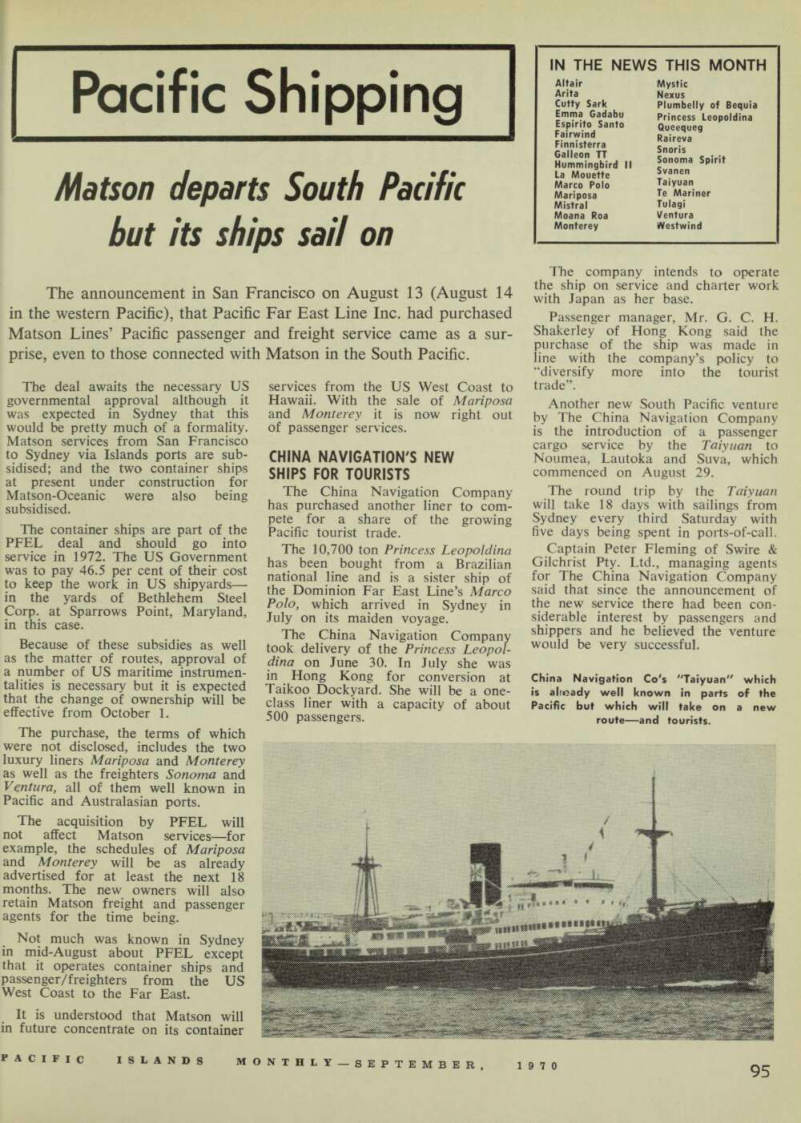
Another new South Pacific venture by The China Navigation Company is the introduction of a passenger cargo service by the Taiyuan to Noumea, Lautoka and Suva, which commenced on August 29.
The round trip by the Taiyuan will take 18 days with sailings from Sydney every third Saturday with five days being spent in ports-of-call.
Captain Peter Fleming of Swire & Gilchrist Pty. Ltd., managing agents for The China Navigation Company said that since the announcement of the new service there had been con siderable interest by passengers and shippers and he believed the venture would be very successful.
China Navigation Co's "Taiyuan" which is already well known in parts of the Pacific but which will take on a new route —and tourists.
Rusden's "Altair" Lost
Off Malekula
Captain A. R. Rusden has been unlucky again. On August 1, the 260 tons Altair sank off the coast of Malekula, New Hebrides, apparently after springing a leak in a storm when about 14 miles off the island.
All on board, one Australian and 12 New Hebridean crew members, spent 12 hours in a small launch before they reached safety on the south coast of the island. Before Altair foundered she was battered by 25 ft waves. The crew cut loose the ship’s boats and then jumped into the sea to swim to them. They all ended up in what the first reports described as “one small launch”.
Altair, of 260 tons, was built in Melbourne in 1944 and was owned and operated for many years in Fiji waters by Morris Hedstrom Ltd. She was sold in 1955 to Captain Rusden.
When she sank she was carrying a cargo that included objects of primitive art—said to be worth thousands of dollars but uninsured.
Export Prospects
But No Shipping
Various attempts by shipping com panies to start a trade link between Townsville, Qld and Port Moresby have never eventuated despite the efforts of the Townsville District Development Association.
A regular shipping service was to have been started in 1969 by a Danish company. The vessel did arrive in Australia but the company behind the venture experienced internal problems that forced them to withdraw from the charter.
The Assn, says that while a number of shipping companies have indicated positive interest, all insist on guaranteed base loads before commencing the service.
Manager of the Assn., Mr. K. M.
Fitzpatrick, said that the tonnage that is available ex-North Queensland is fragmented and no single item offers sufficient tonnage, although products are available that could provide this base load. However, to have these products exported from North Queensland would require a major change in the marketing pattern of the companies concerned.
Mr. Fitzpatrick said that it has been proved that products can be landed in P-NG from Townsville at competitive prices. With only 2i days sailing from Townsville, a ship ping company needs to give the trade six months to build up.
Among the products that can be ex ported are fabricated steel, industrial gases, metals, salt, roof decking, timber, freezer cargoes, fruit and vegetables, bituman and so forth.
New Tuna Venture
In Melanesia
An American 730-ton tuna seiner, Espirito Santo of United Continental Tuna Corporation Pty. Ltd. (Bris bane) will purse-seine for tuna start ing during September in the waters of the South Pacific, including Solomon Sea, around the New Hebrides and Fiji.
Townsville is the vessel’s first Aus tralian base and tuna will be trans shipped to Japan and America. A crew of New Guineans has been taken on to learn the art of tuna fishing. (Note: It is not named after the island Espiritu Santo, which is spelt differently).
Raw Shipping Deal
For Nz Exporters
Exporters in New Zealand who have explored and built up a large volume of trade to the Pacific Islands since devaluation in 1967 have been expressing, in no uncertain terms, their discontent with NZ shipping services.
Shipping services out of NZ ports have never recovered from the ship ping strike at the end of last year and, it was reported in early August, there was a three months backlog of cargo consigned to Fiji, Samoa and Tonga.
In late July representatives of the NZ Importers and Exporters Bureau
were critical of the Union Steam Ship Company which they said was slower to develop new trade routes for NZ exports than had been the Holm Line and the New Zealand Export Line.
Other exporters said that since the ship that called at Lyttleton had been cut out early this year, South Island exporters had to tranship at Auckland, with subsequent delays from that port. Cargo booked for Fiji, Samoa or Tonga had to wait three months for space.
Exporters were of the opinion that a great deal more could be done in building up trade with the South- West Pacific, if there were shipping services to carry the goods. It had been calculated that New Guinea alone buys goods to the value of $1 million that NZ was capable of supplying; and that the giant Panguna copper project on Bougainville offered a tremendous opportunity for traders.
Exporters were urged to support the German-owned New Zealand Export Line which had been servicing the British Solomons and New Guinea for two years but which had sustained big losses and had to withdraw one of its two ships on the run.
Following the barbed comment about NZ shipping services, or lack of them, exporters and executives of the Union Steam Ship Co. met in late July and during discussions the USS Co. announced that it had chartered a 5,000 ton freighter to go into the Pacific trade to shift the backlog of cargo that had built up. But matters were not helped when the Taveuni was damaged by fire and had to be replaced by the smaller Karamu.
A spokesman for the company said that it has experienced great difficulties in getting officers and crews for its ships—in late July three company ships were laid up in Auckland because of the manpower shortage.
Backloading was another problem.
Rumpus Over Cl
Freight Increase
A 15 per cent, increase on freight carried by Moana Roa, the New Zealand Government vessel that services the Cook Islands, was causing a fuss in Rarotonga in July.
Telegrams passed back and forth between the Cook Islands Premier, Mr. Albert Henry (who said that freight rates should not rise without a consultation between his and the NZ Governments), and NZ’s Minister of Maori and Islands Affairs (who said that the NZ cabinet had already made up its mind and the 15 per cent, increase stayed).
Mr. Henry then said that it was unfair to expect the ordinary Cook Islander to pay for the increase and
that the business community should absorb it.
If the business community refused and the vessel arrived at Rarotonga carrying freight at the new rate, she would be sent back to NZ and another vessel sought for the Cook Islands run.
Mr. Henry was later reassured by a personal telegram from the NZ Prime Minister and said that he “now saw no reason why the Moana Roa should not call at Rarotonga in July”.
She was due to leave Auckland on July 22 and presumably departed.
“But freight rates will still be in creased,” said Premier Henry.
He said that his cabinet would soon meet to take steps to ensure that increased costs of imported goods and export fruit were not passed on to the people and growers.
He was also going to ask the NZ Government to review all shipping services to the Cooks.
"Tulagi" Is Uneconomic
Bums Philp’s cargo-passenger ship, Tulagi, is expected to be taken off the Sydney-Norfolk-New Hebrides- Solomons run within the next three or four months because it is no longer a money-making proposition, ac cording to a Burns Philp spokesman.
Tulagi will not be replaced until a more streamlined type of ship is found for the run. When Tulagi’s replacement is found, she will call only at Vila and Santo in the Hebrides.
Nauru Ship Takes
Tongan Stewards
In August, 21 Tongans were in training at the Dateline Hotel, Nukualofa, in the hope of being selected as stewards on the Nauruan passenger-cargo vessel Emma Gadabu.
The President of Naum made the offer to employ Tongans on the Nauruan ship when he was in Tonga for independence celebrations in June. Applications were called and 81 would-be stewards replied. The number of applicants was finally reduced to 21 and of these 15 will be chosen at the end of August to work on Emma Gadabu.
It is hoped in Tonga that this is only the beginning of a scheme that could give employment to many more young Tongans.
The response in Tonga is only one indication of the pool of under employed young people in the Islands who are crying out for work op portunities. The Gilbert and Ellice Islands Colony started a training scheme for seamen some years ago but so far it has scarcely made a dent on the number of Gilbertese
who are available for this sort of employment.
Hundreds of Islanders are willing and, with some training, would be able to man ships. Yet, in another item in this section this month it is reported that three Union Steam Ship Co. vessels are tied up in Auckland for want of crew. cdciput datcc cad
MirilrA J mirlrn rmr
Wewak Under Fire
Like the Cook Islands, some of the outports of New Guinea have also been hit recently with rises in shipping freight rates.
The Karlander Line raised rates for cargo between Australian ports and Wewak, Manus and Kavieng in New
Guinea. Freight is now $36 per ton from Australia to Wewak—sll more than cargo shipped to Lae.
One reason that shipping corn panics would no doubt give for this differential is that at Wewak there is no wharf although this reason doe sn't hold good for the other , ports, A new wharf is expected to open at Wewak in 1971 when, it is h °P ed > there will be a reduction in freight rates.
If there is not, it won’t be for lack of local effort. A committee, under the chairmanship of Mr. F. Martin, has been set up to look into ways of improving shipping services from Australia, in general, and freight rates in particular.