Magazine Section
pp. 77-83 · Read in the full issue


Tahiti's "Nature Man'-Symbol
Of A Revolution
By Robert Lang Don
When the American novelist Jack London and his wife Charmian arrived in Tahiti in 1907 in their yacht Snark, one of the first people they met was Edward Darling, the Nature Man.
The Snark had barely entered the pass into Papeete’s lagoon when the Londons saw Darling’s “startlingly Biblical figure” standing in a small outrigger canoe which a native was paddling towards them. He was wav ing a blood-red flag, which, he ex plained to Jack as his canoe came closer, was a symbol of socialism.
The Nature Man was a magnificent bronzed figure with long brown hair which fell over his shoulders in luxuriant curls and a shaggy, golden beard. When he came over the side of the Snark wearing only a scarlet loin cloth, and bearing gifts of man goes, pineapples, bananas, limes and oranges, he seemed to Jack like a sun god.
Jack London and the Nature Man were old acquaintances. Jack had first noticed him in Market Street, San Francisco, several years previously.
It was a wet and drizzly afternoon, yet he was striding along, with a score of excited urchins at his heels, clad solely in “a pair of abbreviated knee-trousers and an abbreviated shirt, his bare feet going slick-slack through the pavement slush.”
Some time later, Jack saw the Nature Man again while staying with friends in the Piedmont hills over looking San Francisco Bay. They had caught him up a tree which he was apparently using for a bed. Jack accompanied his friends to meet the Nature Man, and found that he was living up a steep hill, in a rickety shack in the midst of a eucalyptus grove.
The Nature Man delivered Jack and his friends a message, which, he said, would save the world. It was twofold. First, mankind should strip off its clothing and run wild in the mountains and valleys. Second, it should adopt phonetic spelling. . .
At that time in his early 30’s, the Nature Man had originally picked
up his creed after surviving the cold winters of Oregon and contracting tuberculosis at San Francisco’s Stanford University. Noticing that Red Indians go naked and appear in perfect health, he had decided to emulate them. It worked.
He regained his health and began marching towards California preach
ing nudity and simple foods. To
avoid trouble he wore knicker bockers, sandals and a singlet made of fishing mesh. It didn’t do him any good—he was arrested 11 times be tween Arizona and California.
Having found that the US was rather stony ground for his creed, the Prophet of Nudity stowed away on a ship bound for Hawaii where the tropical climate seemed to offer
better prospects. Here he was ad judged an undesirable citizen, and given the choice of a year in prison or deportation. He chose deportation.
It was from Hawaii that Darling reached Tahiti, and it was from the purser of the ship that took him there that he picked up the notions of socialism which he incorporated into his philosophy. In Tahiti, Darling found that the authorities looked on him with a more tolerant eye than he had previously experienced; and he proceeded to seek out a piece of land where he could establish him self as a full-time nature man.
Meanwhile, he earned some money as a boxing instructor.
After several weeks, he found a spot that suited him—about 80 acres of guava-covered scrub at a height of about 1,500 ft in the mountains behind Papeete. According to the authorities, it was ownerless.
Darling spent several weeks clear ing the scrub for a plantation and building a road to make it accessible.
He planted trees and vegetables; but soon found that the area was in fested with rats and wild pigs, and that these tore up and ate his plants as soon as they began to sprout. He declared war on these pests, shoot ing the pigs and trapping the rats, and at one period he caught 1,500 rats in a single fortnight.
Gradually, he began to get ahead.
He built a hut five yards long by five wide, and before long he had 500 coconut trees, 50 pawpaws, 300 mangoes, and many breadfruit and avocado trees, besides vines, bushes and vegetables.
The arid shoulders of the hills, where formerly the blazing sun had parched the jungle and beaten it close to earth, blossomed into trees and shrubs and flowers. Not only had the Nature Man became self-supporting, but he was now a prosperous agri-
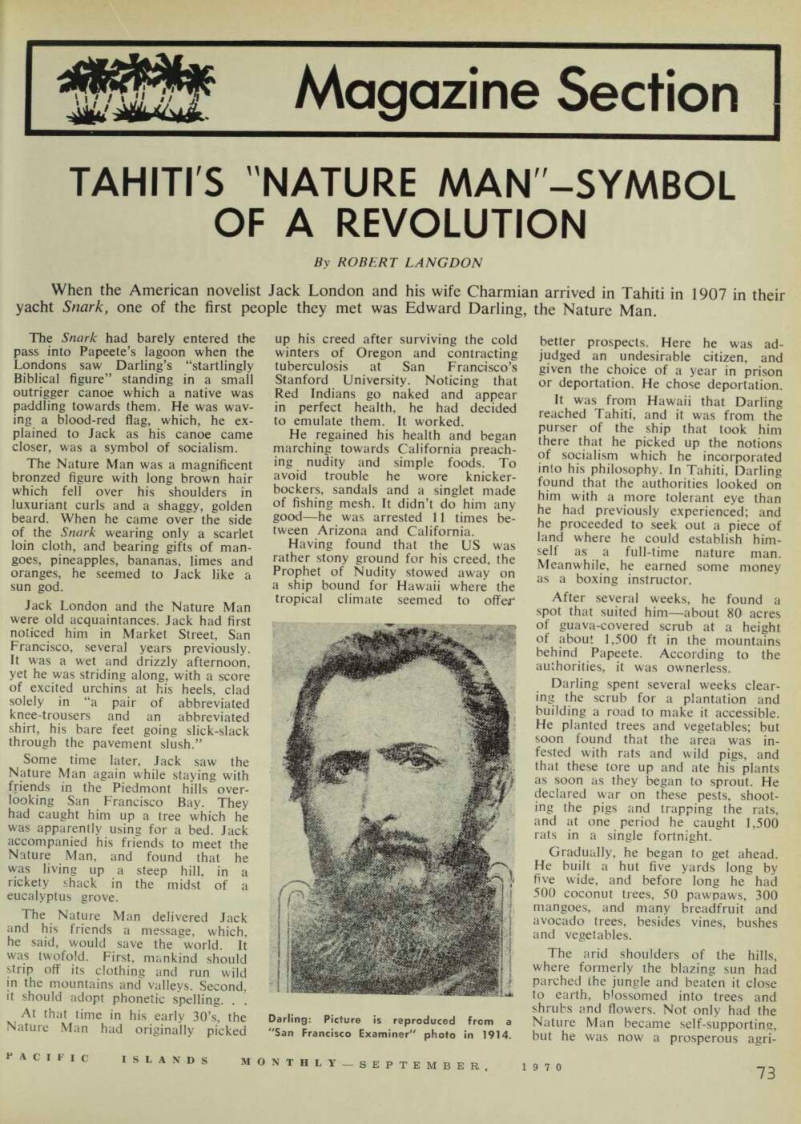
Darling: Picture is reproduced from a "San Francisco Examiner" photo in 1914.
culturist with produce to sell to the city-dwellers of Papeete.
Darling then discovered to his dismay that his land did, in fact, have an owner-no less a person than ex-Queen Marau, the divorced wife of Tahiti’s last king, Pomare V. All of his work seemed in danger of being lost. In some consternation, he went down to Papeete to confront the ex-queen; but the good lady was remarkably accommodating, and agreed to sell him the land for an almost nominal sum, 200 francs.
Thp cnr.- a n«t \i Q t,irp u came one Of Sor, R,» hU over tA the Tahitians to discard thdr Mothe Hubbards and other white men’s garments, Darling fell foul of the French Protestant missionaries through whose property the road to his plantation ran The result was that the road he had built with so much labour was barricaded with triple barbed-wire fences, and his easy access to the Papeete market destroyed. From then on the Nature Man’s only means of reaching the town was by a wild pig trail.
This was so steep that most people could only negotiate it by crawling on all fours.
Rut the Mntiin. A-A 4- Re h Nature Mai ? d! d not care.
be ieve h Tn t ?
Durnose of h ini nH f ? r moment tn d he as Jack London said a " y pursuit, jack London said.
The English writer George Calderon, who visited Darling at his plantation shortly before the Londons, found it was part of the Nature Man’s philosophy to “emit wild cries of de light whenever he entered sunshine or water, or reached the top of a hill.” If the take-off was suitable he would also fling a pirouette. It was the Nature Man’s practice also to about “ as naked a * Isaiah”; and one report has it that he erected a not,ce on his P r °P er *y saying: U R free 2 D ' nude rite now ”
According to Calderon, Darling’s hu < was open back and front like a , trud-sellers booth, with walls of P lai( ed coconut leaves, and a floor ° bare earth. A big bunch of P'antams was suspended in the gap of the back wall; a ban jo la V across the tie-beams of the roof; while cut- L m ?s fr ° m Amencan .newspapers, Wlth mntastic portraits of the Nature Man and articles about him”, were on the walls. Beside the news- P a P er sticks was a copy of the Nature Man’s “Ten Commandments”, which he had had printed as a pamphlet. Two of the Ten Com mandments were “Thou shalt not f‘ m f, et ” an u d “ vizit tro PPMe yuntra :,\ Other commandments co H n ?? lled nakedness, non-acid foods, no religion, no drugs, and simplified spelling.
Calderon spent several days with the Nature Man at his plantation.
At , ™B ht > Darling made a bed of sacking on the floor for his visitor, climbed into a hammock himself, and talked and talked until Calderon tell asleep. Among other things, he said: “What we want is faith, brother, we have faith we can perform miracles. With a little more faith ? float out of this hammock I the air and sail right around this house.
In the morning, the Nature Man bounded out of his hut with “a wild cry of exaltation and threw another pirouette into the air.” He and Calderon then worked for an hour ? r ‘*° in ,he . e f ar| y sunsh j“ ™8 .‘he ground for new plantations, A simple breakfast of frait and coco out milk followed. While the Nature Man ni'lked the cococow (i.e., ex ‘racted the liquid from the coconut) he uttered simple rhyming couplets such as: If you don » t eet meet Y ou won’t get sore feet, The COC onut cow Can’t pull a plow According to Calderon, Darling expected to “create a sort of religious and social revival among the Tahitians.” However, most of the natives regarded him as something of a joke; and he himself said that those who joined him on his planta tion robbed his hut. On the other hand, other would-be Nature Men
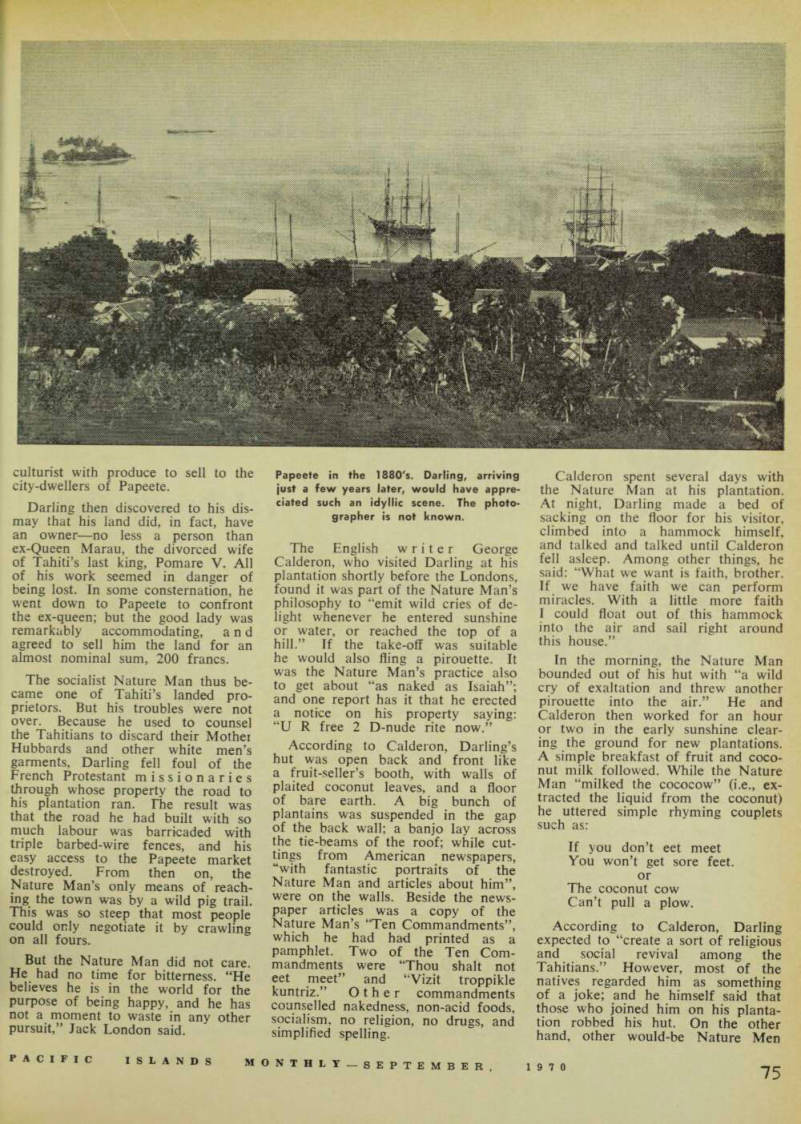
Papeete in the 1880's. Darling, arriving just a few years later, would have appre ciated such an idyllic scene. The photo grapher is not known.
‘Live simply,work
were attracted to Tahiti from time to time by the publicity that Darling 1 earned himself abroad. One such was : an American called Betts, whose ideal, according to Calderon, was “to live simply and work furiously, when the mood is on him, in order to live at ease at other times.” Others of similar ilk were a German called Gus Kromer and a Frenchman, Eugene Dufour. Dufour, in time, became something of a bete noir in Darling’s eyes, for he got possession of the Nature Man’s land, and eventu ally sold it, pocketing (if a nudist can do such a thing) the proceeds.
It seems that towards the end of 1912, the Nature Man decided to leave Tahiti and return to the United States. His reason for doing this is not clear, although the Press in San Francisco claimed that it was be cause he was lonely and wanted a wife to share his existence. At any rate, the newspaper reporters enjoyed themselves hugely at his expense, and did their best to help him find a Nature Woman.
One reporter wrote: “He has no preference in the matter of race or colour. She must be in good health.
She must be willing to dispense with raiment except in such places as are burdened with a chief of police of conventional ideas. And she must be willing to subsist on uncooked food.
In return for these sacrifices she gets
Darling, .
Meanwhile, Darling had left his property in the hands of Dufour, and had had the title to it transferred to him on the understanding that the land would be used to found a colony of nudist Frenchmen. The idea of the nudist colony was apparently a pet scheme of Dufour’s, but the scheme ran into difficulties (probably not difficult to imagine) and eventually it came to nothing. Mean while, Dufour let Darling’s planta tion go to ruin, and consistently neglected to answer the plaintive letters that Darling wrote him from California.
Indeed, with one exception.
Darling’s Tahiti friends all proved to be remarkably poor correspondents.
The one exception was Alexandre Drollet, the government interpreter, who not only replied to Darling’s letters and cards to him—whether they were in phonetic English, more or less plain English, or Esperanto— but he had the foresight to preserve them all for posterity. The Darling correspondence is now in the Papeete Museum. It was recently discovered
there with whoops of delight by the Pacific Manuscripts Bureau and copied on microfilm for the Bureau’s mem ber libraries.
The earliest item is a postcard posted in Berkeley, California, on June 5, 1913. It reads: “My dear Drollets: After my picnic trip on Tahiti I landed in dead old Cal. & seemed to b welcomed by even the happy robins. Took my blankets up to foothills first nite & slept under eucalyptus. My short pants and sleeves pass police OK.
Few will beleev that I gave my place
to Dufour. Vizited Jack [London], such a happy time. I rode up mts with him.”
Other items among the Drollet correspondence show that, in addition to tree planting. Darling did some lecturing in California, and also took up the study of Esperanto. A card advertising one of his lectures in Patterson’s Hall, 5432 East 14th Street, Melrose, Oaklands, says that, for an admission fee of 10 cents, the Nature Man would briefly describe the climate, natives and home-setting possibilities in Tahiti, that he would devote part of his lecture to answer ing questions from the audience, that
he would be dressed in native costume, and would “show how rich milk is made from the coconut.”
Darling never did see Tahiti again.
But he did get back to the South Seas. On June 21, 1918, he wrote to Drollet from Suva, Fiji: “Helo my dear Alexandr and all that’s left ov the family: I’ve had quite a trip round the Pacific, visit ing Japan, China. Philippines, Java 4 mos., Singapore, India, Aust., NZ & Fiji, and never saw a better place than dear old Tahiti. O that I had kept that plase in my name. Please find out all you can about it & what it looks like. I might come to see it again after I visit Samoa & Tonga.
What do you think.
“How r the social & politikl kondishunz. Likely 2 b eni chanjez?
“Climate here is lovely. Rather much rain, but fruit & nuts are hard to get, variety limited, quality in ferior 2 that of dear old Tahiti.
Peepl heer liv mostly on bred, meet, fish, taro, kandy & kow’s milk. Bah!
Maa Tahiti mea maitai ai, roa!
I bot a gd set tool here, planted kokanuts, bans, utas, pines, &c., all over our lot. Meni nice peeple here, English, Fijian & Indian. Am with Indian lawyer, Dr. Manilal, fine man.
“Am trying to persuade the peeple 2 live more on nature fdz, stop send ing 1,000,000 fr. a year out of this produktiv country for foodstuffs.
Konserv that money. Biid swimming pools, jimnazioums, publik skoolz for all the brown peepls, teeching horti kulchure, hijiene, sanitashun, ekon omix, demokrasy, vejetarianizm, thus bringing permanent, substanshal, uni sarsaly satisfactory world peace.”
As part of his campaign for living reform, Darling had a set of post cards printed at the Fiji Times office, which he distributed to anyone in terested at threepence per pair. On one side of each card was a picture of himself with a very woolly beard, and the caption: Nature Man— Ernest Darling, student Stanford University, California. 7 yrs on hiz plantashun on Tahiti, Society lies, working mostly nude and mostly on unkookt fd (froots & nts, best quality), now touring Pacific, riting a bk; teeching a gradual return to nature for helth, hapiness & true prosperity (2 krds 3d).” On the other side was a similar message in Fijian.
Darling was still dreaming of re turning to Tahiti when he wrote his last letter to Drollet from Fiji at the end of August, 1918. “Am anxious 2 no if I mite do as wel by returning 2 Tahiti as I did before,” he said. “Iz the plase all run down
Darling counselled the Tahitian women to discard their Mother Hubbards and other white man's garments. A contemporary of his would have been this lovely Tahitian girl.
Refused drugs
or iz there enuf left for me 2 start it agen if I were willing 2 buy it bak?” He went on: “I may not return, but should like 2 no kondishunz. Many fine lokashunz here & fine nativz, gd government ofiserz, &c. . . I was thinking of taking an island here (leasing a small one), but first wish to look around. Next Friday hope to visit Samoa for four weeks, then Tonga. . . Feel fine and happy. . .”
Darling was 47 years old at that time, but he was still so fit that he could turn hand-spring somersaults with the agility of a youth. However, his robust good health was no proof against the virulent influenza epidemic that was then sweeping the world.
Towards the end of 1918, he was stricken by it. A doctor who attended him, prescribed drugs. But the Nature Man was true to his faith to the last and, refusing to take them, died on December 9, 1918.
He was buried in Suva Cemetery.
Friends erected a tombstone over his grave bearing the inscription: Beloved Natura Sleepeth Here Ernest W. Darling Born Aug. 5, 1871 Died Dec. 9, 1918 American