Independence Spells
pp. 59-61 · Read in the full issue
Road Delay
From SUE WENDT in Suva
Tenders won’t be called for fbp rproncfrnrtinn of the Nadithe reconstruction oi me rsacn Suva road in September as had been expected. This set-back to
Fiji’s biggest road project is one
indirect but important result of np W rVmctifntirm the country s new Constitution which also gives it Dominion status.
Under the old set-up, the Fiji Government had the right to acquire land for public purposes although landowners had the right to dispute the amount of compensation paid.
Under the new constitution the goveminent needs to come to agreement with landowners before acquisition and, in the event of disagreement, the matter must be taken to the Supreme Court.
The new measure is clearly designed to protect the landowners —and, one suspects, the Fiji landowner particularly—from the worst
excesses of bureaucracy, but in the case of the i m P ortant redevelopment Qf the Nadi . Suva highway where m any landowners are concerned it could cause costly delays.
The existing Nadi-Suva road carries more traffic than any other in the Colony, but it was built in the pick and.sh y 0 ’ ve| days of the , 920 . s and 1930’5; it follows the contours of a winding coast, it is surfaced in gravel that turns to slush in the wet and asphyxiating clouds of dust in the dry, and it beats cars to death in about 40,000 miles of use.
The sealing and rehabilitating of this road has long been a Fiji dream and only in recent months a dream that seemed as though it might at last come true. The route surveys have been completed, specifications prepared and the World Bank has indicated that it is prepared to lend the money required to complete the work.
Now, it seems, as an unexpected
backlash from independence and a new Constitution, there could be long delays in starting the vital job—
Continued p. 57
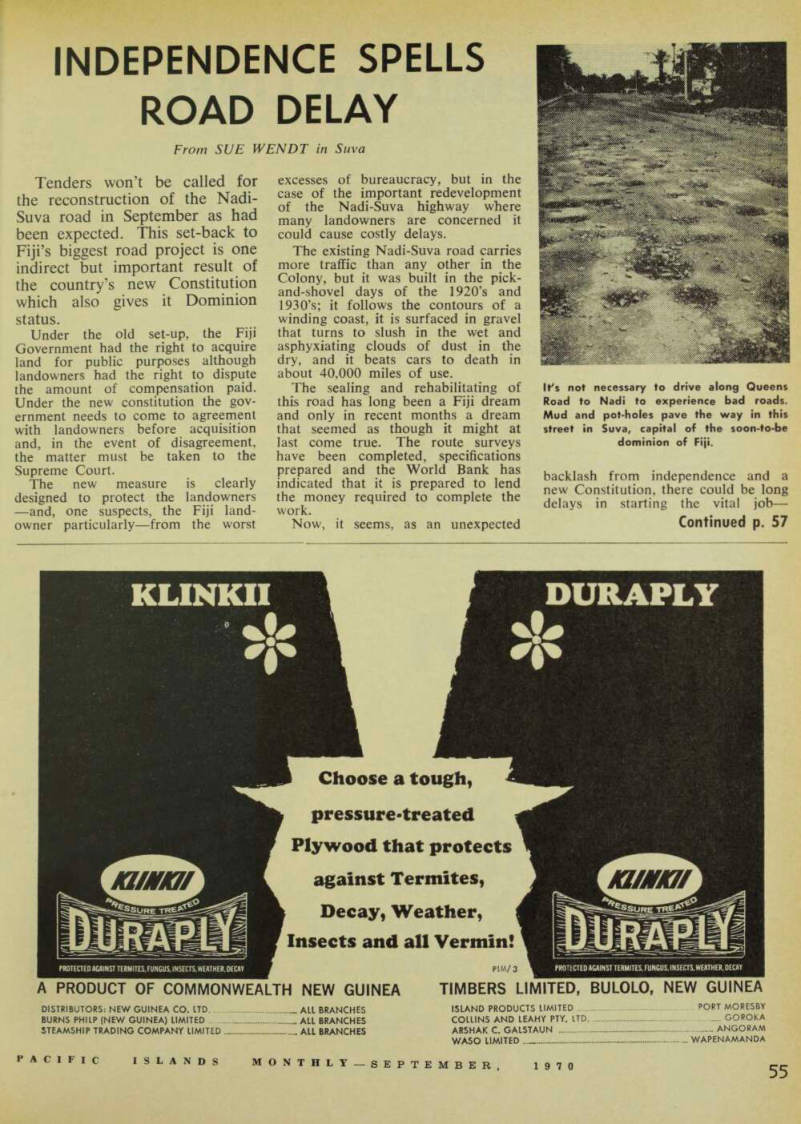
It's not necessary to drive along Queens Road to Nadi to experience bad roads.
Mud and pot-holes pave the way in this street in Suva, capital of the soon-to-be dominion of Fiji.
Cost goes up
with the risk that the World Bank may not keep its offer open in definitely and the certainty that with every month that passes the cost of the project will go up. The estimate in August, 1970, was $l5 million.
Meantime, although Fiji motorists don’t need experts to enlighten them about the wear and tear involved in travelling frequently along the Queens Road, between Suva and Nadi, a team of London consultants has completed a survey to show how many dollars will be saved when the new road is built.
Every mangled mudguard, tattered tyre and shattered windscreen ex perienced along the road’s 130 miles of gravel and potholes costs the motorist real money so that the statistics relating to how much money motorists might save if the road were paved made frustrating—if interesting —reading in August.
According to the consultants, Rendell, Palmer and Tritton, the cost of driving a medium-sized car, at 30 mph on a paved Queens Road would be cut from the present 9.99 cents a mile to 9.06 cents.
The cost of driving a medium sized truck at the same speed would be cut from 16.45 to 11.74 cents a mile.
At 30 mph on a sealed road, say the consultants, the driver of a medium-sized car would get 23.25 miles of travel from a gallon of fuel, compared with 19.35 miles a gallon when driving on gravel as at present.
The tyres would last for 16,000 miles, instead of 8,000.
At 40 mph, running costs per mile would be cut from 8.83 to 7.73 cents; at 50 mph from 8.5 to 7.18 cents; and at 60 mph, from 8.77 to 7.07 cents.
For medium trucks, running costs at 40 mph would be cut from 17.88 to 11.69 cents a mile, and at 50 mph from 20.61 to 12.49 cents a mile.
The report said that resort invest ment and promotion would rise sharply if the road were paved and that the number of beds available to tourists on the Coral Coast would be doubled. There would also be fewer accidents—4.2s per million vehicle miles, instead of 6.75 as at present.
The consultants concluded that, regardless of the effect increased resort development might have on the character of Fijian life, the :ountry’s level of income would un loubtedly rise because of it.