in Port Moresby
pp. 41-43 · Read in the full issue
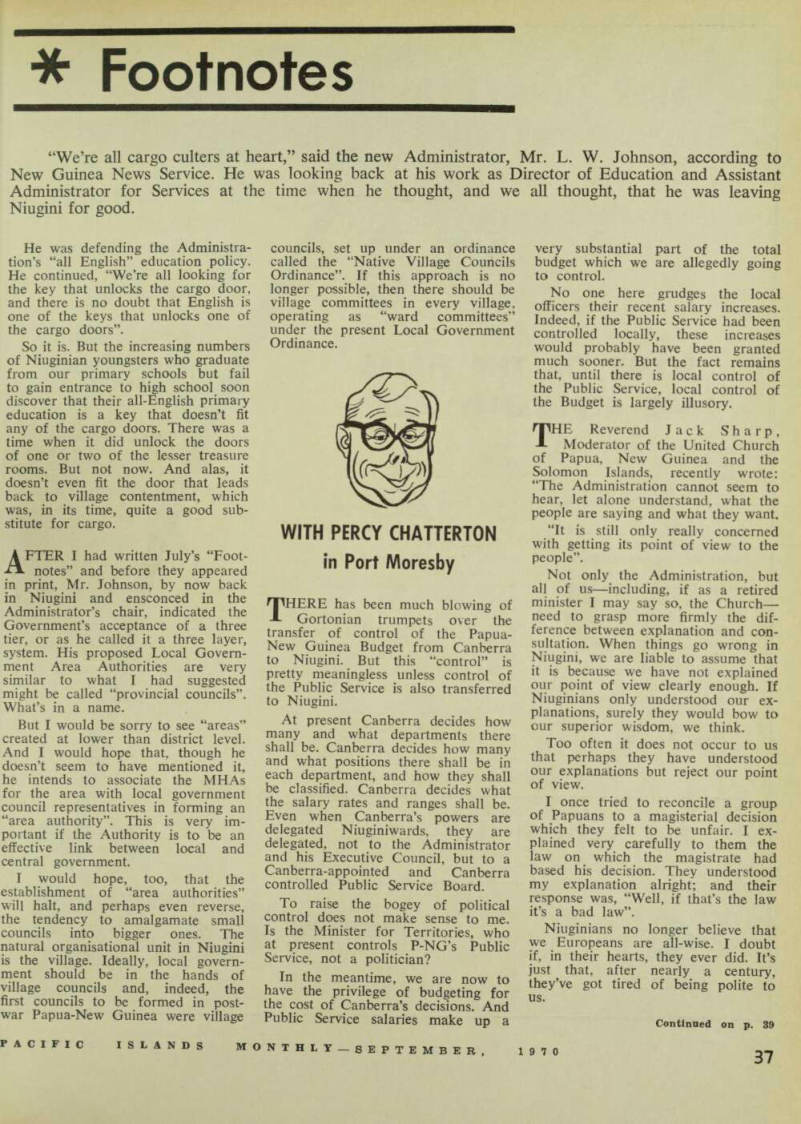
With Percy Chatterton
THERE has been much blowing of Gortonian trumpets over the transfer of control of the Papua- New Guinea Budget from Canberra to Niugini. But this “control” is pretty meaningless unless control of the Public Service is also transferred to Niugini.
At present Canberra decides how many and what departments there shall be. Canberra decides how many and what positions there shall be in each department, and how they shall be classified. Canberra decides what the salary rates and ranges shall be.
Even when Canberra’s powers are delegated Niuginiwards, they are delegated, not to the Administrator and his Executive Council, but to a Canberra-appointed and Canberra controlled Public Service Board.
To raise the bogey of political control does not make sense to me.
Is the Minister for Territories, who at present controls P-NG’s Public Service, not a politician?
In the meantime, we are now to have the privilege of budgeting for the cost of Canberra’s decisions. And Public Service salaries make up a
very substantial part of the total budget which we are allegedly going to control.
No one here grudges the local officers their recent salary increases.
Indeed, if the Public Service had been controlled locally, these increases would probably have been granted much sooner. But the fact remains that, until there is local control of the Public Service, local control of the Budget is largely illusory.
THE Reverend Jack Sharp, Moderator of the United Church of Papua, New Guinea and the Solomon Islands, recently wrote: “The Administration cannot seem to hear, let alone understand, what the people are saying and what they want.
“It is still only really concerned with getting its point of view to the people”.
Not only the Administration, but all of us—including, if as a retired minister I may say so, the Church— need to grasp more firmly the dif ference between explanation and con sultation. When things go wrong in Niugini, we are liable to assume that it is because we have not explained our point of view clearly enough. If Niuginians only understood our ex planations, surely they would bow to cur superior wisdom, we think.
Too often it does not occur to us that perhaps they have understood our explanations but reject our point of view.
I once tried to reconcile a group of Papuans to a magisterial decision which they felt to be unfair. I ex plained very carefully to them the law on which the magistrate had based his decision. They understood my explanation alright; and their response was, “Well, if that’s the law it’s a bad law”.
Niuginians no longer believe that we Europeans are all-wise. I doubt if, in their hearts, they ever did. It’s just that, after nearly a century, they’ve got tired of being polite to us.
Continued on p. 39
I UNDERSTAND that in Paris mini-skirts are “out”. I hope that this news will take a long time to filter through to Niugini’s young womanhood, or that it will be ignored by them.
I like mini-skirts. Not, of course, when the legs which protrude from them look like hunks of raw beef.
But many young Niuginian women have just the right figures for mini skirts.
As a matter of fact, mini-skirts are a Papuan invention. Long, long before Europe thought of them, the sturdily built damsels of the Mekeo plain were getting around in mini-grass skirts.
How relative all this business of propriety in dress is! Mekeo was an exception. Along most of the southern Papuan coast, women and girls wore their grass-skirts down to, or below, the knee, but thought nothing of going bare-topped. Their grand-daughters think nothing of letting us see their shapely legs, but would be acutely embarrassed by the exposure of their breasts.