Tropicalities
pp. 34-36 · Read in the full issue
Gilberts on their best behaviour
When the Duke and Duchess of Kent saun tered through the New Hebrides and Solomons last year following their attendance at the opening days of the South Pacific Games in Port Moresby, New Guinea, the GEIC missed out on
seeing the Royals.
The couple sent a telegram of regrets to the Gilbert and Ellice Islands—sorry we couldn’t fit you in our itinerary, it said.
Now, the GEIC will make up and even do better with the heir to the British throne, Prince Charles, paying a four-day, flying visit to the GEIC immediately following his attendence at the Fiji independence cele brations, October 10 to 14.
On Tarawa in mid-August even the highest government officials didn’t know much more than just that about the prince’s proposed stay.
Prince Charles is supposed to be going to the GEIC “for a break”, but he can forget any thoughts of lying carefree on the sands of a Pacific atoll, taking in the sun.
It will be the second royal visit ever to the GEIC. The Duke of Edinburgh, Prince Charles’ dad, spent two weeks in the GEIC in 1959. Tarawa, the GEIC atoll capital, is being turned upside down already for the prince.
A three-man committee, headed by none less than the GEIC’s top executive, Sir John Field, has been formed to plan the prince’s “break”, and several subsidiary committees are also in gear to cover such weighty subjects as entertainment, security and catering.
The dusty 20-mile Bonriki-Bairiki road will be upgraded; resthouses will be built at Bonriki Airport and at least two outer atolls. The huge maneabas (meeting houses) of Bairiki and Betio will be re-thatched; land ing pontoons will be refurbished and supplies and mini-mokes hastily delivered to outer islands where the prince might visit for an hour or two.
At the Government Residency, Bairiki, Sir John and Lady Field will relinguish their living quarters for
the prince and a friend. They will move into the Residency guestrooms nearby. The Residency will be re decorated. Lady Field was in Mel bourne in August selecting new curtains, lamps and two new beds.
Two new cars are being imported for the prince’s travels around Tarawa and sentries will be ap pointed, presumably to guard him during his stay at reefside Residency.
And then there’s the rumours currently flying about: Expatriate wives are said to be ordering dresses from France, for cocktail parties they haven’t yet been invited to, and talk is of young attractive female relatives of higher-up officials flying out from London for the occasion.
It’s impossible to get any idea of the total cost of the preparations— sso,ooo is a conservative guess. How ever, it’s fair to add that many of the improvements for the prince were needed in Tarawa anyway.
Fiji has a JP
in Australia
The first Fiji Indian to be sworn in as an Australian Justice of the Peace is Mr. Satyendra Pretap Sharma, 28, who is studying arbitra tion, trade unionism and labour re lations part-time at Sydney University Law School.
Mr. Sharma, formerly president of Fiji Transport Workers’ Union, has been in Australia a year. In 1968 he was awarded a scholarship to study at Moscow State University, another first for a Fiji resident.
A graduate in economics, political science, trade unionism and inter national law, he told PIM, “While this honour has delighted me it has also added a new page in the political history of Australia and Fiji.”
A statue for
a president
American chaplain, the Rev. David Bush, is back in the Solomons after carrying out a mission in the US for Solomon Islanders.
He had been travelling aboard the British malaria control boat Tevai last year when some islanders recognised him as an American. They gave him a stone statue of the late President John F. Kennedy whom they remem bered as the man they saved from capture by the Japanese during the Pacific War.
Kennedy, on board the PT-109, had been rammed by a Japanese destroyer and had taken refuge on Plum Pudding Island. A young native carried a message from Kennedy to Rendova to get help. Kennedy and
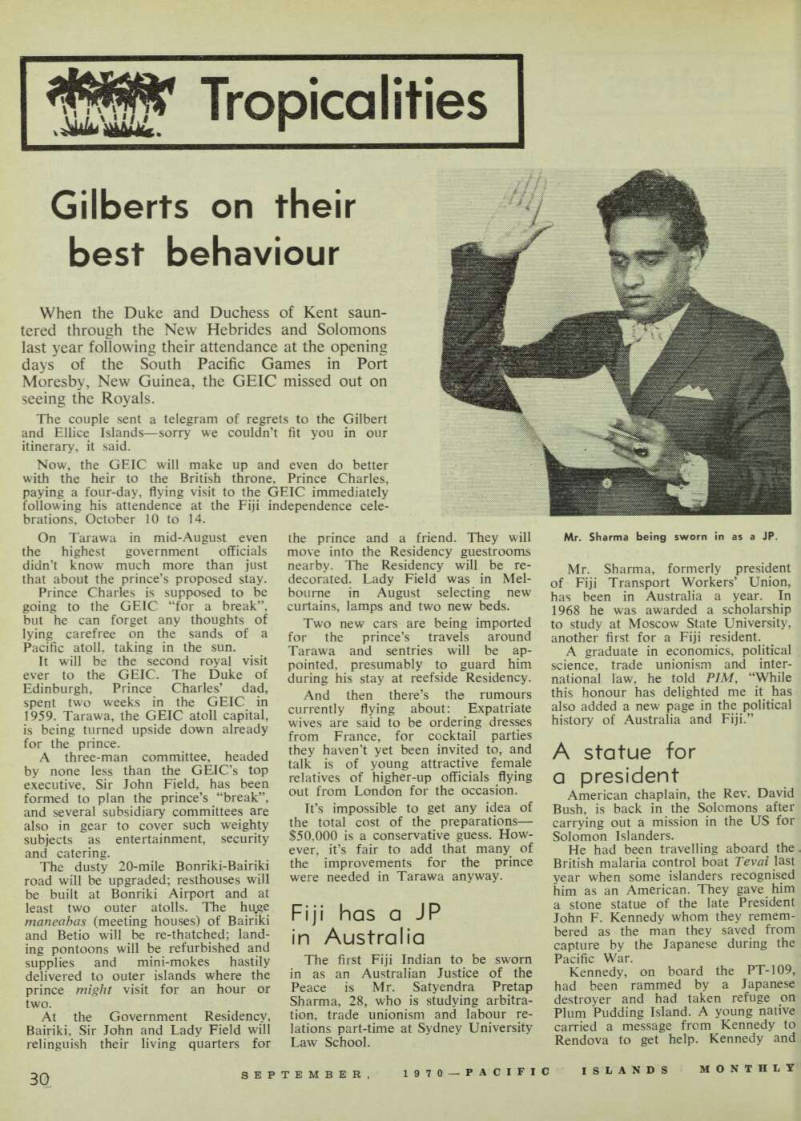
Mr. Sharma being sworn in as a JP.
his men were duly rescued but his memory, it appears, lived on.
Late last year Chaplain Bush had an audience with Senator Edward Kennedy and presented him with the statue in memory of his brother John. It depicts a headhunter (Ken nedy) holding the head of a defeated enemy. Since then the islanders have received letters of thanks from Senator Kennedy, and Chaplain Bush has taken his family to live among the people of Munda in the Solomons.
Appeal for
'Midnight Mover'
Lost somewhere between Auck land and Tahiti—the Chinese junk, Midnight Mover, disappeared on May 16 and hasn’t been heard from since.
The wife of the captain/owner of the 65 ft vessel, Mrs. Marguerite Riviere, has written to PIM to appeal for in formation on the boat and its five occupants.
She writes: “Can you help us please? Will everybody look for a Chinese junk or a dinghy. It is possible that they were forced to escape the boat in a hurry. They were navigating by sail only. Per haps the gales pushed them far off flieir route and threw them on an isolated little place where they mav still be.”
The Midnight Mover had remained in radio contact with Auckland for 10 days on its route to Tahiti and then on May 16, stopped. Last con tact said they were becalmed and had rudder trouble. Mrs. Riviere’s address (she was to have met her husband m Tahiti): 2433. C.Cleghorn Street, Honolulu, Hawaii 96815.
Brett Hilder will
be back soon
Brett Hilder, one of the South Pacific’s best known sea captains, has completely severed his connection with Burns Philp, the company he served for 42 years.
Captain Hilder left the firm after the Braeside was sold to a Liberian based group for an undisclosed sum and, dissatisfied with his severance award, he took the firm to the arbitration court. He told PIM in sarly August that his final award by the court was $22,000.
Bums Philp, he said, had offered severance pay for only 17 years of the 42 he had served with the com pany. The court had awarded him a good deal more than that. A Bums Philp spokesman, asked to comment, said the company was happy about ;he award.
Captain Hilder, 58, has not been
idle during the arbitration period.
He has been skippering the Ore Regent, carrying bauxite between Weipa and Gladstone, Qld., for Clutha Co. Ltd.
Now he can’t wait to get back to the South Pacific.
Captain Hilder joined BP’s as a cadet in 1928; he became master in 1937, extra master in 1938 and took his first command for BP, the Maiwara, in 1939. His commands have included the Muliama, Mangold, Morinda, Malaita and Bulolo, all in the South Pacific.
He has made charts and plans of coastlines, harbours and anchorages all over the New Guinea area and a small group of islands near Bougain ville have been named after him.
During the war Captain Hilder took to the air and after teaching navigation in the RAAF, became a Wing Commander and piloted Cata linas, laying magnetic mines in enemy harbours.
Other talents include the designing of several postage stamps for Islands territories and a reputation as a watercolour artist and sketcher. His sketches have been appearing in PI M’s pages for many years. His two books are Navigator In The South Pacific, and The Heritage Of J. J.
Hilder.
It now looks as though Captain Hilder’s talents will not be lost to the South Pacific. His dispute with BP’s is now patched up and it looks as though he will be taking a com mand with one of the other Pacific shipping lines in the near future.
Caledonian students
have freedom
A group of 15 student teachers from Auckland Teachers’ College spent three weeeks in New Caledonia through July, studying language teaching methods at the Noumea High School.
The student teachers stated they were impressed by the modern tech niques of language teaching at the high school and much appreciated their experience there.
Some of the New Zealanders how ever expressed their surprise at the freedom enjoyed at the high school, where they observed that students were free to smoke, the boys per muted to grow beards, while dress seemed far from regimented: girl students’ attire ranges from brief mini-skirts and high heels to smart pantsuits.
The behaviour of these young people also showed a surprising degree of independence and self assurance, away beyond that of their southern neighbours of the same age, the New Zealanders noted.
Aunt Jemima
is 100 Norfolk Island was to take a public holiday on September 13 to celebrate the 100th birthday of Aunt Jemima Robinson, grand-daughter of Matthew Quintal, one of the original Bounty mutineers.
Aunt Jemima lives with her daughter, Mrs. Celia Nobbs, in Rocky Point Road near the sea. She can still read without glasses, plays the piano and likes most of all to sing.
Although Aunt Jemima didn’t know it, the island has been planning her celebration for some time and Government House is being used to give her a memorable centenary.
Pacific people at
food congress
Several South Pacific representa tives were among the 1,600 delegates attending the 2nd World Food Con gress in Holland in July.
Australian and New Zealand mem bers of the Freedom From Hunger Campaign committees were there, as well as Tofa Lauofo Meti of West ern Samoa and Mr. Kilipati from the GEIC (he had just completed a course on co-operatives management).
Australian Mrs. Elizabeth Silver stein, promotor of the Foundation for the Peoples of the South Pacific, flew up for a few days from Nice.
Father Hosie of the same foundation was also there from New York, together with fellow Australian Mr.
Alan Harris, economic programme director of the South Pacific Com mission.
According to Mr. Harris, the
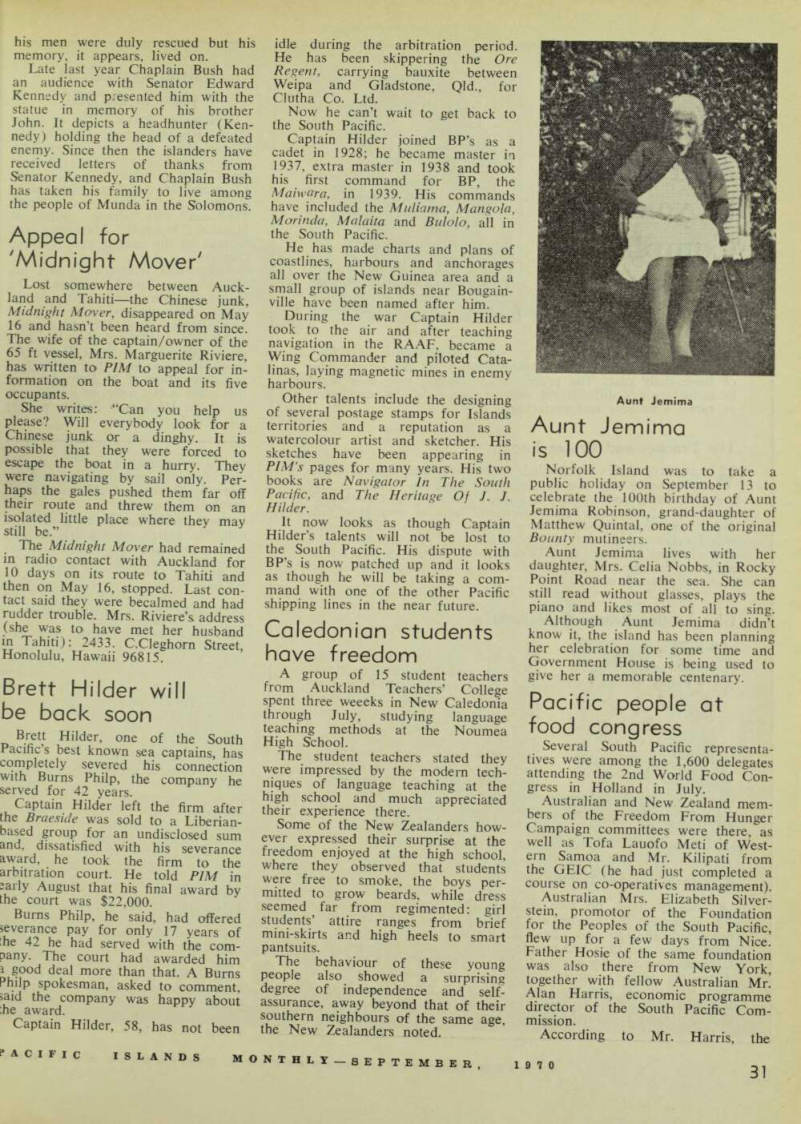
Aunt Jemima
Pacific representatives made a special plea for aid organisations to con sider the particular problems of small developing countries.
During talks outside the conference hall, Mr. Harris reports that at least one major aid-giving foundation ex pressed an interest in coming into the Pacific.
Nerve gas again
It was meant for Oregon, US; then it was due to go to Alaska. Finally they decided on Guam. Now the nerve gas causing the Americans much embarrasment on Okinawa is to be shipped “probably” to Johnston Island, 2,000 miles north of Ameri can Samoa.
The nerve gas is highly unpopular wherever it is planned to be taken.
Having no natives, Johnston was once involved in American nuclear testing programmes. US authorities obviously hope that they can store the gas on Johnston and perhaps forget about it. But Johnston is only 800 miles from Hawaii!
Big money from
Nauru
Few countries can have contributed so well to the Peruvian earthquake disaster relief fund as the inhabitants of little Nauru. By the end of August the people themselves had raised $A 11,100 for the fund and the gov ernment was expected to add a further grant to it.