marriage (albeit
p. 31 · Read in the full issue
It's a happy marriage (albeit a tense one)
Premier of the Cook Islands, Mr. A. R. Henry, likened his nation’s relationship with New Zealand to a marriage partnership while speaking on the fifth anniversary of internal self-government on August 4.
However, although he was com plimentary on that occasion, later developments in Rarotonga and New Zealand showed that it was a marriage with more than the usual amount of tension.
He said the constitution was “the most unusual, the most unique form of agreement or contact established in the world between two countries...”
“The Cook Islands has exercised her constitutional right as wife—the right to pester and demand, to worry and continually nag New Zealand,” the Premier said. “. . . this day I solemnly express the Cook Islands’ gratitude to New Zealand for this form of contract . . . which has been strained at times. But the fact that we are still together and happy says much for our partnership.”
Reviewing progress made during five years of internal self-govern ment, the Premier noted that “there are visible signs that people have more money to spend”.
The number of Cook Islands tax payers rose from 213 in 1966 to 1,200 in 1969. There were 34 busi nesses in 1965 and over 40 today, and of these, nine were European owned.
“Internal revenue increased from a few hundred thousand dollars to over S 2 million per annum,” said Mr. Henry. “Import and export values have increased tremendously, in fact to such an extent that urgent priority consideration must be given to immediate changes in the shipping services to remedy the defects revealed. My government is con vinced that increased freight rate is not the correct remedy and that such action only tends to prolong the
painful uneconomic and unrealistic situation.”
One of the major problems facing the new Cook Islands Party Govern ment in 1965 was that of uniting Cook Islanders, and Mr. Henry said he was “happy and very touched, not only as a politician, but also as a Cook Islander,” at the progress made in that direction.
But within a few days of the sth birthday speech, Premier Henry was hinting at constitutional change for the Cooks—a local Head of State instead of the New Zealand represen tative Mr. L. Davis, who at present combines the functions of Queen’s representative with those of being High Commissioner for New Zealand.
According to some Cook Islands opinion, Mr. Davis “uses his power to push NZ interests”.
Cook Islands government feelings were exacerbated in July when the NZ government raised shipping freights on the Moana Roa, without prior notice (see shipping section).
Because of this and other matters there is a move to have a Cook Islander appointed permanent representative in New Zealand.
It was thought in Rarotonga in August that because of New Zea land’s “high handed” actions, that Premier Henry might not attend the triennial negotiations in Wellington at the end of the month in which the Cl subsidy from NZ is fixed.
However, as the Cooks hope to be getting $4 million a year from New Zealand by 1973—about twice as much as at present—boycotting negotiations seems a peculiar way to go about it. The increase is essential, it’s said, to develop tourist ancillary services, when the famous airport is a going concern.
Tourism, which was once a dirty word in the Cooks, is now regarded as the industry that is going to solve most of the Group’s economic problems.
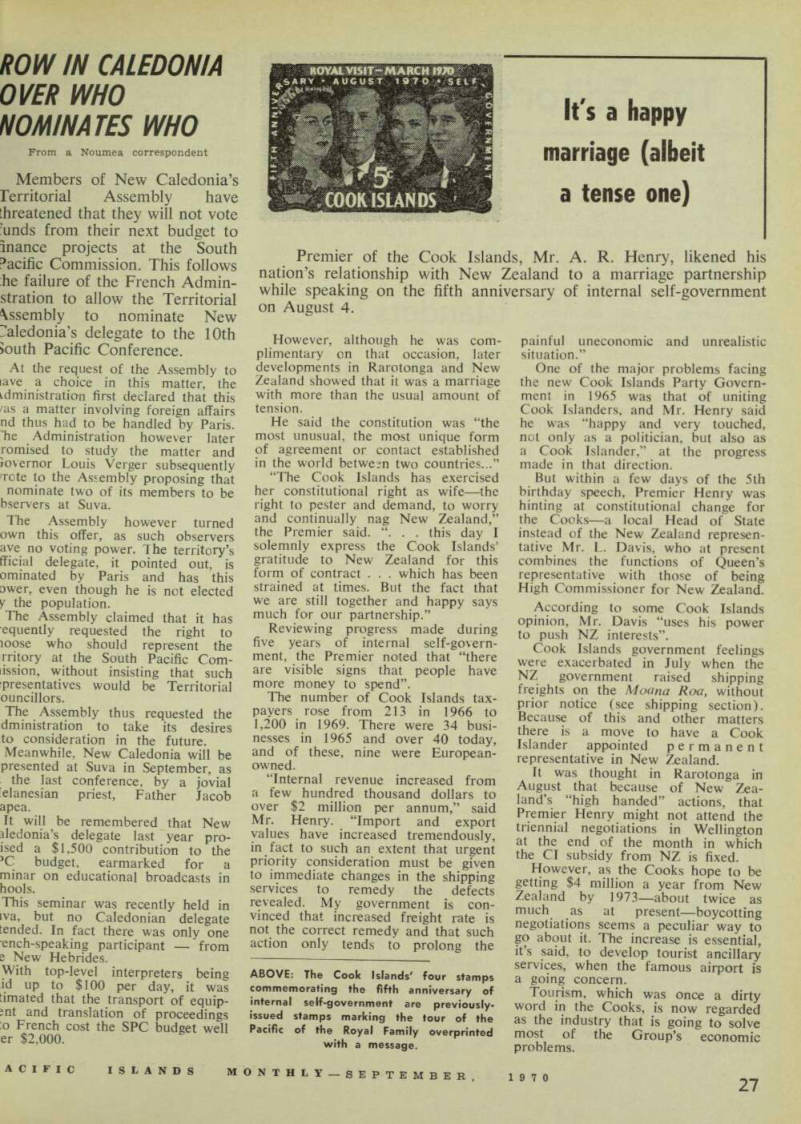
ABOVE: The Cook Islands' four stamps commemorating the fifth anniversary of internal self-government are previously issued stamps marking the tour of the Pacific of the Royal Family overprinted with a message.