Air Tahiti "swindled”
pp. 27-28 · Read in the full issue
One of the most remarkable success stories in the field of Pacific Islands aviation in recent times has been the air taxi service between Tahiti and its sister island, Moorea, run by two local airlines, Air Tahiti and Air Moorea.
Since early last year, when Air Tahiti began the service, the two companies have carried approximately 100,000 pas sengers. In so doing, they have considerably boosted tourism on Moorea and have reduced the travelling time between the two islands from H hours in the fastest inter-island ferry to a mere seven minutes.
Yet on August 11, the president of Air Tahiti, Mr.
Bertrand Jaunez, called a Press conference at Faaa Air port to announce that the two airlines had ceased operations that morning and were going into immediate liquidation.
The reason for this extra ordinary action, Mr. Jaunez said, was that the French Government had blocked the importation of two Britten- Norman aircraft which were essential for the companies’ continued operations.
Without mincing words, Mr.
Jaunez then proceeded to tell the story of his company’s unsuccessful two-year battle against what he described as “administrative trickery”, “swin dling”, and a number of similar things.
The story began, he said, in March, 1968, when Air Tahiti proposed the Tahiti- Moorea air taxi service, using a Britten-Norman aircraft from Libreville, which was adjudged the ideal plane for a flight of seven minutes.
The airline’s investment programme which Mr. Jaunez said had so far cost 82 mil lion Pacific francs (about 5A750,000) was approved by officialdom; the airline took an option on four Britten- Norman planes; and it began recruiting personnel, printing tickets, buying ground equip ment, etc. Finally, with several light aircraft hired locally, the air taxi service was inaugurated.
However, difficulties were encountered as soon as Air Tahiti showed that it meant business and would be a serious competitor for RAI, the inter island airline owned by the French company, UTA.
Whereas Air Tahiti’s applica tion for a licence to import the Britten-Norman aircraft was refused, delayed and pigeon holed, RAI was allowed to im port a Twin Otter which it put on to the Tahiti-Moorea run.
Subsequently, RAI reduced the fare on that service by 30 per cent., although its fare to Bora Bora was put up by 28.6 per cent.
“And now,” Mr. Jaunez, added, “RAI is about to im-
Continued over
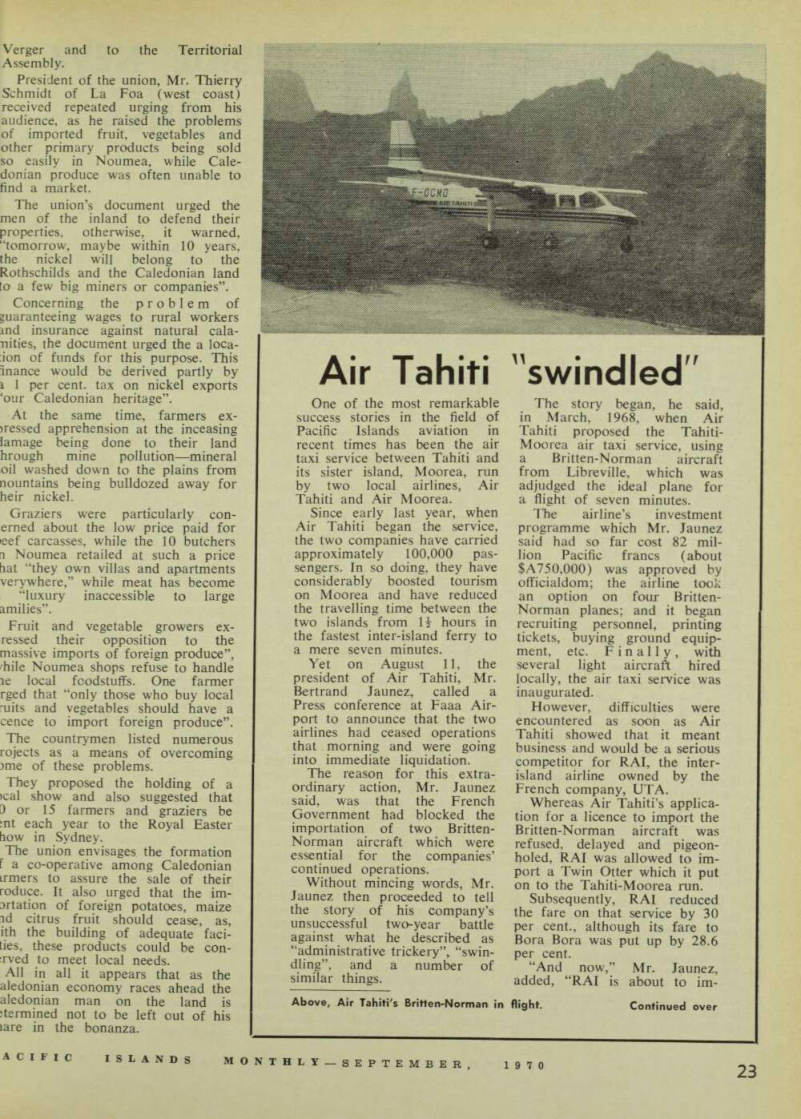
Above, Air Tahiti's Britten-Norman in flight.
port Britten-Norman aircraft for its own use in order to asphyxiate Air Tahiti, while our own Britten-Normans are still waiting in vain to leave the Isle of Wight. We have thus been forced to cease operations from this morning, August 11, 1970.”
In a circular to clients issued at the same time as the Press conference, Air Tahiti and Air Moorea stated that they had made numerous appeals to the highest authorities, that the local parliamentarians had intervened on their behalf in the public interest, and that the Territorial Assembly had made a unanimous protest to the French Government. How ever, nothing had broached the veto of Paris against the two airlines.
The cessation of the air taxi service came at a time when RAl’s Twin Otter was out of service with an engine break down. So there was an im mediate increase in the number of passengers travelling on the Tahiti-Moorea ferries.
However, Mr. Pierre Sachet, the owner of one of the ferries, the Keke 11, was not especially pleased about the increased business.
He told the Press that the problem of Air Tahiti was his also in that the French Gov ernment had refused to grant him foreign exchange to acquire a bigger, faster, more comfortable boat—a British hydrofoil. They wanted him to buy a French model which was a little faster than the British one, but much more expensive and noisy.
He added that tourism in French Polynesia was “the affair of UTA” and that that company, with RAI, wanted to establish a monopoly in the territory.
When PIM went to press, the latest news on what one Tahiti newspaper called “a scandalous affair” was that the territory’s Governor, Mr.
Pierre Angeli, had cabled Paris in a last-ditch attempt to allow Air Tahiti to import its Britten-Normans from the Isle of Wight.