Book Reviews
pp. 108-109 · Read in the full issue
A Pacific Quintet For
The History-Minded
Five new books on a variety of aspects of Pacific history, which have made their appearance recently, seem to demonstrate that Pacific history is a subject of universal appeal—at least to publishers.
The five books, all scholarly works, were published in five countries Great Britain, New Zealand, Holland, the United States and Australia.
Considering that this is still Captain Cook’s bi-centenary year, a note worthy feature of the quintet is that only one is concerned with the good captain.
New Zealand scholar, John Dunmore, who is Professor of French and Dean of Humanities at Massey University, Palmerston North, has two titles to his credit.
They are: French Explorers in the Pacific (Vol. II), published by Oxford University Press at $6.55, and The Fateful Voyage of the St. Jean Baptiste, published by Pegasus Press, Christchurch, at SNZ4.
The other three volumes are: • The Treponematosis of Tahiti, by Isaac Van Der Sluis. (Distributed by B. M. Israel, Amsterdam. 35 Dutch guilders—approx. $8.75). • Robinson Crusoe's Island, by Ralph Lee Woodward, Jr. (The Uni versity of North Carolina Press, Chapel Hill, North Carolina. UK price: £Stg.4). • Captain Cook: Navigator and Scientist, edited by G. M. Badger. (Australian National University Press, $5).
The publication of the second volume of Dunmore’s French Ex plorers in the Pacific has followed rather tardily on the first volume, which appeared some 4\ years ago and was reviewed in PIM (March, 1966, p. 91). But it has been well worth waiting for.
Whereas Vol. I dealt with the French explorers of the 18th century, the present volume is concerned with those of the 19th—to wit, Baudin, Freycinet, Duperrey, Hyacinthe de
Bougainville (son of Tahiti’s early visitor), Dumont d’Urville, Laplace, Vaillant and Dupetit-Thouars.
Vol. II follows the pattern set in the first volume. After an intro ductory section explaining the back ground to last century’s exploration of the Pacific by the French, the author briskly narrates the achieve ments and most interesting events in the voyages of each explorer.
As a work of reference, Vol. II is particularly useful for two reasons.
One is that, except in Baudin’s case, no English translations of the accounts of the 19th century French explorers were ever published.
Secondly, the original French ac counts are now so scarce and ex pensive in most cases that they are virtually inaccessible to most scholars.
Dunmore’s work as a translator and editor is, in the main, first class.
But there are one or two errors and omissions that should be attended to in future editions.
The most serious omission is the author’s failure to record the voyage of the French trader, Louis Ruault Coutance, who sailed from Mauritius to South America and back in 1803-04, discovering several Pacific islands en route. (An account of this voyage by the present reviewer was published in PIM (May, 1966, p. 81).
Another omission is the author’s failure to identify some of the islands that his explorers visited by their modern names. Thus, for example, on p. 149 Dunmore speaks of Duperrey visiting the island of Truk while on p. 368 he has Dumont d’Urville visiting the Hogoleu Islands —without informing his readers, and apparently without realising himself, that the second name is an obsolete name for the first.
For those who delight in the
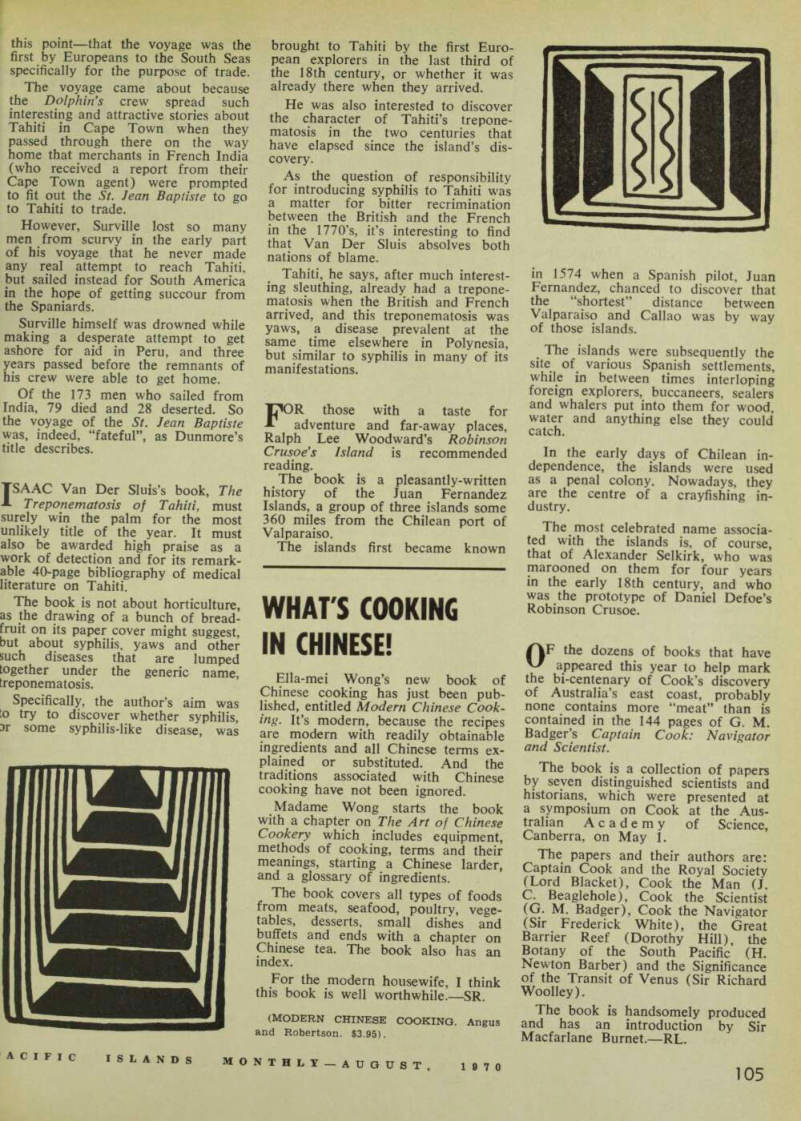
macabre, there is an unusually choice item on p. 373 where Dunmore describes the fate of a young Tongan called Mafi-Kelepi, whom Dumont d’Urville was taking back to France.
Mafi-Kelepi was particularly eager to see France, but this was not to be, for in September, 1839, while still in the East Indies, he died of tuberculosis. France, however, did see him, for d’Urville pickled his body in a barrel of brandy, and, on reaching France, handed it over to the Museum of Natural History!
DUNMORE’S second book, The Fateful Voyage of the St. Jean Baptiste, is a short, popular account of the 1769-70 expedition to the South Seas of the ill-fated French man, Jean-Francois-Marie de Surville.
Although Surville was the man who rediscovered the Solomons 200 years after Mendana first sighted them, and although he was on the coast of New Zealand at the same time as Captain Cook, little has previously been published in English on his voyage.
Dunmore’s book admirably makes amends for this neglect, although a further, more authoritative work is yet in store, for the dust jacket informs us that the author is currently working on an edition of the St. Jean Baptiste journals for the Hakluyt Society.
The present book reveals that Surville’s voyage was one of the first practical results of the discovery of Tahiti in 1767 by Captain Wallis, of the Dolphin. It reveals too — although Dunmore does not mention
Dumont d'Urville, who pickled a Tongan in a barrel of brandy to get him to France.
this point—that the voyage was the first by Europeans to the South Seas specifically for the purpose of trade.
The voyage came about because the Dolphin's crew spread such interesting and attractive stories about Tahiti in Cape Town when they passed through there on the way home that merchants in French India (who received a report from their Cape Town agent) were prompted to fit out the St. Jean Baptiste to go to Tahiti to trade.
However, Surville lost so many men from scurvy in the early part of his voyage that he never made any real attempt to reach Tahiti, but sailed instead for South America in the hope of getting succour from the Spaniards.
Surville himself was drowned while making a desperate attempt to get ashore for aid in Peru, and three years passed before the remnants of his crew were able to get home.
Of the 173 men who sailed from India, 79 died and 28 deserted. So the voyage of the St. Jean Baptiste was, indeed, “fateful”, as Dunmore’s title describes.
ISAAC Van Der Sluis’s book, The Treponematosis of Tahiti, must surely win the palm for the most unlikely title of the year. It must also be awarded high praise as a work of detection and for its remark able 40-page bibliography of medical literature on Tahiti.
The book is not about horticulture, as the drawing of a bunch of bread fruit on its paper cover might suggest, but about syphilis, yaws and other such diseases that are lumped together under the generic name, treponematosis.
Specifically, the author’s aim was to try to discover whether syphilis, Dr some syphilis-like disease, was
brought to Tahiti by the first Euro pean explorers in the last third of the 18th century, or whether it was already there when they arrived.
He was also interested to discover the character of Tahiti’s trepone matosis in the two centuries that have elapsed since the island’s dis covery.
As the question of responsibility for introducing syphilis to Tahiti was a matter for bitter recrimination between the British and the French in the 1770’5, it’s interesting to find that Van Der Sluis absolves both nations of blame.
Tahiti, he says, after much interest ing sleuthing, already had a trepone matosis when the British and French arrived, and this treponematosis was yaws, a disease prevalent at the same time elsewhere in Polynesia, but similar to syphilis in many of its manifestations. rR those with a taste for adventure and far-away places, Ralph Lee Woodward’s Robinson Crusoe’s Island is recommended reading. The book is a pleasantly-written history of the Juan Fernandez Islands, a group of three islands some 360 miles from the Chilean port of Valparaiso.
The islands first became known
in 1574 when a Spanish pilot, Juan Fernandez, chanced to discover that the “shortest” distance between Valparaiso and Callao was by way of those islands.
The islands were subsequently the site of various Spanish settlements, while in between times interloping foreign explorers, buccaneers, sealers and whalers put into them for wood, water and anything else they could catch.
In the early days of Chilean in dependence, the islands were used as a penal colony. Nowadays, they are the centre of a crayfishing in dustry.
The most celebrated name associa ted with the islands is, of course, that of Alexander Selkirk, who was marooned on them for four years in the early 18th century, and who was the prototype of Daniel Defoe’s Robinson Crusoe. fV 7 the dozens of books that have appeared this year to help mark the bi-centenary of Cook’s discovery of Australia’s east coast, probably none contains more “meat” than is contained in the 144 pages of G. M.
Badger’s Captain Cook: Navigator and Scientist.
The book is a collection of papers by seven distinguished scientists and historians, which were presented at a symposium on Cook at the Aus tralian Academy of Science, Canberra, on May 1.
The papers and their authors are: Captain Cook and the Royal Society (Lord Blacket), Cook the Man (J.
C. Beaglehole), Cook the Scientist (G. M. Badger), Cook the Navigator (Sir Frederick White), the Great Barrier Reef (Dorothy Hill), the Botany of the South Pacific (H.
Newton Barber) and the Significance of the Transit of Venus (Sir Richard Woolley).
The book is handsomely produced and has an introduction by Sir
Macfarlane Burnet.
RL.