Von Luckner
pp. 95-104 · Read in the full issue
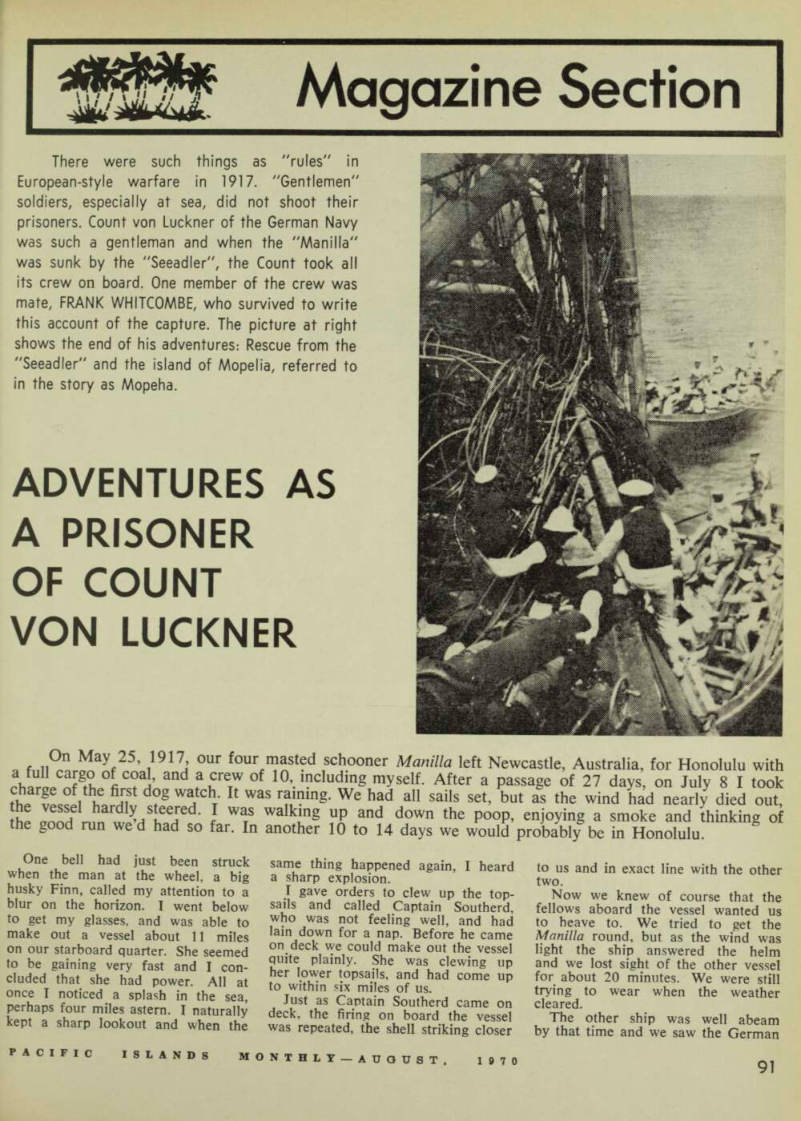


Adventures As
A Prisoner
Of Count
Von Luckner
On May 25, 1917, our four masted schooner Manilla left Newcastle, Australia, for Honolulu with a . „' Ca °« C ? a i’ and f u re T W of 10 ’. '? cludin g myself. After a passage of 27 days, on July 8 I took the wwl l hardifv d ? § Wa ,' Ch , 11 Was We had a| l sai| s set, but as the wind had nearly died out, the pood nm weM tf e H ed ’ f"T wa k i. ng “P and down the P°°P. enjoying a smoke and thinking of the good run we d had so far. In another 10 to 14 days we would probably be in Honolulu
when'the'manlt wheel, fbig
husky Finn, called my attention to a blur on the horizon. I went below to get my glasses, and was able to make out a vessel about 11 miles on our starboard quarter. She seemed to be gaining very fast and I coneluded that she had power All at once I noticed a splash in the sea nerham fnnr LI t * n ’ kept a sharp lookout and p kout and when the
1 I gave orders to clew up the topsails and called Captain Southerd, who was not feeling well, and had lain down for a nap. Before he came on deckwe couldl make out the vessel 2 U plain , ly - She was clewing up f^ r JS!? er t 0 a J?d had come up " s ' x „ ™| e so f us. , Just as Captain Southerd came on on , hoard the vessel was repeated, the shell striking closer
“ eXaCt lkle with ,he o,her Now we knew of course that the fellows aboard the vessel wanted us to heave to. We tried to get the Manilla round, but as the wind was light the ship answered the helm and we lost sight of the other vessel for about 20 minutes. We were still trying to wear when the weather cleared.
The other ship was well abeam by that time and we saw the German
“You ’re captured”
ensign flying aft. As we could neither run, tack nor wear, we started to lower away. Of course everything jammed, and all the halyards fouled.
As the boys were getting to be in a hurry, they used knives. The canvas came down quickly enough then, the gaffs, naturally breaking to pieces.
The raider had steamed up to within speaking distance and someone hailed us in perfectly good Ameri can, “Say where are you from?
Where to? etc.”.
After replying to these questions the old man started to light his pipe again and waited for further develop ments. They came quickly enough.
“Captain of the schooner?” “Yes.”
“This is the German auxiliary cruiser Seeadler. You’re captured and I’m going to sink you. Am sending a boat over. Stand by to take my lines.
We’ll take you aboard here.”
all seemed
very obliging’’
Stand by we did, everybody tickled to death that we didn’t have to go and abandon the Manilla in the dinghy. The German launch came alongside and the prize officer and nine men, all heavily armed, got aboard. The officer told us we were allowed to take all our private belongings and gave us half an hour to pack up. They all seemed very obliging. We got our clothes packed and piled in the boat; one of the German sailors gave us fellows aft a hand.
Captain Southerd was the last man in the boat, and as we cast off, one of the German sailors hauled down the Stars and Stripes then flying on the spanker, rolled them up nicely, and hoisted the German flag over a good old American ship. A few minutes run brought us alongside the raider and, as we came up the pilot ladder, we were welcomed by American merchant seamen. The crews of the R. C. Slade and the H. B. Johnson had the same hard luck as ourselves and managed to get captured.
The Germans made several trips back and forth bringing the Manilla's stores aboard. They were very glad to get fresh potatoes and onions.
By 9 p.m. the Germans were ready to sink our vessel. The launch steamed over for the last time, plac ing some bombs aboard as we learned later, and returned. The moon had just risen and we all gathered amidships by the starboard
bulwarks for a last glance at the old vessel we had brought so near to her home port, and which had been a good home to all of us.
We heard a dull explosion and the doomed schooner started to sink stern first. All her masts were stand ing as she disappeared beneath the waves.
Then the Germans got the sails on the raider and squared away, heading south, looking for more prey.
At 10 o’clock we were told to go below and receive our hammocks.
I do not think that anyone slept much that first night. No doubt shipmates were wondering, same as myself, what would happen to us in the end—if we were being staked to a free ride to Germany or if we were going to be marooned some place.
Towards morning I dozed off only to wake up again at six. Most of the fellows had already turned out and were lashing their hammocks and stowing them. I went on deck to get a little fresh air and sat down on one of the spars. The Germans were just washing down. The Seeadler sure looked a trim craft with all sails set and she was making about five knots. The sun rose about two points over our port bow and I reckoned we were heading about south east.
About 9 o’clock Chief Officer
Kling had all us prisoners called together in the tween decks and laid out the rules of the road to us.
He said, as near as I can remem ber, “It has been an unfortunate thing for you to be captured. How ever you know that our nations are at war and that we aboard the Seeadler are keeping in the boundaries of legitimate warfare by sinking and destroying enemy vessels carrying either guns or contraband, as had happened in your case.
“We are all men of the sea and earning our living on the blue waters, and we do not wish to be harder on you than is necessary, pro viding you do not cause any dis turbance or trouble. But remember, if we have to shoot, we shoot to kill.
“We have plenty of
work for y ”
‘The crews of the H. B. Johnson and R. C. Slade are working aboard here. If any of the Manilla’s crew wish to work we will find plenty to do. Understand, that we do not force you to work, and that if you do you will receive the same pay as our German merchant seamen in time of peace. You have the liberty of the deck from daylight to 10 p.m. After that everybody will go below decks.
A sentry with loaded arms will stand guard at night.”
That did not sound so very bad.
We did not expect decent treatment after the reports we had been read ing in the British papers. Kling spoke perfect English with a very pronounced American accent, and I often heard him use New York slang.
He was a very capable seaman and really the only one who could handle the Seeadler properly.
The rest of the officers, with the exception of the Commander, Count von Luckner, were mostly of the stuck-up military type—the kind one meets in New Guinea among some of the Germans. Count von Luckner was a bit of a sport. He often came and sat down alongside one of us and started to ask questions. I took quite a liking to him.
The Seeadler was a three masted, square rigged vessel, and carried double gallants and royal on each top. Two 10 centimetre guns were mounted forward just abaft the forecastle head and as she had very high bulwarks, they could not be seen until the gun ports were lowered.
The engine seemed big and power ful and I believe was capable of driving the vessel 10 miles per hour.
She was of the semi-diesel type. Of course a powerful wireless plant had
A clever trick
been installed aboard and we were getting the war news quite regularly.
The raider carried two machine guns and there were plenty of revolvers, rifles and hand grenades aboard.
A very remarkable thing was the fog-producing apparatus. The chemi cals were contained in steel drums, hermetically sealed and perhaps 3 ft high and 26 in. diameter.
It is quite interesting to know how the Germans brought the raider through the British lines in the Atlantic and later into the Pacific Ocean. The Seeadler was American built and was owned by the Boston Lumber Company. She was named in those days the Pass of Balmaha.
She was bound for some neutral European port and while passing through the British Channel was stopped and boarded by a British patrol. The officer in charge of this patrol thought something seemed funny about the vessel’s papers and decided to take her into Plymouth and investigate. He put a prize crew aboard and left an officer in charge to sail her in.
While on the way to Plymouth, a German submarine happened along, captured the vessel, and brought her into Bremerhaven. There she was rebuilt and fitted out, and engines and guns placed aboard. After every thing was in complete order, lighters took a deckload of timber alongside and guns, engine room skylights, etc., were all covered with a deckload. On the outside of the vessel were painted Norwegian flags, and a crew recruited suitable to the character of the ship.
The full complement consisted of 60 men, 24 of these spoke perfect Scandinavian. Some of the officers were also masters of the Norwegian language. The balance of the crew and officers were hidden in the ship’s hold below the deck cargo.
So, after the ship had received forged clearance papers, she left a few days before Christmas, 1916.
Some of the sailors told me they were boarded by British officers off the Shetland Islands, that the papers were examined, and the raider passed through the lines as a merchantman.
However, I do not know whether this yarn is true or not.
After clearing the war zone, they jettisoned the deck load and com menced raiding in the Atlantic.
Thirteen ships were destroyed and the crews taken prisoners. Most of these had been steamers and the damage done to shipping must have run into pretty high figures. After sinking these vessels, the Atlantic got too hot for the Seeadler, and after send
ing the prisoners, who numbered 265 by that time, into Rio, they left for the Pacific to continue the work of destruction.
The following pages are a copy of my log book which I kept aboard the Seeadler, time being heavy on my hands and I reckoned that some of my friends would like to learn a little about the life we lived aboard the raider.
July 20, 1917: We have now been three weeks in captivity and have been cruising up and down till last Sunday. Nothing happened aboard the ship and one day passes just like the other. We are all acquainted with one another by this time and are passing the time to the best of our abilities. After supper we mainly sit around the decks smoking and talk ing with the German sailors. After dark we usually go below and start the phonograph owned by one of my shipmates on the Manilla. Someone would sing one of the old songs and then the rest would all fall in the chorus.
All of us mates have a table to ourselves and one of the boys to wait on us. Both officers and men are most obliging with the exception of a few fanatics, and are doing all they can to take the sting out of the feeling that we are prisoners. Nearly all the forecastle hands are educated men, two having been in command of ships in peacetime.
Most of the rest have passed for master or mate. We often discuss the war with them as well as with the officers. Most of them are very broadminded. Of course the Father land comes first, and the majority of them still think Germany will win the war, but they do not all think so.
“Some are drafted
front 'LeppeUm”
Everyone has seen active service.
Some are drafted from the Zeppelins and a great number from the sub marine service. Four of them have been in the sea fights in the North Sea and were wounded there.
August 12, 1917: We sure are having a lot of surprise packages handed to us. I told you that the vessel would perhaps land us on some island. My supposition was quite correct, as you see, at least in some respect. The Germans landed us right enough and managed to land the vessel as well as themselves. In short, the good ship Seeadler is sitting high and dry on the reef and every surf is pounding her and break-
ing her up a little more. All hands are saved and some of the provisions as well.
We made Mopeha on Wednesday and anchored near the reef as the entrance to the lagoon is too shallow for a large ship to enter. We lay there a day and everything was lovely. On Thursday morning a light breeze set in from the west and the first thing we knew the vessel had swung broadside to the reef.
The officer in charge had the spanker set and the two motor launches were towing the stern round but could not budge her. The big engine happened to be broken down and was useless just at this critical moment.
The wind got a little stronger and a beam sea was setting the ship in more and more. Then the Chief Officer had a harp anchor brought out to sea from the forecastle head, and all hands managed to heave the head off a few feet. Then the hawser parted and the ship was thrown back again. But that time the engineers managed to get the engine going but it was too late to do any good.
We had now lost every anchor on board, and with the wind blow ing inshore, there was no way to get the vessel afloat again. So the officers came to the conclusion to abandon the ship and save what
A portrait of the Count sent by him to a friend, Suva photographer, Rob Wright.
On it he inscribed, "Never say die . . . from the old pirate himself".
could possibly be saved. All hands, us prisoners as well, turned to and filled up the casks and sent them ashore with the two launches. All the ammunition tanks were emptied, the shells thrown away and pumped full of water.
Another gang was getting the pro visions ashore. The boats then ran through the entrance of the lagoon, towing the lifeboats deeply laden and stopped to discharge on to the island.
Here 14 men waded out waist deep in water and carried everything ashore. This we repeated all day and night up to two o’clock in the morning. By that time everybody was dead tired and we were all mighty glad to turn in.
There is one thing I nearly forgot to mention. After the order came to abandon ship the doctor, who was in charge of liquor and wines, got petrified drunk and, not knowing what he was doing, handed out beer and liquor to everybody. Of course you can imagine the result!
Here are all the German sailors who have not set foot on solid ground for eight long weary months, given an opportunity to have a great spree and naturally, the majority took the chance and got thoroughly drunk.
That just shows you how much a sailorman cares for tomorrow.
Here is the ship, pounding to pieces on the rocks with over a hundred men on board her; there, a few cables lengths off, an island with very little water and nothing to cat but coconuts and fish. I do not believe that half the crew realised what they were up against.
Saturday morning the main hold filled, and the water reached the tween decks. That day the majority of prisoners and crew went ashore and began to build tents. The
Captain of the Johnson, Peterson, had his wife aboard. She also came ashore. We kept going on Sunday and Monday nights, till the tents were pretty well finished.
Saturday night the ship was abandoned and all hands are now on land and in camp. There are only three natives on this island and a boy about five-years-old. The German camp lies on one side of their huts and ours on the other.
The food has been pretty bad the last few days and most of the men are laid up with sore feet. All the provisions had to be carried over the coral as I told you and shoes only last a few hours before they are cut through and there are no shoes to be had here.
“ They intend to make
a run for it”
I guess the Germans are expecting trouble of some sort as they have armed guards patrolling the beach and camps at night. There was a gang out fishing the other day and caught nearly 150 lb of fish, but we all got disappointed that night as that darned slop of a cook had boiled them in salt water and nobody could eat them.
I do not know how long we will have to stop here. The Germans have installed their wireless plant and could call for help if it came to starvation but naturally they want to hang out as long as possible. They are now getting a motor boat ready and fitting it with sails and so forth.
The officers intend to make a run for Tahiti or Rarotonga and capture a schooner.
They then intend coming back here, embark their crew and will try
and make for Chile or some other neutral country to prevent being taken prisoners. I do not know if they will succeed or not. Anyhow we might as well figure on staying here a couple of months at least.
August 26, 1917: I believe I told you that the Germans were fitting out a motor boat. They got her rigged up last Wednesday and sailed Thursday noon. The Commander, Count von Luckner, was in charge.
Two officers, the chief engineer and two sailors accompanied them. I guess they are bound for Rarotonga.
Perhaps they will capture a schooner if they can find one.
They have two months provisions and water on board, and machine guns and hand grenades and rifles.
They are our enemies alright, but still one cannot help admiring their pluck and their iron will to see the thing through.
Germany lost her colony in the Pacific at the commencement of the war and now the German war flag is again over a South Sea island.
The parting words of the Com mander were “We are going away to try and get means to see you out of this unlucky situation. Do not give up hope—stand by your officers, and for all things, if attacked by the British do not surrender. Keep the flag flying and defend her to the last. Goodbye, and with God for our Emperor and Fatherland”.
Then of course came the cheering and they were off. Well, there are only 60 men left and I hope to goodness a cruiser will come along shortly.
Had a walk around the island on Friday and found three graves— white men’s graves. The beach is covered with wreckage. There are masts and yards and dockwork lying all around, bleached by the sun
“Lagoon rose and flooded us”
and with ironwork all corroding.
There is a big topmast with the name of the ship chiselled on it at the foot. She was a big ship Daloone from Liverpool.
September 2, 1917: Our ship, that is what was left of her, caught fire on Wednesday and burnt out com pletely. To make matters worse for us all we had very high water on Friday. The whole lagoon rose 5 ft in a few hours and flooded the island where the provisions were stored.
Everything was 2 ft under water, and what has not been washed away was spoiled.
That of course, settles their inten tion of waiting for the other boat to come back with a schooner. The Germans are under the impression that the Count has been caught or at least that their motor boat has been sighted. They are working their crews night and day to get the boats ready for sea. They figure on leaving here about 10 days from now.
September 10, 1917: The French trading schooner Lettecu owned by Miller Feine & Co., Tahiti, arrived on the weather side of Mopeha Island and was sighted and reported by the lookout. The Mopeha boat was launched immediately and a machine gun mounted and Lieut.
Kling and nine men took possession of the ship. The native crew con sisted of 14 men and the two owners came ashore. Mr. Feine was very scared and afraid of his life.
German flag”
The Lettecu a 120 ton ship, was loaded to the combings with food, tobacco, liquor, water and so forth.
She was bound for a cruise in the Paumato Archipelago and stopped in Mopeha to take the four natives off.
The Germans commenced at once to embark with their ammunition, clothes and ships stores. They took the wireless receiving apparatus along and demolished the station ashore.
At 5 p.m. Lieut. Kling called all the prisoners and paid all those that had been working at the rate of 10 marks per month. At 5.30 p.m. the German flag was hauled down and the raiders left.
That was the end of the Germans on Mopeha Island. The next morning we hoisted the French tricolour and the Stars and Stripes and commenced work on the boat the Germans had left us. She was in pretty bad con dition. Five of the bottom planks
were knocked out and some of the ribs had to be replaced. We had received tools to repair the boat before the raiders left and all hands got to work on Tuesday morning.
Wednesday, the boat was ready for sea. The Germans had given us some biscuits, flour, tea, coffee and a few other things before they em barked, and the boat was stored with two tins of biscuits, water and 100 coconuts.
On Wednesday night, October 12, the boat left Mopeha Island in charge of Captain Southerd and manned by four natives, Mr. Murphy and myself. We intended to reach Maupiti, an island 90 miles east from Mopeha, as we could obtain a motor launch there to run over to Tahiti in a night.
“ The agony of
those days”
After leaving Mopeha we had fine weather for two nights and had gained enough distance to make out Maupiti on the horizon on Wednes day morning. Then it started to blow from the east. We began to leak badly and the two men could just keep her bailed out. At 10 o’clock that night one of the bow boards had worked loose and the sea came pouring in, so we decided to turn and try to run for it. But as the boat filled up on us several times we had to give it up as a bad job.
We got our oars out and all six of us started pulling at 4 p.m.
Sunday, and we kept on till Wednes day noon. We never stopped. Just dip, dip, dip, dip. I will never forget the agony of those days. None of us really knew any more what we were doing. We just remembered that the minute we stopped rowing we would be swamped and that would be the end, and we could not lose the boat as the people on Mopeha depended on us to bring relief. I think if it had not been for that we would have given up long before we did stop.
By Wednesday night three of the boys were lying on the bottom boards. None of us others paid any attention to them I believe. We just kept on pulling dip, dip, dip. Thurs day morning another lad caved in, and by noon luckily, the sea had eased down a bit, just enough so we could ride it out on the sea anchor.
We kept her head on till Friday noon as we decided to turn back
Back to Mopea
and try to find Mopeha again. I got a sight at noon and made our position out to be seven miles south of Mopeha latitude. How far we had drifted we could only guess but we reckoned to be within 25 miles off Mopeha.
On Saturday afternoon we got a sight of the land and at 4.30 we were inside the lagoon. The boys carried us ashore. We had some hot tea and then we slept.
The next morning we started in again to repair the boat and two days later we were ready to leave, this time for Pago Pago. The old crew were completely worn out. Their legs and arms were full of salt water boils and sores, and a new crew had to be found.
This time we only took four men, myself included. We had fairly decent weather, a few squalls, a big sea now and then, but nothing com pared with the previous trip. After nine days we arrived in Manua, got something to eat and left for Pago Pago where we arrived on the morn ing of the tenth day after covering a distance of 100 miles.
Here we told our story to the war authorities and two days later my three shipmates went back to ’Frisco, while I remained in Samoa.