a colony made of nickel
pp. 55-63 · Read in the full issue

New Caledonia: Where the French have a colony made of nickel
By John Griffin
It is Noumea, the capital of French New Caledonia. A small, bright, and very black Solomon Islander, in town for the South Pacific Commission meeting, shivers in the chill night air despite his unaccustomed suit.
“You know what I wonder about this place?” he says looking at his glass of dark red wine. “Where are the natives? They must have pushed them back into the bush.”
He has a point. There are many Melanesians about this big, cigar shaped island halfway between Fiji and Australia, as well as several other Pacific peoples. But in contrast to Tahiti, the owerwhelming impact on arrival in Noumea is French.
The cab driver coming in from the airport is a young Frenchman. The waiter at your hotel is French. So are some of the street-cleaners. And the weather, the California-ish land scape, much of the architecture, the mixture of sun, sea, bikinis, even the cars and the desperate driving style— all often hint as much or more of Southern France as South Pacific.
This is no mere historical accident.
France has made New Caledonia on its terms and, despite what anyone might think, intends it to stay not just French in feeling but a “part of France”.
“I will give some reasons why you should look at New Caledonia as a special case,” said a young but im portant French official sipping mid day scotch in his modern but relatively modest government home perched on a hill overlooking the growing city and harbour. He ran through them like a well-rehearsed scenario: “One, almost half our population —over 40 per cent.—is European.
And you can be sure we will be bringing more to fill labour needs.
“Two, almost everybody of all races is Christian.
“Three, they all speak French.
“Four, almost everybody is educated.
“Five, there is no real unified Melanesian society. Certainly not like Fiji.
“Six, there are only 47,000 Mela nesians and economically they are not very important.
“Seven, because of our economic growth, France can now do more to help these people. Naturally, we already support the school system and the hospitals. All the doctors outside Noumea are from the French army.
“Eight—and very important—New Caledonia is the richest island in the Pacifiic. Here we have 60 per cent, of the free world’s known nickel reserves. We are booming beyond belief. ... In six years we may have the highest gross national product in the world.”
Not everyone agrees with that French official’s facts and figures.
But they do add up to a list of reasons why New Caledonia is some thing special among Pacific islands and why the French intend to hold on.
What they have is a mixture that attracts and repels, and even alarms.
It is part Gallic Pittsburg with pollution-belching smelters, part St.
Tropez in better days, and part old South Seas. Politically some would say it also has mixed hints of Algeria or a Gallic Southern Rhodesia. All this with a touch of Western youth rebellion playing with a Black Power theme.
Noumea is a European city with some old style, some French-modern touches of mixed distinction, and plenty of growing pains. There is a fine harbour, tree-lined streets and squares rich with flowering colonial atmosphere, Mediterranean beaches, modern office blocks, scurrying blue minibuses (the best public transport in the South Pacific islands), a free way of sorts, and urban sprawl climbing the barren hillsides. Ameri can veterans of World War II find it much changed, although Admiral Halsey’s old headquarters is still there, now serving as headquarters for the multi-nation South Pacific Commission.
Half of New Caledonia’s 100,000 population lives in Noumea. The majority is French, although there are many Melanesians, plus a sprinkl ing of Indonesians, a few remaining Vietnamese, and increasing numbers of Tahitians. Most were lured to work in “the nickel”.
New Caledonia is a metallurgist’s dream. It has large deposits of iron, manganese, copper, cobalt, and even some gold. There’s quite a bit of coal, and oil is suspected.
In addition, there are timber resources, rich land for plantations
* John Griffin Is an Alicia Patterson Fund award winner, from the "Honolulu Advertiser”, Hawaii.
and regular farming, and vast spreads that have supported a cattle industry.
With its assets and with Australia and New Zealand markets nearby, it seems a natural for tourism.
But all else pales against the power and potential of the nickel industry.
Nickel, of course, is used for much more than money. It is a key element in modem technology, with consump tion growing almost 10 per cent, a year. New Caledonia ranks after Canada and Russia as a supplier of world needs. Nickel prices have gone up 24 per cent, recently.
French officials are rhapsodic about the prospects.
Outside of Canada, New Caledonia is said to be planning the greatest expansion of nickel production in the world. Projections given range from 200,000 to 440,000 tons annually within six years.
Whatever works out—and barring an unexpected slump in the world nickel market—it might have been an understatement when a French official said: “New Caledonia will be changed completely in the 19705”.
The importance of nickel is seen in export figures for 1969. Income from exports soared 25 per cent, over the year before, to 12,733 mil lion CFP (Coloniale Franc Pacifique) which is SUSI 27 million. All but Si million of that came from nickel.
At the same time, agricultural ex ports—mainly copra, coffee and trochus shell which involve Mela nesian area efforts—dropped by nearly half in value, to some $U5432,000.
So as nickel becomes even a bigger giant, other activity diminishes in a labour-short market. Even the live
stock and fishing industries fade in favour of imports from the nearby New Hebrides and Australia.
Given this preoccupying boom and some other French attitudes, it is not surprising that tourism is not generating enthusiasm.
The official goal was to top 20,000 overnight visitors in 1969, but during my visit an official when asked turned up his palms, puffed his cheeks, and shrugged in the classic French gesture of resignation: “We are interested in tourism for several reasons, including the danger
you can run of becoming too dependent on one industry—like Brazil with the coffee. The airlines also like to push it, of course—the Paris of the South Pacific, and so forth.
“But the people are just not interested in tourism. Some months we have been running 15 per cent, below last year—maybe the only island in the Pacific below the boom trend in tourism. We lack rooms.
We aren’t well organised. The shops close on the weekends. You can’t even mail a letter. No wonder even the cruise ships don’t stop like they did.”
Warming up, he went on to pronounce Noumea hotel and restaur ant service “the worst I have ever encountered”.
My own view is kinder. A labour shortage makes problems, but a few friendly and efficient people are about. And if you like good French food, that alone can make the stop worthwhile.
French policy in New Caledonia appears to have several elements.
Foremost is to keep the colony French.
The comparison with Tah i 1 1 (French Polynesia) can be interest ing. The policy is the same. But in Tahiti you get the idea that, when the French finish testing nuclear weapons and if local demands are strong enough, they might consider letting go; officials who have served in both territories even stress that Tahiti has unified culture as well as a native majority with astute leaders.
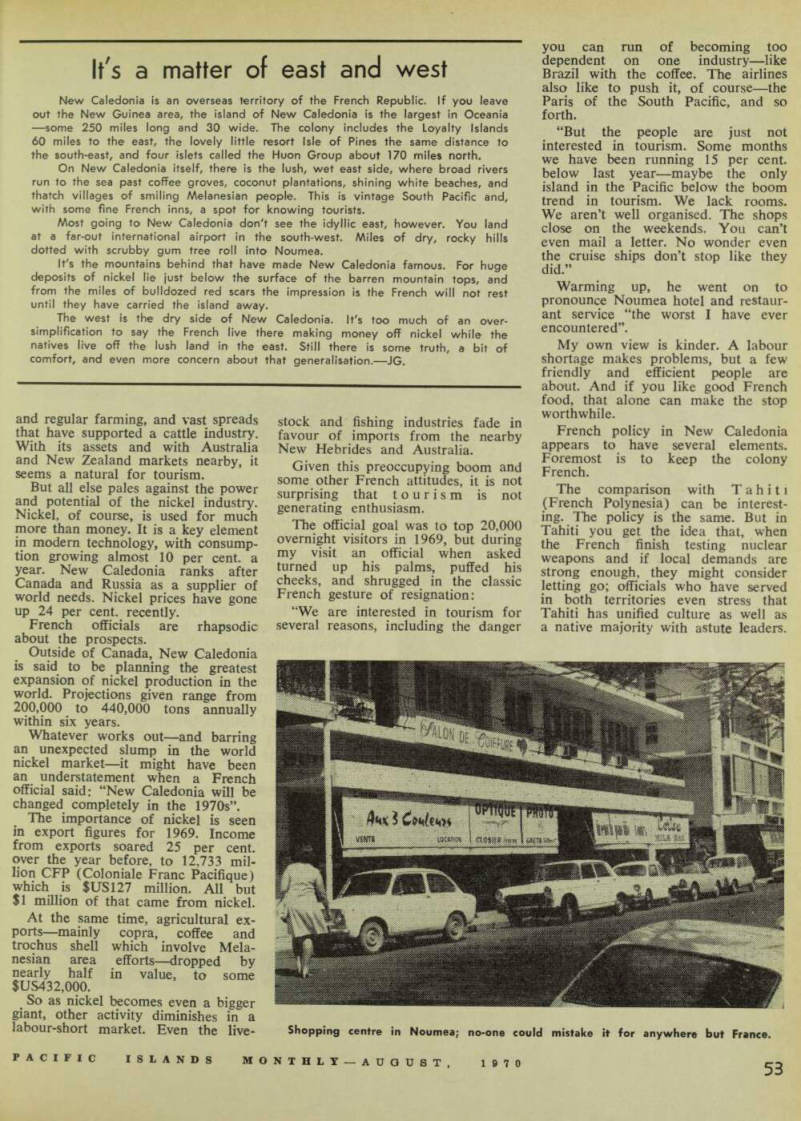
Shopping centre In Noumea; no-one could mistake it for anywhere but France.
In New Caledonia, the French deter mination to hold on is more rigid.
Promotion of the nickel industry naturally has high priority. Elements of the local economic system are geared to the industry. Several political figures made a point to mention that French President Pompidou is a former banker, and that banks have interests in Le Nickel.
Native Melanesian welfare is an element of French policy which has been getting more attention recently, although it’s conceded more in the way of education and other social benefits should be done for those in the rural villages. For those who want work in the cities, economic expansion has provided opportunities.
A young French economist said: “I don’t know if it will work out, but the attitude is that the economic ex pansion, especially of nickel, will head off any local political pres sures”.
Here, as in Tahiti, the French colonial system involves a Paris-ap pointed governor with strong ultimate power (especially including police and security matters) and a Ter ritorial Assembly with considerable legislative latitude.
“ Our Assembly has
more power”
“The Assembly here has more power than such local bodies in France,” said one official. That New Caledonia is a part of France is the position. Its people are French citizens, and with the French nationals in the New Hebrides, they elect a Senator and a Deputy to represent them in the French Parliament.
The Assembly has been controlled by an opposition party for a dozen years. This Union Caledonienne (UC), a mixture of trade union and native groups with a relatively liberal home-rule flavour, has 22 of the 35 Assembly seats. The Union Demo cratic, the local branch of Pompidou’s Gaullist party, has 11 members; its members are mostly French. Other Assembly members are liberal independents. The Assembly make up includes 21 whites and 14 Mela nesians.
Few in New Caledonia, and virtually none of those publicly in power, are talking about indepen dence. The president of the As sembly, UC leader Armand Ohlen, stresses that he opposes it.
“Everyone is wrapping himself in the tricolour (the French flag) now for different reasons,” says one local Frenchman. “The French from France who are here naturally don’t
want any change. The local Euro peans—who don’t talk about being French but rather New Caledonia French —are frightened about any kind of change that might bring the Melanesians to power. And the Mela nesians fear a local European take over because it might mean a Rhodesia situation.”
“Race trouble if
the French left”
Some local people, black and white, feel they could get on quite well without so much Paris inter ference. But it is the French position that there would be local racial trouble if they left. “And it would come soon,” stressed one official.
However, here as in Tahiti there are those who think the French are building their own kind of trouble by frustrating demands for more internal self-government. This is the basic demand of the opposition majority in the Assembly, and some French officials say quite candidly they know it will grow.
The focal point is not for a locally elected governor at this time but for more local participation in the administration, including in the increasingly important financial decisions. The prime vehicle would be the government council, sort of a cabinet where the governor presides over a group named from the as sembly. “We want a government council where the president (the governor) takes the decision of the members. Now the governor is on top and only asks for advice,” says UC leader Ohlen.
He seems a gentle man. But others are less so. Said one politician: “The French answer when too many people start talking too much about more internal self-government, has been to say no and bring in paratroops to parade through the street. For now it serves, but eventually there must either be political evolution—or there will be revolution”.
Urbanised, industrialised Noumea has other problems. Wages are high by Pacific island standards—s2oo-300 a month for labourers. But so are prices. Increasingly, New Caledonia lives on imported goods. Devaluation of the French franc last year helped send the price of such goods up 20 per cent.
And beyond that is the tax system.
New Caledonia has no income tax which has obvious advantages, especially for those with high in comes. But part of the price is high duty on imports. That means basically high prices on everything; something
that hits the less affluent the hardest.
Of all New Caledonia’s social problems, however, none is of more concern than the racial gap. This does not involve the usual discrimina tion; if the French have their hypo crisies in this regard, they do indeed seem better than most other colonial ists. Rather it involves an economic segregation. Said one astute French observer; “It’s one thing to say we may soon have the highest gross national product in the Pacific. But the range is from people making 6,000 francs a year to people making that much a day. This is a country of rich-poor extremes.
“What we most have to avoid is the division of the country among rural Melanesians and urban whites and the economic separation that goes with it.”
Said an educated Melanesian: “We are trying to find ourselves, what our culture means . . . what it can mean in a changing society. City workers can now go back to the villages if they have problems; it’s a safety valve. But in the long run we must learn to live with the situation and demand our rights both from the French government and from the French community here”.
If real integration calls for equality, New Caledonia has far to go. Such is the state of its economic boom that, as the French suggest, the economics of mixed affluence and inflation should preoccupy the colony in the early 1970’5.
But here, again as in Tahiti, it can be wondered if the cultural joys of being “part of France” are enough to compensate for a desire for more self-government in local affairs.
Some stress that Frenchmen in the motherland also face a highly cen tralised national government, but they are closer to Paris and redress against political restrictions. There is a difference and, no matter what the structure, some call it colonialism.
Beyond all else, New Caledonia faces the special problem of being a land where a significant number of white immigrants have come to stay and build a future. In this, New Caledonia may be halfway to be coming another Australia or New Zealand—or the United States, for that matter—where native peoples were pushed aside.
So there is the potential for racial trouble or the tragedy of racial defeat and decline. But that does not have to be in a world today where old lessons can be learned, where there can be affluence for all, and where no Pacific island is going to be an island remote and alone as in the past.