"It's a modern business now, but it
pp. 46-48 · Read in the full issue
still has its romantic moments"
From TESSA FOWLER, in Vila Flying in a light plane in the South Pacific is probably the next most romantic thing to being a bird. You fly high enough to see the complete outline of islands and the perfect circle of the horizon under the blue dome of sky, yet low enough to recognise trading ships, watch the white caps break ing and admire the beauty of awesomely rugged mountains covered in thick jungle, with the trees so tangled in vines that individual outlines are obscured.
The jungle is broken only where smoke rises leisurely from a tiny group of thatched huts, and its drift is intently observed by the piloi as an indication of wind direction.
Breathtakingly beautiful turquoise, pools in the blue-black sea indicate reefs clearly, framing tiny islands each set in its own circle of white sand.
It is a refreshing contrast to most people’s experience of flying today, shut in an apparently motionless box with a beautiful but remote hostess, tinkling ice drinks, preten tious meals and often a film to make sure that no one under any circum stances looks out of the windows, which are as small as possible.
When New Hebrides Airways recently celebrated the 10th anniver sary of its first flight (which was on May 31, 1960) the tendency seemed to be to deprecate the romance and emphasise the new similarity to major airlines.
“There is no longer any adventure in flying in the New Hebrides. It is now just a simple matter of getting business people quickly from one place to another,” says a British government official. And he is right.
It is indeed true that the element of danger once associated with pioneer aviation is gone.
In the 10 years of its history New Hebrides Airways has grown from a partnership between a local planter and a Canadian pilot owning one second-hand Drover, to a member of the pool called “Air Melanesiae”, or “Air Melanesia”, if you like. At the moment, Air Melanesia is New Hebrides Airways, as the pool partner, Hebridair, is defunct. Controlling in terest is held by Qantas and BOAC, and shareholders include Bob Paul, the founder, and Mrs. Paul Burton, the widow of the Canadian pilot.
They operate three Aztecs and one Navajo, but there are plans for re equipment. [lt is reported in Syd ney that the airline will use three Britten Norman Islander aircraft].
In this past decade the government has made considerable investment in airfields and meteorological services, with the public wholeheartedly in favour. For example, the Advisory Council of 1968 virtually forced the government to raise addiUonal taxes m order to be able to spend $40,000 more than the original sum provided for the improvement of island airstrips.
Bob Paul, managing director of New Hebrides Airways, recently received the OBE from the hands of the Queen during her recent tour of Australia. Bob is a conscientious member of the Advisory Council, but the OBE is a recognition of the gratitude that everyone in the islands feels when they contrast the beauty of a half-hour’s flight to the seasick n V sery^ of - a . robin S c 9P ra , b ? a j when the simplest journey often lasted for several days, since the boat had
to trade as well as travel. Too much travelling in these boats has given me, along with a host of other people in the South Pacific, so rigid an as sociation of ideas that I cannot smell copra without feeling seasick, However, that gratitude is frivolous com pared to the feeling of a person SU( jdenly taken ill, who has been brought to a hospital in one of the little planes of Air Melanesiae. The Administration, feeling that Air Melanesiae provides a complete service for the evacuation of the sick and the injured, recently refused an offer by the Australian Flying Doctor Service to operate in the New Hebrides. This was a great tribute to an airline which is primarily com mercial.
Almost every Sunday, when there are no commercial flights, the pilots fi n( j th e y have to stand by in case there might be a difficult birth in Aoba, or perhaps a boy in Pentecost may need an X-ray to gauge internal injuries sustained in a fall from a tree. Several trips have been made under charter to the Condominium
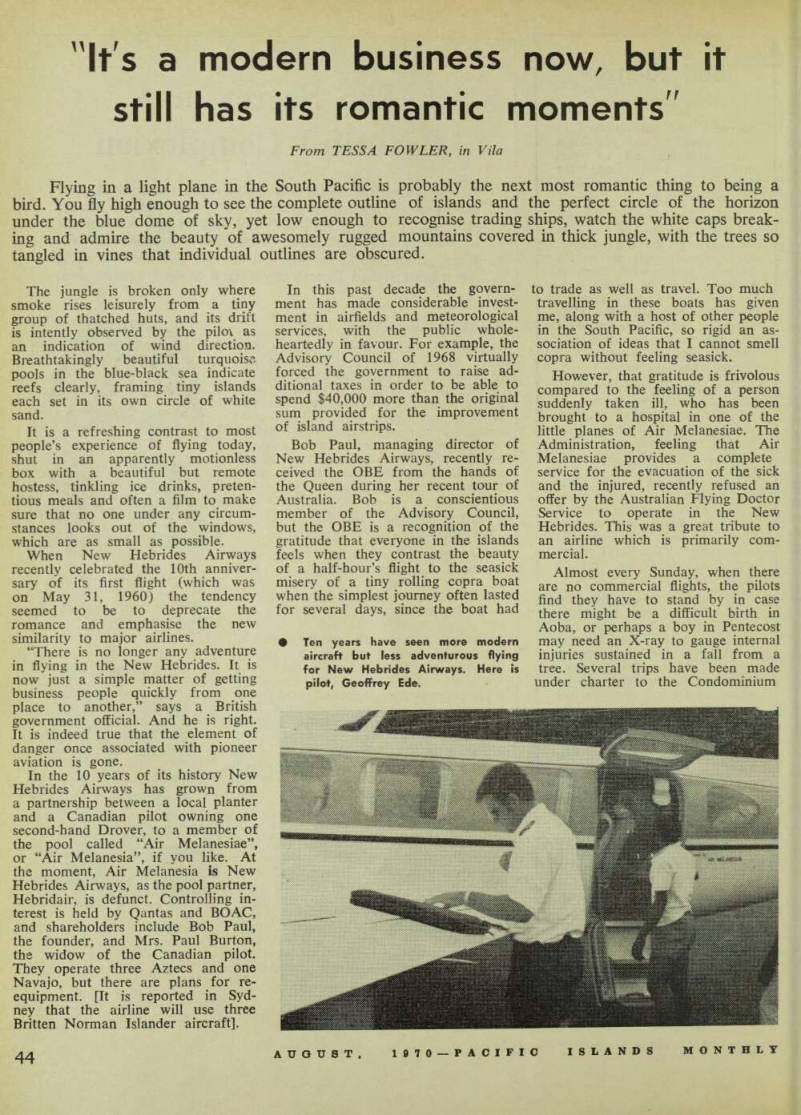
Ten years have seen more modern aircraft but less adventurous flying for New Hebrides Airways. Here is pilot, Geoffrey Ede.
Medical help by air
Administration to Noumea, to carry patients to the more extensive medical facilities available there.
Medical problems in the New Hebrides have been—and to some extent still are—a question of trans port. The population of 700 in Erro manga, for instance, would not keep a doctor occupied full time, but the island is infrequently visited by ship ping and the distance means about 12 hours by boat to the nearest hospital—a distance that could mean the difference between life and death. A forest expert died of acute appendicitis while he was being carried down from the bush in Erromanga a few years ago.
Air Melanesiae’s history is not an unqualified success story from a financial point of view. There has been more promise than performance.
Though the airline is subsidised by the Condominium Administration, shareholders are far from finding it a gold mine. The directors feel that the subsidy would not be necessary if Air Melanesiae, like domestic air lines in most countries, could be granted the monopoly of internal traffic. At present Air Melanesiae must compete with Fiji Airways and UTA on the most lucrative route, between Vila and Santo. Travelling between the two towns of the New Hebrides, even local people seem to forget what is due in the way of loyalty to the local airline. The little airport building in Santo is quite crowded with local people on their way to Vila, but when Fiji Airways and UTA have both taken
off, I am the only passenger left for Air Melanesiae.
The Condominium Administration contends that Air Melanesiae does not have sufficient planes to carry all the passengers between Vila and Santo. The airline in return, points out that it cannot buy more planes until it has the promise of the monopoly. The problem will no doubt be resolved when UTA flies a Cara velle into Vila and no longer calls at Santo.
Perhaps local people are merely in a hurry—and certainly Air Mela nesiae does not fly fast. But tourists, if they choose to fly the international airlines, make a bad bargain. They miss the opportunity of savouring the romance of flying in a light air craft, of seeing the islands and meeting some of the island charac ters. Isolation often has the effect of accentuating eccentricities and making people over-emphasise their per sonalities. Most people who have lived in the New Hebrides for any length of time feel it their duty to be eccentric, colourful and an island personality straight out of the pages of Conrad, Maugham, James Michener or Tom Harrisson.
The airline’s four young pilots, however, are certainly not island characters. On the contrary, they are the epitome of restraint. Two of them are the butt of many jokes because they are both very blond, very tall, very thin and very new to the islands. Old-timers who are not used to meeting strangers, can not tell them apart. The pilots are unruffled, dignified, silent and absolutely untypical of the New Hebrides.
It is Air Melanesiae’s agents who are the colourful characters. Picture a neat flat rectangle of lawn, the only break in miles of luxuriant green jungle. It is the airfield. There are usually no buildings, no sign of any human habitation. For the pas sengers, sometimes as little as 20 minutes away from the comparative civilisation of Vila and Santo, Air Melanesiae’s agent is the only com fort as they cross the bridge between
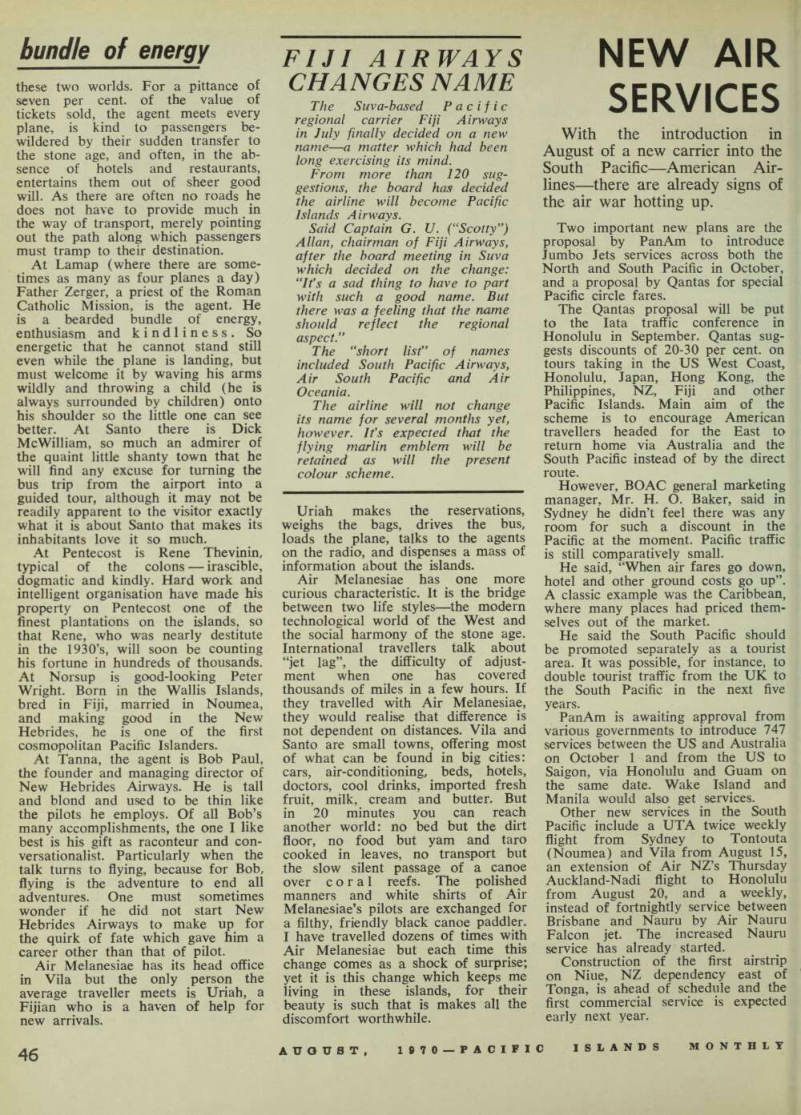
Uriah, the haven of help.
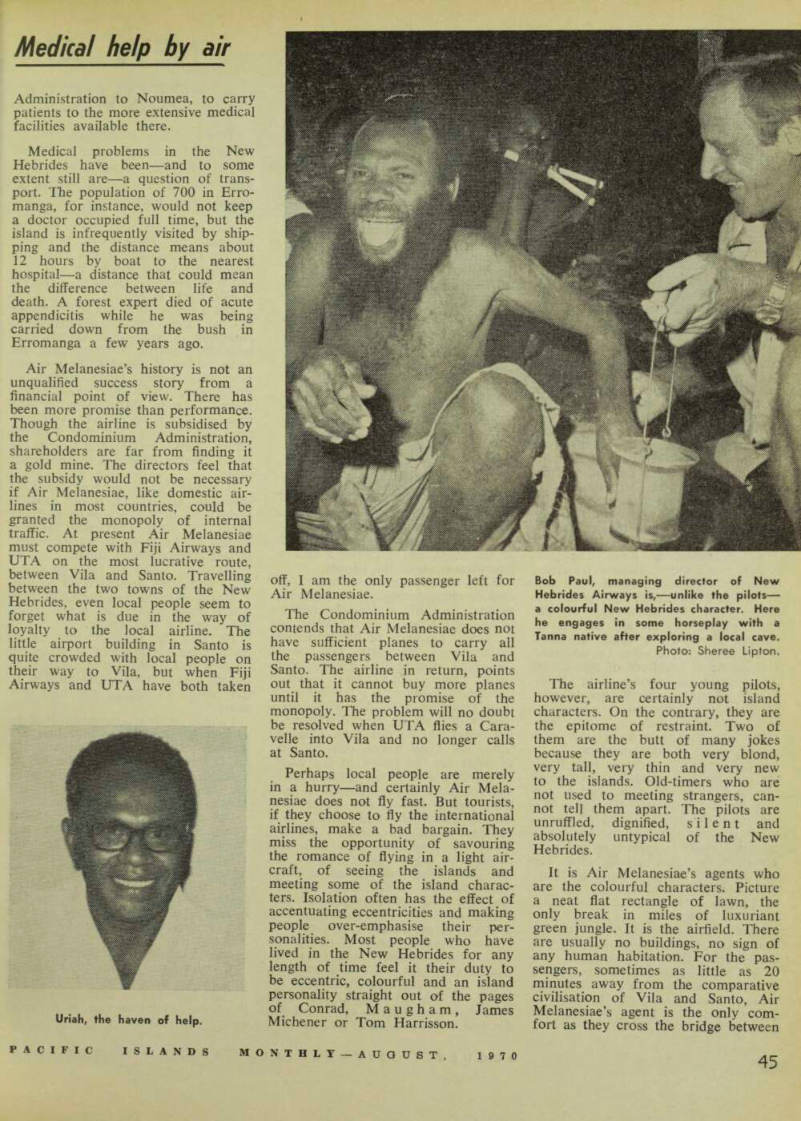
Bob Paul, managing director of New Hebrides Airways is, —unlike the pilots— a colourful New Hebrides character. Here he engages in some horseplay with a Tanna native after exploring a local cave.
Photo: Sheree Lipton.
bundle of energy
these two worlds. For a pittance of seven per cent, of the value of tickets sold, the agent meets every plane, is kind to passengers be wildered by their sudden transfer to the stone age, and often, in the ab sence of hotels and restaurants, entertains them out of sheer good will. As there are often no roads he does not have to provide much in the way of transport, merely pointing out the path along which passengers must tramp to their destination.
At Lamap (where there are some times as many as four planes a day) Father Zerger, a priest of the Roman Catholic Mission, is the agent. He is a bearded bundle of energy, enthusiasm and kindliness. So energetic that he cannot stand still even while the plane is landing, but must welcome it by waving his arms wildly and throwing a child (he is always surrounded by children) onto his shoulder so the little one can see better. At Santo there is Dick McWilliam, so much an admirer of the quaint little shanty town that he will find any excuse for turning the bus trip from the airport into a guided tour, although it may not be readily apparent to the visitor exactly what it is about Santo that makes its inhabitants love it so much.
At Pentecost is Rene Thevinin, typical of the colons irascible, dogmatic and kindly. Hard work and intelligent organisation have made his property on Pentecost one of the finest plantations on the islands, so that Rene, who was nearly destitute in the 1930’5, will soon be counting his fortune in hundreds of thousands.
At Norsup is good-looking Peter Wright. Born in the Wallis Islands, bred in Fiji, married in Noumea, and making good in the New Hebrides, he is one of the first cosmopolitan Pacific Islanders.
At Tanna, the agent is Bob Paul, the founder and managing director of New Hebrides Airways. He is tall and blond and used to be thin like the pilots he employs. Of all Bob’s many accomplishments, the one I like best is his gift as raconteur and con versationalist. Particularly when the talk turns to flying, because for Bob, flying is the adventure to end all adventures. One must sometimes wonder if he did not start New Hebrides Airways to make up for the quirk of fate which gave him a career other than that of pilot.
Air Melanesiae has its head office in Vila but the only person the average traveller meets is Uriah, a Fijian who is a haven of help for new arrivals.
Uriah makes the reservations, weighs the bags, drives the bus, loads the plane, talks to the agents on the radio, and dispenses a mass of information about the islands.
Air Melanesiae has one more curious characteristic. It is the bridge between two life styles—the modern technological world of the West and the social harmony of the stone age.
International travellers talk about “jet lag”, the difficulty of adjust ment when one has covered thousands of miles in a few hours. If they travelled with Air Melanesiae, they would realise that difference is not dependent on distances. Vila and Santo are small towns, offering most of what can be found in big cities: cars, air-conditioning, beds, hotels, doctors, cool drinks, imported fresh fruit, milk, cream and butter. But in 20 minutes you can reach another world: no bed but the dirt floor, no food but yam and taro cooked in leaves, no transport but the slow silent passage of a canoe over coral reefs. The polished manners and white shirts of Air Melanesiae’s pilots are exchanged for a filthy, friendly black canoe paddler.
I have travelled dozens of times with Air Melanesiae but each time this change comes as a shock of surprise; yet it is this change which keeps me living in these islands, for their beauty is such that is makes all the discomfort worthwhile.