Inside New
pp. 30-31 · Read in the full issue
Guinea
With John Ryan
Prime Minister J. G. Gorton came to New Guinea determined not to be provoked into anything rash.
It was a diplomatic mission. In his own short-sleeved, faintly nasal dinkum Aussie manner, J. G.
Gorton reassured New Guinea’s 38,000 Europeans and the million native Highlanders.
Diplomatically, he offered local politicians more power, promised continuing and big Australian dollar-aid, and (trying to not cut across the Parliamentary Select Committee on Constitutional De velopment) laid down the law about self-government.
“No timetable . . . not 1972 ... not until the majority is ready” he told New Guinea in radio broadcasts, and at public meetings.
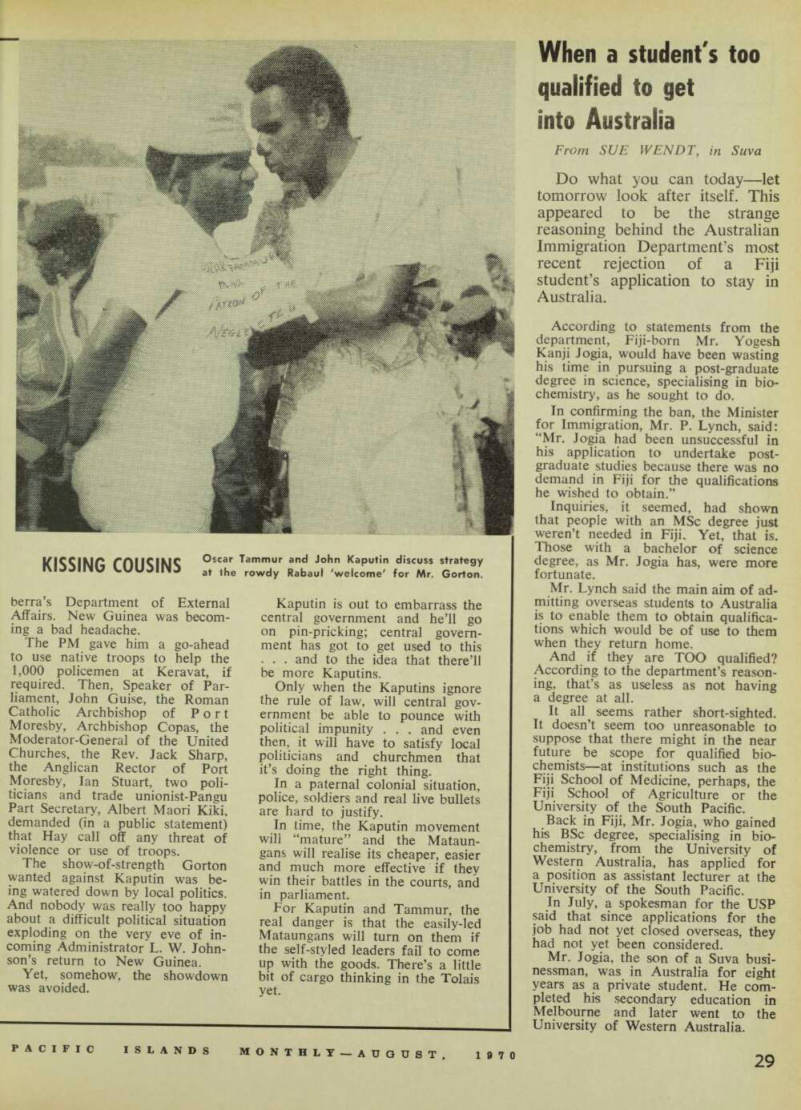
Holding his temper at Rabaul, he let Mataungan rebel leaders, John Kaputin and Oscar Tammur, MHA, have their political heads in a rowdy, anti-Australian airport welcome that shocked some Aus tralians.
Gorton was paternal while in New Guinea.
Only when the Mataungans pounced on government land soon after his departure did the Prime Minister start saying what he’d wanted to say while on tour.
As the Mataungan-Keravat land crisis escalated from day to day towards month’s end, PM Gorton: “New Guinea could become another Biafra . . . there cannot be self-government at least until 1974 . . . I’m authorising native troops to be used against Mata ungan, if the Administrator needs them.”
Gorton made one important discovery on tour: New Guinea and its tribes are much, much closer to South-East Asia than to Australia, the old continent we Australians stole from the
Aborigines. To make a reason able success of decolonising New Guinea, the tribes would have to be given a strong lead by Aus tralia . . . might (possibly) is right.
And first on the list for the lesson in strength would be Rabaul’s Mataungan boss, John Kaputin.
Farewelling New Guinea, Gorton broadcast the warning that Australia would not allow anybody in New Guinea to ignore the rule of law . . . Mataungan Tolai tribespeople squatting on some of the 16,000 acres of gov ernment land near Keravat would get off, or they’d be thrown off.
With the Gorton green light on, retiring Administrator D. O.
Hay passed the message down the line to Acting Police Com missioner, B. J. Holloway, and Rabaul District Commissioner Harry West. One thousand police men were flown in.
Mataungan and Kaputin were to be taught a lesson.
Mataungan is the most sophis ticated of New Guinea’s numer ous (over the years) local “inde pendence” movements, but it’s cer tainly not the first.
Tommy Kabu tried it in Papua’s Gulf District long before World War 11, Paliau Moloat, MHA, tried it on Manus with ideas noted during the war, the Navuneram Tolais tried it (for slightly dif ferent reasons) in 1958 in a bitter confrontation with police, Hahalis Welfare Society boss, John Teosin, tried it from 1961 on Buka Island, and his movement still teeters along; Bosmailik and his brother tried it on New Hanover (near Kavieng) in 1964; and now John Kaputin, Oscar Tammur, MHA, and the Mataungan “independ ence” movement.
Many New Guinea people, in cluding “foreigners” from Aus tralia, have been wishing Kaputin
and Tammur the best of luck.
Some government men have even publicly applauded Kaputin’s original initiative in trying to get the Tolais to do something economically, socially and politic ally for themselves, instead of having local government and gen eral development theories con tinually rammed down their throats by Kiaps.
But much of the pro-Mata ungan feeling has been frittered away by the bashings-up last De cember, the Kaputin-Tammur in tractibility in negotiation, and their (foolish) insistence on trying to shame the central government, rather than putting central gov ernment in its place and then pro ceeding to use as many central government services (agricultural and fiscal help) as possible, to get Mataungan strongly off the ground.
But Kaputin has said the only way for the 70,000 Tolais (includ ing the unknown number of Mataungan hard-core supporters) to stand on their own feet, is to rid themselves of foreign control in a revolutionary situation.
An old Indian gentleman achieved the same revolutionary aims against Britain in 1947, and won independence for his nation with polite, passive resistance.
Only the bully-boys on the fringe of India’s movement engaged in violence.
With the Keravat land situation worsening daily and the evictions about to begin, a Papuan politician telegramed Kaputin: “If you have any regard for the international reputation of New Guinea and any regard for your own Tolai people, I strongly recommend passive re sistance —not violence.”
Watching nervously overall, re tiring Administrator Hay must have been yearning for the quiet, well-ordered hallways of Can-
berra’s Department of External Affairs. New Guinea was becoming a bad headache.
The PM gave him a go-ahead to use native troops to help the 1,000 policemen at Keravat, if required. Then, Speaker of Parliament, John Guise, the Roman Catholic Archbishop of Port Moresby, Archbishop Copas, the Moderator-General of the United Churches, the Rev. Jack Sharp, the Anglican Rector of Port Moresby, lan Stuart, two politicians and trade unionist-Pangu Part Secretary, Albert Maori Kiki, demanded (in a public statement) that Hay call off any threat of violence or use of troops.
The show-of-strength Gorton wanted against Kaputin was bemg watered down by local politics.
And nobody was really too happy about a difficult political situation exploding on the very eve of incoming Administrator L. W. Johnson’s return to New Guinea.
Yet, somehow, the showdown was avoided.
Kaputin is out to embarrass the central government and he’ll go on pin-pricking; central govern ment has got to get used to this ... and to the idea that there’ll be more Kaputins.
Only when the Kaputins ignore the rule of law, will central gov ernment be able to pounce with political impunity . . . and even then, it will have to satisfy local politicians and churchmen that it’s doing the right thing.
In a paternal colonial situation, police, soldiers and real live bullets are hard to justify, In time, the Kaputin movement will “mature” and the Mataun gans will realise its cheaper, easier and much more effective if they win their battles in the courts, and in parliament.
For Kaputin and Tammur, the real danger is that the easily-led Mataungans will turn on them if the self-styled leaders fail to comp up with the goods. There’s a little bit of cargo thinking in the Tolais yet.
Kissing Cousins
Oscar Tammur and John Kaputin discuss strategy at the rowdy Rabaul 'welcome' for Mr. Gorton.