Welcome Mr. Gorton, sir. . .Go home, Gorton!
pp. 25-26 · Read in the full issue
From JOHN RYAN, in Port Moresby Australia’s Labour Opposition leader, Gough Whitlam, was in New Guinea December-January for 14 days, and promised self government in 1972 and independence in 1976 if he became Aus tralia’s Prime Minister.
Early last month, Prime Minister, John Grey Gorton, toured for six days and promised: • More territory control, with Canberra to begin taking a back seat (perhaps because the new Admin istrator, L. W. Johnson, is a very strong-willed man, and would brook no interference from Canberra by retiring Administrator D. O. Hay). • More local power for the six elected native members of parliament with ministerial rank in the Admin istrator’s Executive Council. • Significantly greater local con trol over budget-making especially recurrent expenditure and minor works money. • A spokesman in parliament for the Administrator’s Executive Council. • Conscious attempts by the Aus tralian Federal Executive Council and the Governor-General, to
exercise even less the Canberra veto over legislation from the territory. • For Ministerial Members of Parliament, much greater depart mental and portfolio responsibility for education, public health, tourism, co-operatives, business advisory services, workers’ compensation, industrial training, posts and tele graphs, territory revenue including taxation, price control, coastal ship ping, civil defence, corrective institu tions, registration of customary land, land-use, leasing of land, town planning and urban development.
To try to counter Whitlam’s barn storming tour in January, Gorton in July had to make as many genuine promises as possible—without cutting across the planning of the territory’s Parliamentary Select Comimttee on Constitutional and Political Develop ment. In fact, Gorton was told politely before coming to New
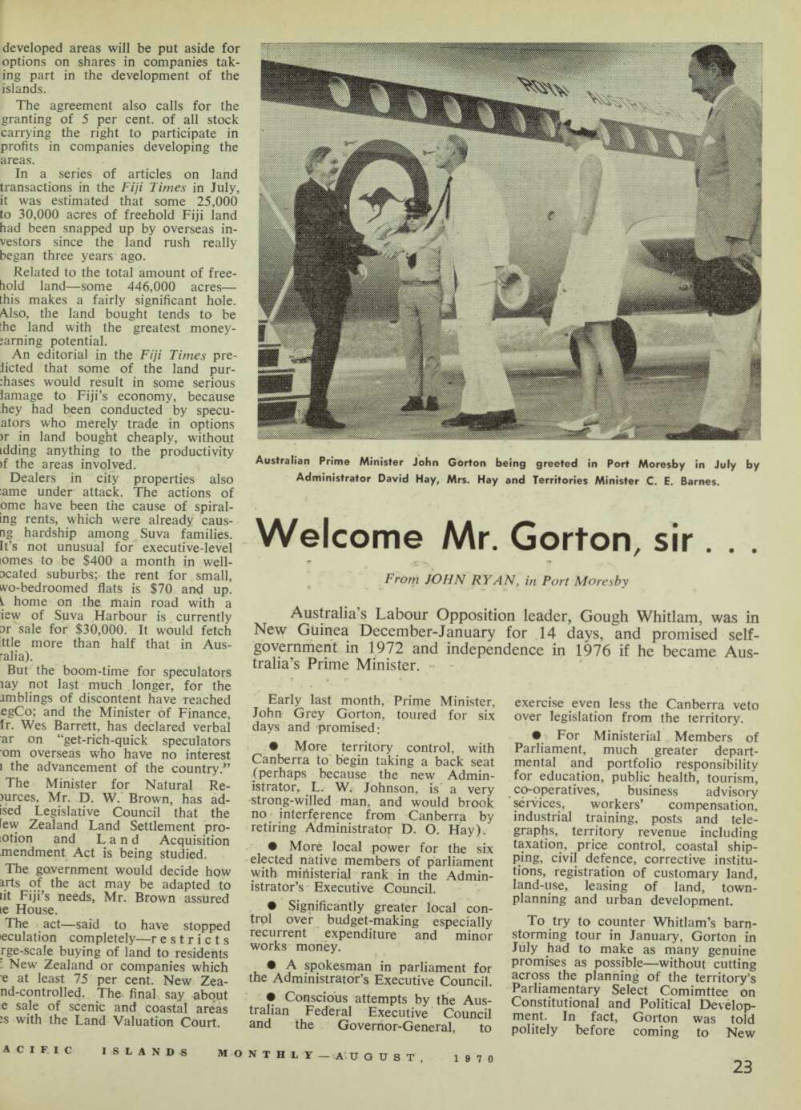
Australian Prime Minister John Gorton being greeted in Port Moresby in July by Administrator David Hay, Mrs. Hay and Territories Minister C. E. Barnes.
Guinea, that he’d better keep off the constitutional grass.
PM Gorton warned the territory that Australia —forking out something like SAI3O million for New Guinea in 1970-71—will go on holding a fairly tight rein . . . “The authority which we wish and must at this stage retain final authority, are the judiciary, the enforcement of law and order, internal security, external affairs, external trade, and of large scale development projects in agri culture, forestry, transportation . . . in those things that make up the five year development plan of which we are now some half-way through, and which will for the most part, be financed by the Australian taxpayer rather than ... the territory.”
In his Port Moresby policy speech before a four-day flying tour of the Highlands and the Rabaul and Bougainville troublespots, PM Gorton described the announced developments as “very significant steps forward along the road towards transferring power to the representative members of the territory ...”
On the question of those all-im portant Australian dollars for New
Guinea: “For the present and fore seeable future, we intend to provide that assistance at least, which we provide now [$A 122,600,000 in 1969-70]”.
The pace of change?—“. . . I know, in some areas these advances will be thought of as going too fast and which I know, in other areas of the territory, will be thought of as not going far enough . . . but, looked at from both ends, are necessary steps towards a future which must, at some time, hold full internal self government and full independence.”
Gorton refused to set a target-date: “I believe it against all logic and all sense to put a timetable on this.
We don’t want to remain in the ter ritory one week, against the wishes of the majority of its people.
“We don’t think we ought to get out of the territory against the wish of the majority of its people. Wc don’t want to rule any people, with out their consent.
“We don’t think it proper to move out, and possibly help a vocal minority rule of majority without that majority’s consent.”
Predictably, Port Moresby’s urban
and native academic elite press* hard for timetables and early se: government, but the Prime Minis! carefully avoided anything vague like a promise or a hint.
In the Highlands, he was pn dictably greeted with appeals ft Australia to ignore the coastal ta about self-government.
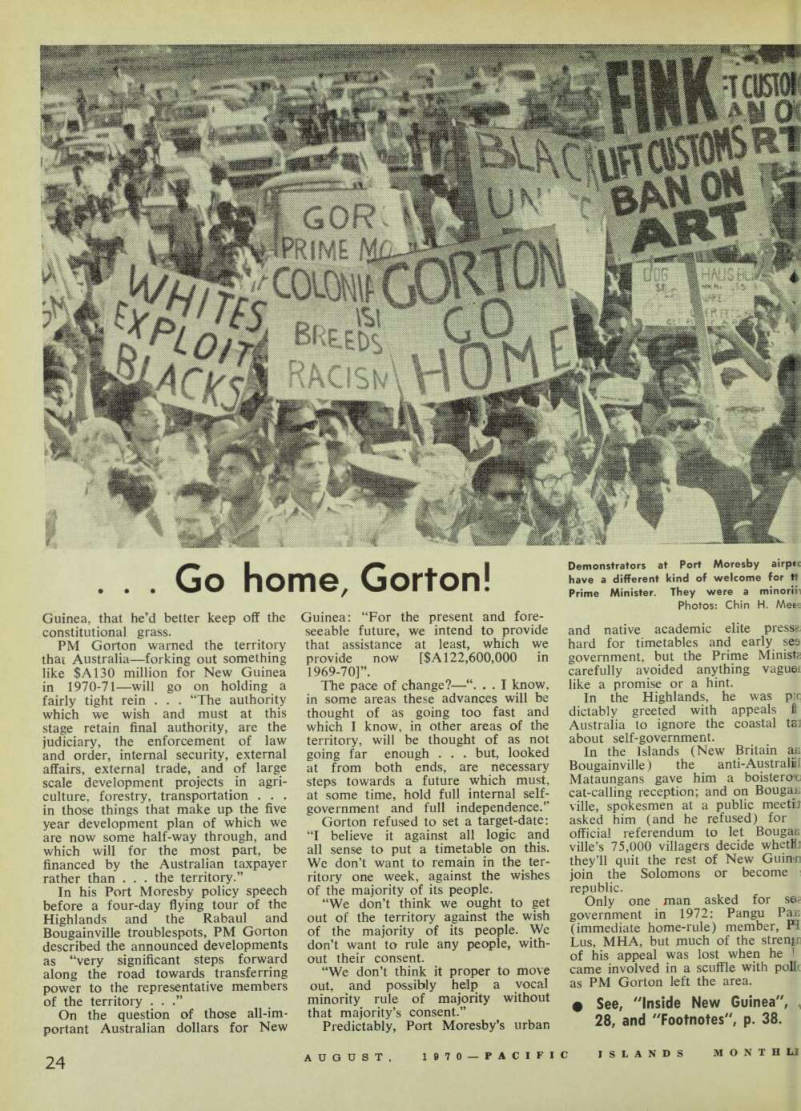
In the Islands (New Britain at Bougainville) the anti-Australia Mataungans gave him a boistero>< cat-calling reception; and on Bougai ville, spokesmen at a public meeti asked him (and he refused) for official referendum to let Bouga£ ville’s 75,000 villagers decide whetH they’ll quit the rest of New Gumi join the Solomons or become republic.
Only one man asked for s© government in 1972: Pangu Pai (immediate home-rule) member, K Lus, MHA, but much of the strenjj of his appeal was lost when he 1 came involved in a scuffle with poll as PM Gorton left the area.
• See, "Inside New Guinea", 28, and "Footnotes", p. 38.
Demonstrators at Port Moresby air[?] have a different kind of welcome for tt[?] Prime Minister. They were a minorii[?] Photos: Chin H. Me[?]