'Toddy please, barmaid!'
p. 22 · Read in the full issue
From VIJENDRA KUMAR, in Fiji Fiji drinkers are being introduced to a new mildly alcoholic beverage—palm toddy.
The liquid is the bitter-sweet sap extracted from a wild variety of date palms growing in large numbers at Nadi, just a couple of miles away from the airport.
A 61-year old jack-of-all-trades, Mr. Dayal Bhola, is tapping them for a small Suva-based company which sees a bright market for the drink, both in Fiji and in other Pacific territories. Mr. Bhola came to Fiji as an indentured labourer while still in his teens. At various times in his life, he worked as a restaurant keeper, taxi driver, odd-job man, market-vendor, until somebody found out he possessed the art of tapping palms for toddy.
A frail-looking, lean and white-headed man, but with plenty of vigour still in him, he scales a 20-ft tall palm tree with the ease and grace of a chimpanzee, even though they are covered in needle-like spikes.
“My father and the rest of my folk back in India were experts at toddy-tapping. I learnt the art from them but never had occasion to use it in Fiji until now,” he told me when I met him last month.
He showed me the simple trick of extracting the sap.
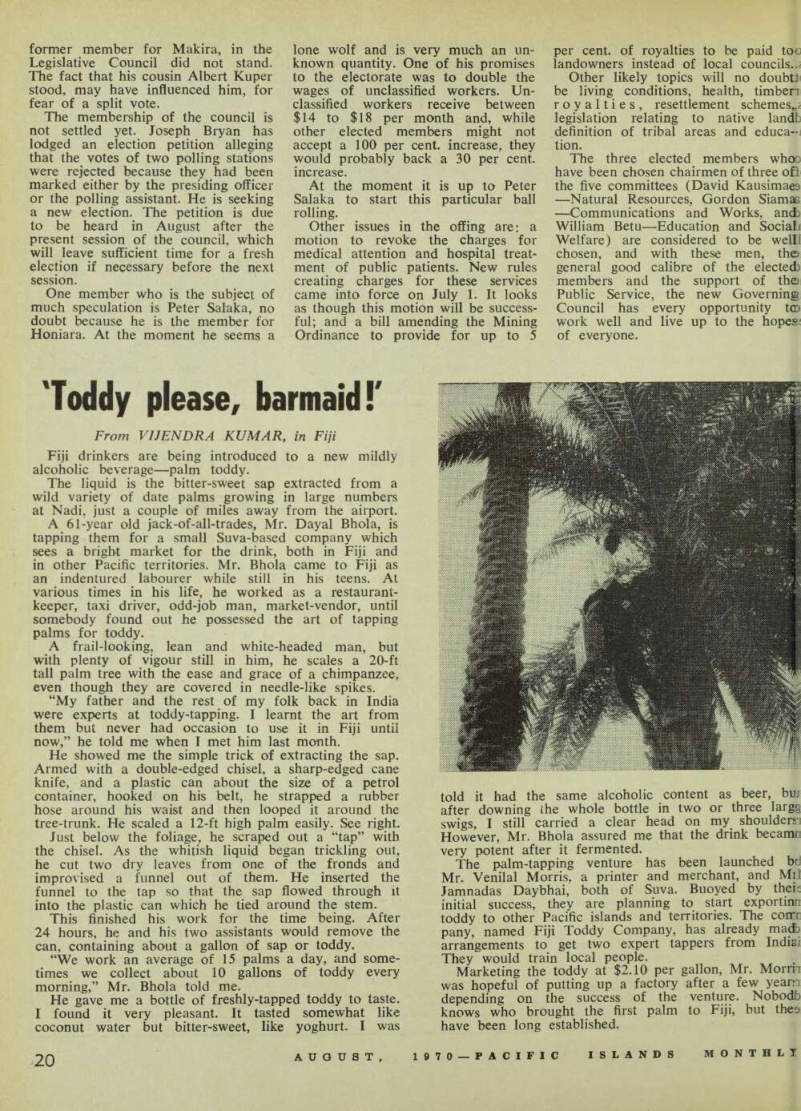
Armed with a double-edged chisel, a sharp-edged cane knife, and a plastic can about the size of a petrol container, hooked on his belt, he strapped a rubber hose around his waist and then looped it around the tree-trunk. He scaled a 12-ft high palm easily. See right.
Just below the foliage, he scraped out a “tap” with the chisel. As the whitish liquid began trickling out, he cut two dry leaves from one of the fronds and improvised a funnel out of them. He inserted the funnel to the tap so that the sap flowed through it into the plastic can which he tied around the stem.
This finished his work for the time being. After 24 hours, he and his two assistants would remove the can, containing about a gallon of sap or toddy.
“We work an average of 15 palms a day, and some times we collect about 10 gallons of toddy every morning,” Mr. Bhola told me.
He gave me a bottle of freshly-tapped toddy to taste.
I found it very pleasant. It tasted somewhat like coconut water but bitter-sweet, like yoghurt. I was
told it had the same alcoholic content as beer, bin after downing the whole bottle in two or three largs swigs, I still carried a clear head on my shoulders* However, Mr. Bhola assured me that the drink became very potent after it fermented.
The palm-tapping venture has been launched be Mr. Venilal Morris, a printer and merchant, and Mi] Jamnadas Daybhai, both of Suva. Buoyed by then initial success, they are planning to start exportinn toddy to other Pacific islands and territories. The comr pany, named Fiji Toddy Company, has already mads arrangements to get two expert tappers from Indisj They would train local people.
Marketing the toddy at $2.10 per gallon, Mr. Morrn was hopeful of putting up a factory after a few yearn depending on the success of the venture. Nobodb knows who brought the first palm to Fiji, but thee have been long established.