Education must be "freed"
pp. 137-139 · Read in the full issue

to work for Tongans
By 'I PUT A HELU, a Tongan schoolteacher
Three views—all in error—continue to prevent educational progress in Tonga.
The first is the view that education should be a hand-maid of society.
Granting that the school is a social mstitution and education a social activity, it does not follow that education should be made subservient to social needs.
Courses for Tongan schools show clearly how far teachers and educational leaders of the country subscribe to this view. In fact many attempts have been made to force schools to give too much emphasis to the subject of agricultural science at the expense of other sciences. The general idea is that Tonga needs more agriculturalists than anything else. 1 his instrumentalist kind of view is Wlf y J° ngan ’ lt t i - n f? at °£ C findS ll i ln u S most virulent form. For example, the newly-formed University of the South of WhT r 8 tC> mC v th t P C u ds ot South Seas communities, had her courses designed in such a manner as to aid the Islanders in their fishing and agriculture, which will result in a predominance of fishermen and farmers in the future composition of the populations of South Seas
countries—as is the case at present to a lesser degree.
Whereas this might appear bene ficial to society, it certainly is not so to education, taking education to be autonomous, as something with a distinct character of its own, related to, but independent from, other social activities.
It would be extremely difficult to regard education as a continuing tradition, and much more to formu late its definition when it is sub jected to the whims of age and society.
This notion was demonstrated bv the attitude of people to the educa tional system of Dr. Moulton* It came under fire bec ause Moulton was careful to design his courses so that there would be nothing “practical” about them, so far as thl then tongan environment was con cerned.
This may have been takW the* Y 6 bCen takmg the
-Dr. J. E. Moulton, early missionary t 0 Ton ga. established the Tupou college, Nukualofa, in 1866, and was later president fn S. ne Collegc in Sydney ' He dled
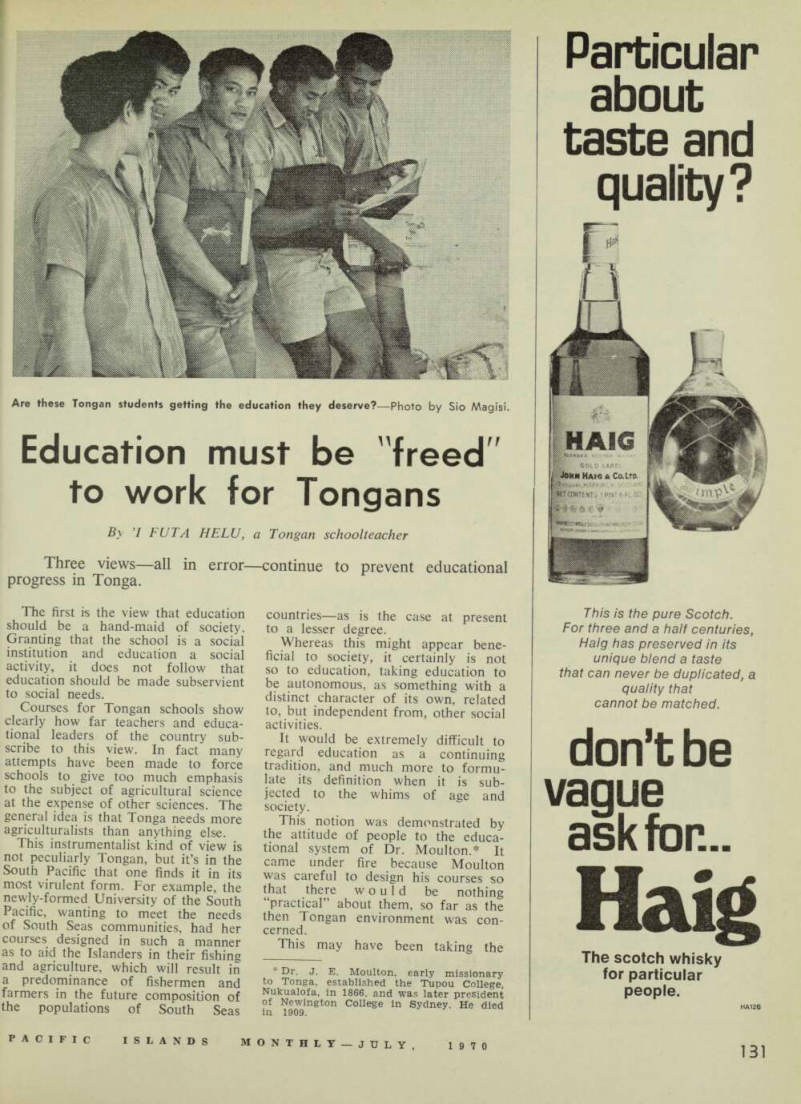
Are these Tongan students getting the education they deserve?— Photo by Sio Magisi.
matter to extremes, but the spirit was right for it implied the fact that the end of educational inquiry is knowledge and not the improvement of living conditions.
Another wise thing which Moulton did was the adoption of syllabuses of overseas countries for use in his Tongan College. This is a grand lesson for our syllabus committees which have nothing to guide them but “the will of the people”.
After Moulton, the subsequent systems were designed to provide students with something they could “use”, and these systems have been very efficient in producing two types of people—clerks and preachers.
A second view—a variant of the first—is the notion that education should be pursued only to enable one to make a living, to get a job.
The effect of this view is just as harmful to education, for, like the first, it makes the scope of education pitifully limited, and leads to the same undesirable results. This arises, as already indicated, from our view ing of education too much through the optics of social welfare and society—through the optics of greed.
Mould character
Thirdly, there is this view that education should mould a man’s character. Tongans believe this so ardently that they take “good” character as more important than knowledge and even wisdom.
This is a debatable point, but what is amazing is that the teachers at our schools have not, for the most part, studied ethics. I do not mean to say that a person must know ethics before he can do good acts, but our teachers are superbly lacking in any ability for moral judgment apart from passing on accepted norms, which shows once again the effect of social domination over education.
This view is maintained and re inforced by churches whose present interests lie in material and not spiritual gain and this piece of coercive psychology is very useful to them.
These views have ravaged educa tion for so long, it’s time education was rescued and given back what really belongs to her—autonomy and freedom from a dominating society.