Business and Development
pp. 116-124 · Read in the full issue
Outside Investment Invited For
Tonga's New Five-Year Plan
By John R. Baker
Tonga’s new five-year development plan, released on July 1, stresses that the independent! kingdom’s economic growth in the immediate future must come from agriculture. But only in the short! term. Long term, Tonga can’t base its development solely on agricultural expansion, and the must be diversified.
The plan hopes Tonga can achieve a favourable investment climate and encourage local and foreign interest to develop light industry. And the plan also lays stress on the value of tourism, and it plans for an in crease.
The new development plan, Tonga’s second, covers 1970/75 and takes effect from July 1.
The kingdom’s first five-year plan, which ended on June 30, achieved most of its main objectives. Urgent social needs were largely met and a promising start was made on the rehabilitation of the coconut industry, and on the modernisation of agri culture.
Tonga will soon benefit from the opening of a modern hospital in Nukualofa. A new police training school is already training up to 20 recruits a year. The Queen Salote wharf, built during the plan, has swiftly made a big contribution to the Tongan economy by facilitating shipment of major export crops, and by encouraging cruise ships to call.
The new plan will mean ex penditure of about 5T4.9 million, and like the the last one it depends heavily on external assistance, par ticularly from the British Govern ment. But it’s expected—in fact it’s one of the plan’s main objectives— that at the end of the next five years Tonga will be less dependent on foreign aid.
Here are the main points of the plan:
Emphasis on agriculture
It is proposed to continue the rehabilitation of the coconut in dustry, to develop further the banana industry and to expand agricultural services with trained staff, so as to
raise production and to permit diversification with new crops. These steps, the plan argues, should make it possible to absorb a rising popula tion, at a rising standard of living.
But agricultural development is seen to depend on the full and effective utilisation of the kingdom’s land resources, and the government is at present awaiting a report by Mr.
J. B. Hardaker, an agricultural economist from the Ministry of Over seas Development, on this subject.
Such a policy is dependent upon the strengthening of the Department of Agriculture. This is to be achieved by rehousing the department at a cost of 5T52,000, and by setting up a staff training centre costing STBO,OOO.
Crop development schemes (5T36,000) and a livestock develop ment scheme ($T104,000), coupled with research and investigations, general agricultural expenditure and a farmer training centre, are other significant fields of departmental expenditure.
More forestry
The coconut replanting scheme, which began in 1966 and which by mid-1970 has replanted 12,000 acres of coconut palms, should replant a further 20,000 acres during the next five years, resulting in increasing copra exports towards the end of the seventies.
Limited expenditure will also be undertaken in the field of forestry development, principally on the island of ’Eua. The government’s deep-sea fishing vessel; Pakeina, is to be re placed by a more suitable fishing vessel, and other additions to Tonga’s fishing fleet are to be made.
In total, over STI.I million are
to be spent on agricultural develop-i ment, the coconut replanting schemes and fisheries development in the new/ plan. This represents some 23.6 pen cent, of all plan expenditure, andb compares favourably with the actual] expenditure of STO.6 million incurred) in these fields in the 1965-70 plan.
Light industry and a bank
In stressing the need to encourage light industry development with local) and foreign participation, the plam announces that the government hopes: to establish a commercial bank im Tonga. It says discussions are at) present going on with three foreigm banks on this subject. The establish-f ment of an Industrial Loan Fund isi also being considered, with the in-i tention of encouraging local entrepreneurs to engage in light in-i dustrial activity, by providing thenn with equity and loan finance.
The electric power generating plant on Tongatapu is to be replaced and extended at a cost of $T350,000,( This will involve the construction oh a new diesel power station at Popuai several miles from the centre ol Nukualofa, and for the replacement! of many of the present distribution lines.
Nukualofa’s water supplies are to be improved by the investment ok 5T31,000 in the construction of new pumping stations, reservoirs and pipe* lines.
Improved transport
The archipelagic nature of Tongs; means that in addition to the usuas road network, it is also necessary foie the group to be unified by good se*: and air services.
The 1970-75 plan continues thor
roads development programme which was a major feature of the last plan, but more emphasis will be placed upon crop evacuation roads and on roads to tourist sights than has been done previously.
Airfields are to be constructed at Vava’u, Ha’apai and ’Eua, so that internal air services can be operated.
The airfield at Vava’u is to replace the one which was built in 1967 and which proved unserviceable on account of its poor site. Fua’amotu airfield, Tongatapu, is to be extended and surfaced, to accommodate the medium jet aircraft which Fiji Air ways are expected to operate to Tonga from mid-1972 onwards. Night flying facilities will be installed, and other improvements.
Internal shipping services are to be improved through the acquisition by the government of a fast inter island vessel to serve the main shipping route between the capital of Nukualofa and the islands of Ha’apai and Vava’u.
Shipping shake-up
The government also states that t is giving consideration to operating ill government and commodity board vessels as a National Shipping Line, fongan vessels, such as the Niuvakai ire to continue to serve overseas K>rts, provided that the services are ither profitable or necessary for the fongan economy.
Vuna Wharf, the deepwater wharf tow replaced by the Queen Salote Vharf, is to be converted into a srminal for inter-island passenger ervices. The small govemment wned slipway is to be further ex snded so as to accommodate all ut the largest vessels in Tonga’s hipping fleet. The possibility of
creating other more modern slipway facilities is also to be investigated.
In addition to the development of the road, air and sea services already detailed, telecommunication facilities are to be improved, although a proposed new telephone exchange for Nukualofa has had to be shelved.
Total cost of all the above proposals amounts to about STI.6 million, or 33.5 per cent, of total planned expenditure. Largest amounts will go on road development ($T250,000), shipping services (5T574,000) and airfield development ($T433,000).
Tourism
Of all sectors of the economy, the plan considers tourism offers the greatest potential to the kingdom, as an employer of labour and also as a source of foreign exchange.
The government says it accepts that tourism, “if properly controlled”, can make a positive contribution to the economy, and it intends to improve the basic facilities available to tourists.
A Tourist Office is to be estab lished in Nukualofa. The construction of airfields on the other islands, coupled with the upgrading of Fua’amotu Airport, are evidence that the government is conscious of the advantages of tourism, but it might be added that the phrase, “tourism, if properly controlled”, also suggests that the government is not unaware of tourism’s darker side.
The International Dateline Hotel, which in the plan is quoted as having a room occupancy for 1969 of 30 cent cent., is to have its accommoda tion doubled from 100 to 200 beds by 1974.
But provision of other hotel accom modation is, the plan states, “to be
left to private enterprise and will obviously, be contingent upon the growth of tourist traffic”.
Total expenditure on tourism dur ing the plan period is estimated at $T261,040, and of this sum, 5T250,000 will be devoted to the Dateline Hotel extension.
Quality in education
Unlike many other Pacific terri tories, Tonga has had universal (i.e., compulsory) education for all children of primary school age since at least 1927.
Similarly, at the post-primary level, while schooling is not com pulsory, a fair proportion of the age group receiving some form of schooling.
Tonga’s problem, according to the plan, is not quantitative, but the need for an improvement in quality.
This will be contingent upon curriculum development, teacher training programmes, a compre hensive scheme of scholarships at the tertiary level, improved buildings and equipment and upon an effective administrative service.
Out of a total of $T411,500 devoted to improving the quality of Tonga’s education, $T150,000 is to be spent on the further development
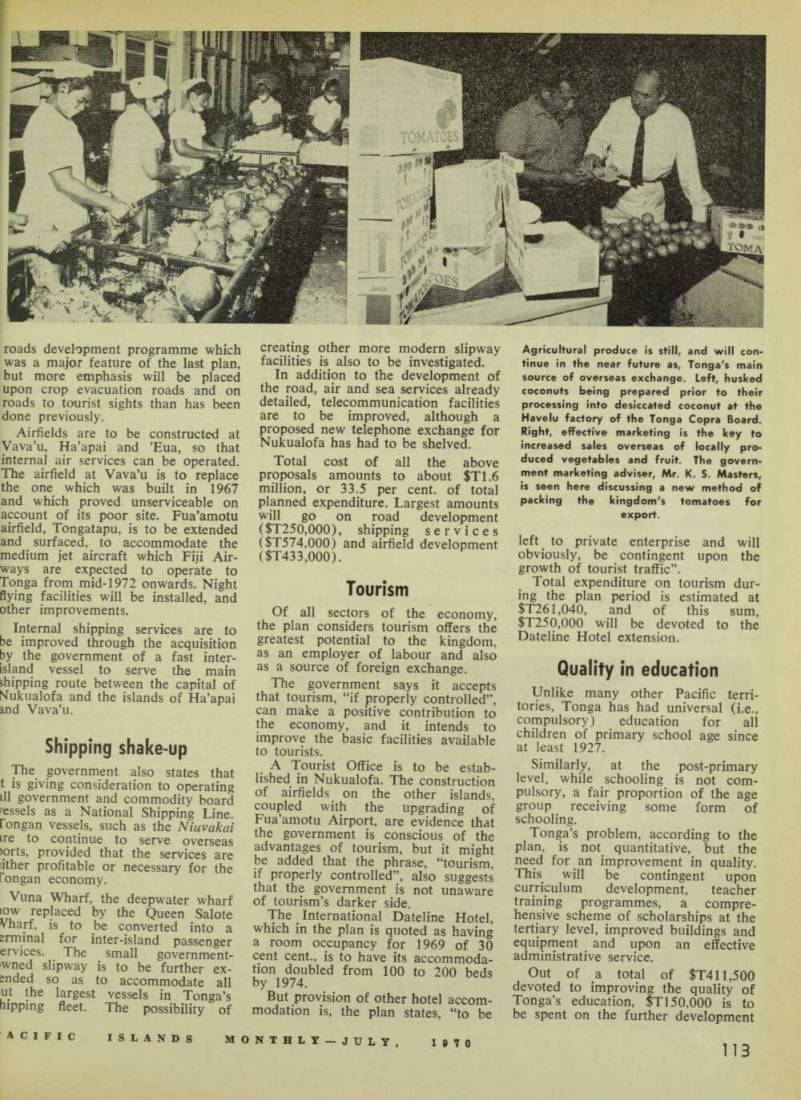
Agricultural produce is still, and will con tinue in the near future as, Tonga's main source of overseas exchange. Left, husked coconuts being prepared prior to their processing into desiccated coconut at the Havelu factory of the Tonga Copra Board.
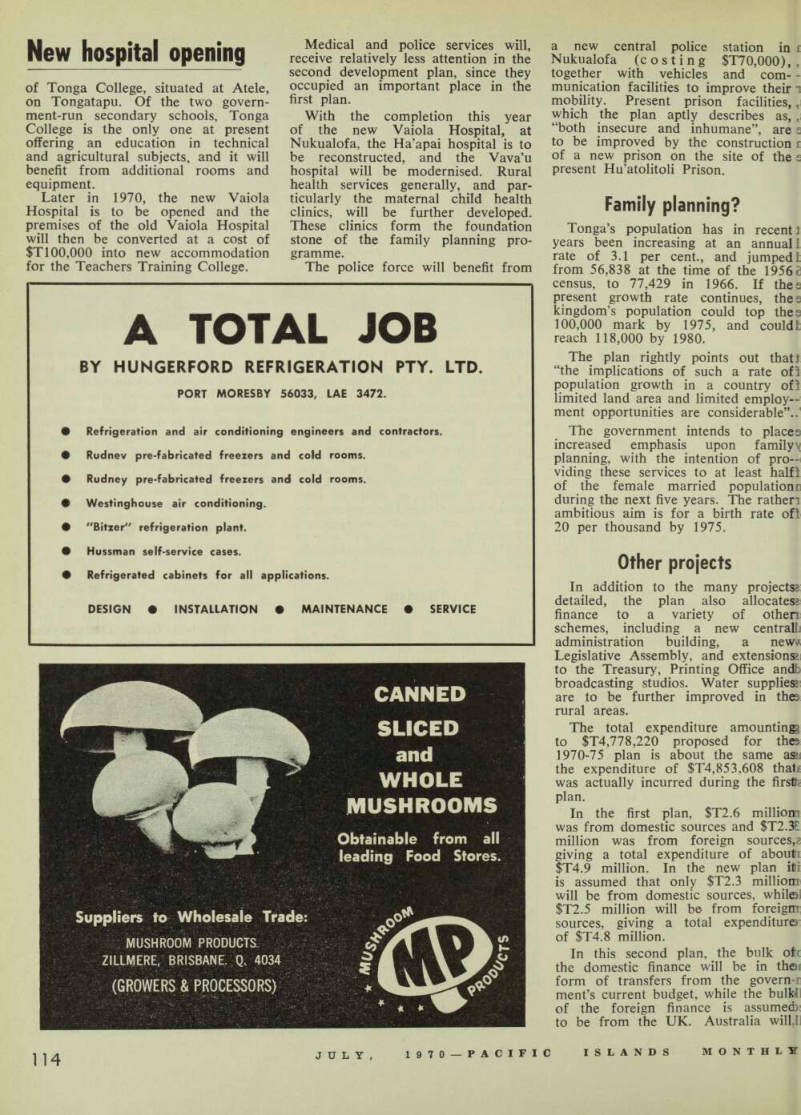
Right, effective marketing is the key to increased sales overseas of locally pro duced vegetables and fruit. The govern ment marketing adviser, Mr. K. S. Masters, is seen here discussing a new method of packing the kingdom's tomatoes for export.
New hospital opening
of Tonga College, situated at Atele, on Tongatapu. Of the two govern ment-run secondary schools, Tonga College is the only one at present offering an education in technical and agricultural subjects, and it will benefit from additional rooms and equipment.
Later in 1970, the new Vaiola Hospital is to be opened and the premises of the old Vaiola Hospital will then be converted at a cost of STIOO,OOO into new accommodation for the Teachers Training College.
Medical and police services will, receive relatively less attention in the second development plan, since they occupied an important place in the first plan.
With the completion this year of the new Vaiola Hospital, at Nukualofa, the Ha’apai hospital is to be reconstructed, and the Vava’u hospital will be modernised. Rural health services generally, and par ticularly the maternal child health clinics, will be further developed.
These clinics form the foundation stone of the family planning pro gramme.
The police force will benefit from
a new central police station in c Nukualofa (costing $T70,000), , together with vehicles and com- munication facilities to improve their i mobility. Present prison facilities, t i which the plan aptly describes as, t ; “both insecure and inhumane”, are s to be improved by the construction c of a new prison on the site of the s present Hu’atolitoli Prison.
Family planning?
Tonga’s population has in recent! years been increasing at an annual! rate of 3.1 per cent., and jumped t from 56,838 at the time of the 1956 S census, to 77,429 in 1966. If thes present growth rate continues, thee kingdom’s population could top thee 100,000 mark by 1975, and could t reach 118,000 by 1980.
The plan rightly points out that!
“the implications of such a rate ofi population growth in a country ofl limited land area and limited employ ment opportunities are considerable”..’
The government intends to places increased emphasis upon planning, with the intention of pro—i viding these services to at least half! of the female married populationc during the next five years. The rathen ambitious aim is for a birth rate ofl 20 per thousand by 1975.
Other projects
In addition to the many projects: detailed, the plan also allocates finance to a variety of othen schemes, including a new centralh administration building, a neww Legislative Assembly, and extensions to the Treasury, Printing Office andb broadcasting studios. Water supplies; are to be further improved in thes rural areas.
The total expenditure amounting to $T4,778,220 proposed for the? 1970-75 plan is about the same asi the expenditure of $T4,853,608 that* was actually incurred during the first!? plan.
In the first plan, 5T2.6 milliom was from domestic sources and ST2.3£ million was from foreign sources,2 giving a total expenditure of abouti 5T4.9 million. In the new plan itri is assumed that only $T2.3 milliom' will be from domestic sources, whilol 5T2.5 million will be from foreigm; sources, giving a total expenditure* of ST4.B million.
In this second plan, the bulk otc the domestic finance will be in thei form of transfers from the govern-r ment’s current budget, while the bulkll of the foreign finance is assumed); to be from the UK. Australia will.ll
it is hoped, contribute at least $T0.25 million over the plan period. Whether the Tonga Government can finance its own share of the plan will depend upon the state of the country’s economy. The plan document emphasises that in the long run the government recognises that it will be necessary to undertake a major reform of the tax system so as to enable it to capture a larger share of the kingdom’s income.
In the preparation of the new plan, which began in August of 1969 and was largely completed by this May, the Tonga Government received assistance under the United Kingdom’s Technical Assistance Pro gramme. Copies of the plan can be obtained from the Government Printer, Nukualofa, Tonga.
Exports and imports
well up in P-NG
Exports of prawns, tea, desiccated coconut and scrap metal performed best of New Guinea’s smaller export items in the four months ended October 31 last. NG’s Bureau of Statistics, in its May bulletin, com pares sales of these products for this period with sales in the same period of 1968: Prawn receipts jumped from nothing to $310,000; tea sales went from $53,000 to $149,000; desiccated coconut from $307,000 to $409,000 and scrap metal exports increased from $Bl,OOO to $137,000.
The bureau totalled all exports for the four months of ’69 at $33,890,000, a healthy jump from $22,799,000 in ’6B.
The best improvers were coffee sales, which jumped from $6,742,000 to $8,695,000, and cocoa, which increased from $4,318,000 to $6,180,000.
Imports to NG for the same two periods, unfortunately, rose cor respondingly; from $47,138,000 to $62,962,000.
On imports, the bureau said that the October monthly figures were $3.7 million above average. Heavy equipment and large shipments of live oysters and petroleum products went to Port Moresby.
Two aircraft, a helicopter and large consignments of industrial machinery were imported into Lae.
Several aircraft engines and large shipments of tobacco, industrial machinery, vehicles, tyres and tubes, also entered NG.
On exports, the bureau said October was average for season crops. Large shipments of prawns left Moresby; two aircraft engines and large shipments of copra went from Madang.
NCW brewery for
. 1 9
New Caledonia
.„, , , , As hills are bulldozed down and dumped into low-lying marshland, a new commercial complex is taking shape at the PKS (sth kilometre) out of Noumea, New Caledonia, beside Magenta airport. . **r Ihe first portion of this 35-acre property, belonging to Caledonian businessman, Edouard Pentecost, is a depot for imported mining trucks and heavy earth-moving equipment.
As the hiUsides are being chiselled away, the first group of homes has been assembled—imported from New Zealand. The 10 weatherboard dwellings are to house employees of the Pentecost group. Plans to import a second batch of homes have been abandoned following the May announcement of Paris-imposed limitations on the export of Cale donian nickel ore (Mr. Pentecost is the island’s main independent mine operator), Plans are going ahead, however, for a new brewery on this site. This
will be the island’s second brewery, to be known as the Grande Brasserie de Noumea.
The new plant is being financed by local soft drink makers, retail traders, the Bank of Indo-China and some interests from Tahiti. The brewery output is no doubt destined to compete with the large quantity of beer currently imported from Holland, France, Germany and USA.
Construction of the plant is expec ted to begin in August. Production is intended to reach 450,000 gallons of beer a year, and an identical supply of soft drink.
Uproar over Caledonia
nickel quota
The French Administration found itself with many questions to answer in New Caledonia’s Territorial As sembly, following the May announce ment of Paris-imposed limitations on the exportation of Caledonian nickel ore to Japan.
Caledonian independent miners who had been negotiating contracts with Japan to sell over six million tons of nickel ore, were advised that a quota of 3.8 million tons had been im posed. This was for the Japanese fiscal year, begun on April 1, 1970.
The news of the quota was re leased in Noumea on May 20, although the decision had been made in Paris by the Department of Scientific and Industrial Develop ment”, on March 25.
Principal independent Caledonian mine operator, Mr. Edouard Pentecost, second vice-president of the Territorial Assembly and mem ber of the Gaullist Union Demo cratique, told PIM in Noumea: “We are stunned by this decision from Paris which does not take into account the needs of the territory’s economy and of our clients.”
Sixteen independent mining groups (excluding the Societe Le Nickel) then presented the visiting Minister for Overseas Territories, Mr. Henri Rey, with a four-page document seeking a reversal of the Paris decision. Mr.
Pentecost declared: “We hope he takes our request into consideration, for the reverse position would be heavy with responsibility.”
It was later announced that the 3.8 million ton quota would be raised to 4.1 million ton. (Japan bought 3.5 million tons in its last financial year.) In the ensuing Territorial Assembly debate on June 3, the head of the French Administration, Secretary- General Mr. Michel Levallois, re minded the Assembly that New Caledonia, being part of the French Republic, must submit to laws voted by the French Parliament.
The Administration expressed the fear that Japan was over-buying and would create nickel stock-piles. The Director of Mines in New Caledonia, Mr. Leca, however announced that France would be prepared to raise the quota to 4.5 million tons, the quantity estimated as meeting Jap anese needs, if Japan undertook to assist financially in the development of a French nickel processing factory in New Caledonia.
The factory concerned is planned for Poum, in the north, with the SLN as major shareholder. It was understood the Japanese had been asked to grant a loan of approxi mately SUSI6O million to help the
Sln.
In the meantime, in opening the Territorial Assembly Session on May 20, Governor Louis Verger had de clared that New Caledonia’s export tax derived from nickel for the first four months this year is 5U5530,000 below estimates, due “firstly, to the SLN extension programme being slower than expected in getting under way.”
The SLN’s latest problem had been a 15-day strike by 120 workers, re
suiting in the closing down of three blast furnaces for that period.
The return to work was finally arranged for May 23, the morning the Paris Minister was scheduled to visit the smelting works.
In the meantime, work is pro gressing at the SLN’s new mining centre of 400 homes at Nepoui (west coast). The eight-mile long conveyor belt to bring ore to the loading wharf is to be completed by the end of September.
But as the Paris-based SLN worked on its extension programme, the in dependent Caledonian miners had also been preparing to share in the boom. One operator claimed he had invested over SUS 7 million in new equipment, in view of the encourage ment given for an expanded mining activity in the territory.
When the Paris curbs were an nounced on May 20, one miner im mediately closed two mines and dis missed 76 workers in the Poya area.
This was followed by another operator closing two mines and dismissing 40 workers in the Bourail area.
Contractors who had borrowed heavily to finance trucks and ex cavators became anxious over repay ing their debts.
Following meetings at Monte Dore (near Noumea) and Kone (175 miles away on the west coast), Caledonian mine workers, contractors, truck drivers, etc., formed a Union-Syndicat Independent des Mines (SIM).
On June 15 they addressed a cable to French President Georges Pompidou, and the President of the French National Assembly, in Paris.
The telegram requested: “Firstly, immediate cancellation by the Administration of quotas on ex portation of nickel ore to Japan.
Secondly, abolition by the parlia ment of the three so-called Billotte laws. Thirdly, speeding-up of replies from the Mines Department con cerning requests for transfer of min ing titles, exploitation permits, etc.”
The cable continued: “Considering the dismissals already carried out and those to come, we draw your at tention to the growing malaise in the mining world resulting from the decision to limit exportation of nickel ore. Signed Syndicate In dependant des Mines de Nouvelle Caledonie.”
The independent miners claimed that the Japanese, if thwarted in New Caledonia, would go and buy their nickel elsewhere.
Moreover, the Caledonians claimed the loss of contracts would cost the
territory SUS2O million and a similar loss to France.
Considering that nickel is the herit age of the Caledonians, miners asked that Japan be invited to participate with the locals in financing a smelt ing plant—a desire expressed equally by the Japanese and Caledonians.
Meanwhile, the newly formed union was quick to receive financial aid from men whose incomes were threatened. An office has been set up in the heart of town (rue Anatole France) with a highly decorative col lection of rich ore samples (chrome, iron, nickel) from mines which mem bers are fighting for the right to work.
Search for minerals
in Solomons?
Solomon Islands Mines NL was recently formed by an Australian minerals explorer, Eastmet Minerals NL, to search for various minerals “over several hundred square miles” of the Choiseul and New Georgia areas of the Solomons.
The company has lodged applica tions for reconnaissance permits for these areas, but as yet, PIM under stands, it has not been granted the permits.
The areas would be explored for bauxite, precious metals, non-ferrous
and ferroalloy metals and beach sand mineral deposits. Finance would come from “several substantial UK financial institutions” (undisclosed), which would, the company said, ensure that the explorations were "prosecuted thoroughly”.
J One director of Solomon Islands Mines is Mr. D. G. Thompson, a member of the Sydney Stock Exchange and a principal in Guadalcanal Plains Ltd Guadalcanal is not associated with the venture. a • - ~, • A major survey of the Waghi Swamp in Papua-New Guinea has begun. The swamp is fed by the catchments of the Waghi and Gumanch rivers and is a main agricultural resource. When drained, the swamp will have a potential of 14,000 acres of first-class land.
A Si I N
Vl ' ruae 0,1 ri 9 nT S m D_M/2 A r n .. . „ Australia will continue to give any f. rude 0,1 discovered in New Guinea the same rights with respect to price and guaranteed access to the Aus tralian market, as is accorded to Australian-produced crudes, This H wil , be reviewed in 197J> or earlier, if proposals for the establishment of a refinery in NG are put forward. . * n recen f years oil companies have explored in the territory hoping they would have domestic supplier status on Australian market, Oil explorers have been searching in NG for over 50 years; to the end of last year, $lO5 million had been
spent by private enterprise in the search.
Although promising finds of gas and condensate have been made in the Gulf District of Papua, no com mercial oilfields have been discovered.
First estimates on
Bougainville
Net profit from the Bougainville copper project will be $lOl.B million in 1973, $105.8 million in 1976 and $47.8 million in 1980.
Sydney stockbroker, Garrett, Lance and Co., estimates these figures in a detailed analysis of the pros pects of New Broken Hill Consoli dated Ltd., CRA’s smaller partner in the project.
Garrett assumes a current price of $l,OOO a ton for copper (current price, $1,300), SUS3S an ounce for gold and $2 an ounce for silver in its profitability predictions.
Garrett says production should be gin early in 1972. Higher grade ore would be mined first to build up a sizeable cash flow in the initial years when loan repayments would be heaviest, and tax liability nil. A steady ore production rate of around 32 million tons a year was envisaged from 1973 on, which would yield an estimated mine life of 30 years, based on current reserves of 900 million tons.
Garrett estimates the total realisa tion cost for copper would be $l5O a ton. This included normal smelter deduction, commodity price deduc tion, smelting charges per ton of concentrate and transport costs. For gold and silver, realisation costs would be negligible.
The firm assumed the total capi tal cost of $350 million for the project would be written-off over 12 years and the $250 million in loan funds already negotiated would carry an average interest rate of 9 per cent.
Loan repayments would be repaid by the end of 1982 with annual payments, 1973-75 at $5O million, 1976-77 at $35 million and 1978- 82 at $6 million.
Garrett’s predictions on Bougain ville’s profitability are the first serious estimates on the Islands’ major mining venture, which can only be rivalled by New Caledonia’s nickel miners collectively.
It obviously takes no account of industrial stoppages at Bougainville, which would upset production figures, but it carefully takes into consideration the future of copper prices on world markets.
How tight a deal Bougainville has made with its buyers in Japan and
Europe on copper price variation is unknown, but it’s likely a major fluctuation could cause contracts to be rehashed.
Copper prices are at some of their highest levels now. Consumption is slightly outstripping production, but in the medium term, with new mines being born and production at old ones to be greatly increased (Mt.
Isa, for example) production will ex ceed consumption.
A price fall, then, is likely in the mid-1970’5. a factor which Garrett has anticipated.
Tahiti strike
fizzles out
An “indefinite” general strike in Tahiti, which began over the sacking of a number of workmen at the Bali Hai Hotel on Moorea, fizzled oui after only 36 hours at the end of May.
While it lasted, the port of Papeete was partially paralysed and some workmen, who did not wish to join the strikers, had stones hurled at them.
The strike ended after the Gov ernor of French Polynesia, Mr. Pierre Angeli, intervened and arranged for the Bali Hai to re-engage some of its sacked workmen and for others to be given jobs in the Department of Public Works- The Bali Hai is owned and operated by three Americans, Messrs.
Jay Carlisle, “Muk” McCallum and Hugh Kelley.
Downward turn
in Tahiti
French Polynesia’s economy, which reached a peak this year, is now on a downward curve, according to the territory’s Governor, Mr. Pierre Angeli.
Opening the administrative session of the Territorial Assembly at the end of May, Mr. Angeli said that, apart from tourism, the territory’s traditional industries were stagnant.
However, he predicted that the ter ritory would continue to prosper.
This was because private investment was twice as high as had been estimated, the local budget had been tripled, and the support of the French Government, including the nuclear testing project, had risen to 7,600 million Pacific francs (about SA7O million).
Mr. Angeli said that under a new development plan two hotels would be built in Tahiti; Point Venus and the Papeete waterfront would be beautified, and the territory would be promoted overseas; there would be
experiments into the production of pearl shell, which were expected to produce income by 1973; and there were plans for the development of agriculture.
Mr. Angeli said it was hoped that the territory’s tourist business would triple between now and 1975 and that 5,300 new jobs would be created.
Much needed to be done in that sector, it being particularly necessary to control prices. “Businessmen and hoteliers must help us to maintain them, if not bring them down,’ Mr.
Angeli added.
Following Mr. Angeli’s speech,
elections were held for the various Assembly committees, In accor dance with an agreement between the two majority coalition parties, Mr. Jean Millaud was elec ted president of the Assembly in succession to Mr. John Teariki, who is now Ist vice-president. Members elected to the Commission Per manente, a sort of cabinet, are: H^nri Cuvier (president), Daniel Millaud (vice-president), Adolphe Agmeray (secretary), Jean Amaru and Eugene Haereraaroa.
No members of the minority parties are represented on the new committees.
New GEIC grants for
ferries and copra
New grants approved by Britain for the Gilbert and Ellice Islands development plan, include over $250,000 to increase copra produc tion and $60,000 to improve ferry services between Bairiki, government centre, and Betio, commerce centre, on the capital atoll of Tarawa.
The colony’s Agriculture Depart ment has given $lBO,OOO for re planting, partly with subsidies to growers, of coconut groves and
$54,630 will also be spent on coconut nurseries, research stations and housing for employees.
The $60,000 for ferry services will be spent on converting the colony’s landing barge, Tabakea, into a vehicle and passenger ferry, and a new ramp will be built at Betio. Tabakea will be refurbished at Tarawa by the Marine and Public Works Depart ments.
Commerce briefs
• Fiji’s timber industry may have found a regular market in the Cook Islands. A large Cook Islands (partly
Hong Kong-owned) trading company, A. B. Donald Ltd., of Rarotonga, has already bought 30,000 super ft of damanu and dakua planks and framing from Carpenters Fiji Ltd.
In June, another shipment of 45,000 super ft left Suva for Rarotonga, also for Donald. Total value of die shipment was SFB,OOO. • Freeport Indonesia Inc., an Australian-incorporated subsidiary of Freeport Sulphur of the US, will in vest SUSI 6.9 million in the Ertsberg copper project in West Irian. Japanese and West German sources will lend 542 million for the project and Free port has arranged a $5B million loan from a group of American insurance companies and banks. Total cost of the project is $l2O million. The com pany expects to begin shipments and production early in 1973 ( PIM , Mar., p. 121). • Australian electronics company, Racal Electronics Pty. Ltd., has been awarded a $400,000 contract for the supply of equipment for high fre quency radio subscriber services in Papua-New Guinea’s five-year de velopment programme. The system will provide high quality communica tion to remote areas of the territory. • Placer Prospecting (Australia) Pty. Ltd. will spend not less than $lOO,OOO to explore 118 square miles of New Guinea Goldfields Ltd. leases in the Wau-Edie Creek area of New Guinea. Under an agree ment with NG Gold, announced in May, Placer could spend up to $5 million looking for gold, copper and other materials. If a mining opera tion is proved, a joint company will be formed on a 60-40 basis between Placer and NG Gold respectively. • For its first work in New Guinea, Sydney-based Central Con structions Pty. Ltd., has won a $1 million contract with the Australian Department of Works to build a 1,830 ft steel and concrete bridge over the Markham River, near Lae, on the Wau-Bulolo road. Equipment for the job was to arrive in Lae in June and work is scheduled to be finished in November next year.
Central has built 230 bridges and culverts in Australia over the last 18 years. • The Western Samoa Chamber of Commerce has increased the basic wage for casual labour in Samoa from SWSI.IO to $1.30 per day. It was the first time in 15 years since labour rates were fixed. New rates are to start July 1.