Pacific Shipping
pp. 105-113 · Read in the full issue
MILI interested in the cruise business
MILI, the US Trust Territory shipper, is con sidering chartering or buying a cruise ship for eight, 10 and 12-day passenger cruises out of Saipan, Mariana Islands.
Directors of MILI, who met re cently in Ponape, Carolines, to review the company’s current operations, decided to further investigate the project.
They noted heavy bookings on their vessels out of Japan and the US West Coast to Micronesia. Mr.
K. Suzuki, MILI rep in Tokyo, indicated that more and more Japanese were travelling to Micro nesia, particularly Saipan.
Directors said that since February 2, 254 MILI shares had been sold, for a total of 171,545 shares now held by residents of Micronesia.
There were 78,455 shares still avail able out of the initial 250,000 issue.
Current price was SUSI.IO.
Other points at the meeting in cluded: • Losses on operations had occurred in the first two quarters of the current financial year; a “healthy” profit was expected in the third quarter and, if reserves “proved adequate”, MILI would move ahead by a “narrow margin” in the fourth quarter. • Fare increases averaging 8 per cent, became effective on the Far East runs from May 1. • Because of the new wharf, port time for vessels calling at Ponape had been reduced from an average five days to 2\ days. Yap, however, continued to cause stevedoring problems. • “Shrinkpack” palletisation had
proven initially successful. Cargo was loaded onto pallets, covered with heavy plastic, and slightly heated to shrink the plastic coating. The result was a compact, watertight pallet load which arrived at destinations exactly as loaded. ® A proposition to consider a direct run from Auckland/Sydney to Truk/Ponape once or twice a year would be studied.
MILI has long hoped for such a direct Australasia-Micronesia run, which at the moment doesn’t exist (except for calls by the Gilbert and Ellice Islands’ Moanaraoi every 12 weeks).
It’s a run many businessmen in Australia would support. Traders would like to crack the rich US Trust Territory import market, which is dominated by the US and Japan.
The US has so far turned a blind eye to the Moanaraoi*s calls at Majuro. Australian and NZ goods have been getting through, much to MILI’s chagrin.
A year ago MILI began an un successful run to Tarawa, GEIC, to try to collar the trans-shipment cargoes, Moanaraoi, with backing from Bairiki, won out.
New Repair Dock
For Fiji?
An American company, Imodco International of Los Angeles, is in terested in bringing a large floating dock to Fiji as the basis for a major ship repair industry.
If the dock is brought to Fiji it will mean work for hundreds of men.
The dock, in Suva, would take ships
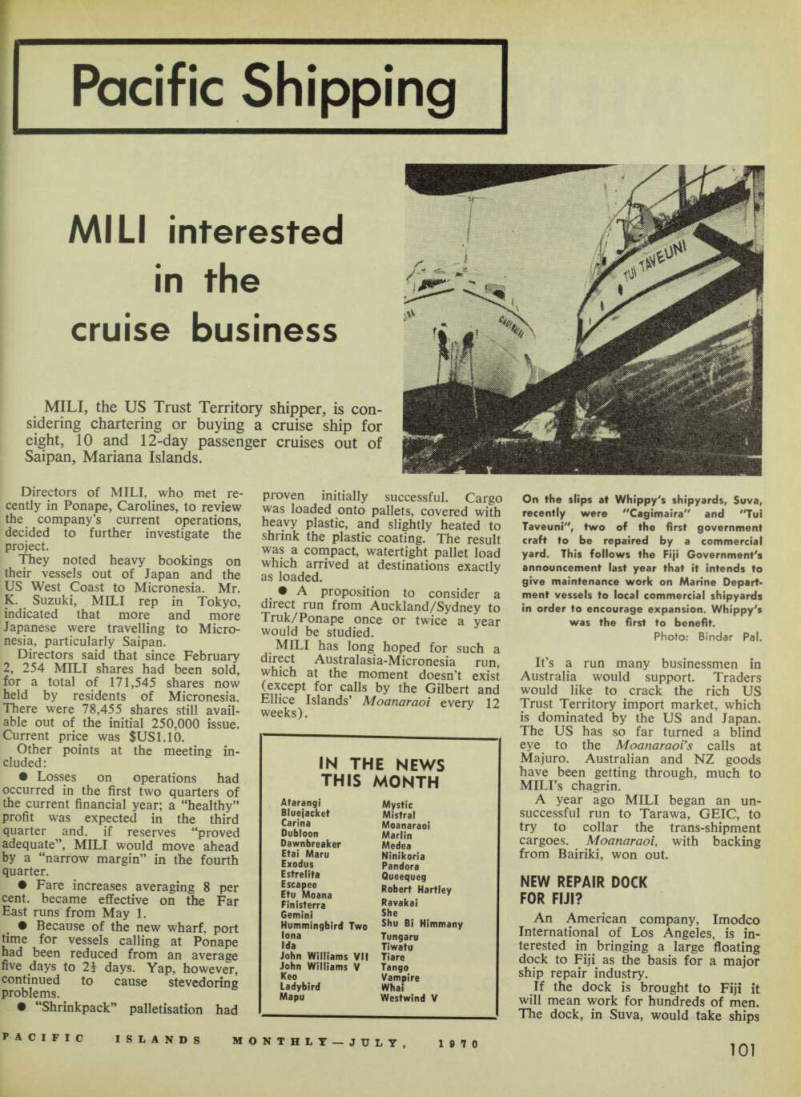
On the slips at Whippy's shipyards, Suva, recently were "Cagimaira" and "Tui Taveuni", two of the first government craft to be repaired by a commercial yard. This follows the Fiji Government's announcement last year that it intends to give maintenance work on Marine Depart ment vessels to local commercial shipyards in order to encourage expansion. Whippy's was the first to benefit.
Photo: Bindar Pal.
of up to 5,000 tons displacement, allowing many of the overseas cargo ships putting into Suva to be accom modated.
An Imodco official visited Suva recently for talks on the proposal.
Imodco is also interested in taking over the Fiji Marine Department’s shipbuilding yard at Walu Bay.
The company designs and con structs off-shore moorings for oil tankers and designs and builds ships.
Fisheries 7 Development
Gets Afloat
“SPIFDA is finally getting afloat,” according to the project manager, Mr.
Alan Tubb, who has been on the job in Noumea since March last year.
All governments concerned have now signed the plan of operations for this South Pacific Islands Fisheries Development Agency, which uses the South Pacific Commission as a base for its activities. The agency works on funds supplied by the UNDP, in co operation with the territorial govern ments in the area, and has the job of developing South Seas fisheries of all kinds.
Mr. Tubb has been contacting people in top jobs concerning fisheries development, with a view to arranging visits to the South Pacific.
He said he expects two high-level consultants to be in the area by September.
Following initial surveys of fisheries prospects, the agency will seek to recruit field workers to carry on specific projects in the territories.
The agency’s preliminary sound ings-out among the Islands have revealed a keen interest in the farm ing of turtles. On this subject, Dr.
Harold Hirth, a biologist at the Uni versity of Utah, has been contacted.
Dr. Hirth has worked with turtles in the Gulf of Aden and the Red Sea.
Another turtle specialist SPIFDA is interested in is Professor J. R.
Hendrickson, of Arizona. Professor Hendrickson has worked particularly in Malaysia, with the giant leather back turtles.
In response to Islanders’ interest in crayfish as a luxury trade item, Dr, R. W. George of the Western Australian Museum has been con tacted. The insatiable demand for crayfish in the USA and Europe has made crayfish farming a particularly lucrative prospect for the Islands.
On the subject of constructing ferro-cement fishing craft, Mr. Tubb expects Englishman John Fyson will be available at the end of the year Mr. Fyson could work with the United Nations Industrial Develop
ment Organisation, which is already handling ferro-cement craft con struction in Fiji.
Concerning reef and lagoon studies, Mr. Tubb hopes these may begin by the end of the year. Dr. Frank Talbot, director of the Australian Museum, Sydney, has been ap proached to do a primary study.
Mr. Tubb then hopes to arrange a meeting of specialists concerned with reef and lagoon systems to draw up a project which could be carried out by the territories.
The agency will be working always in co-operation with local fisheries officers. The only territories not to have such officers, according to Mr.
Tubb, are the Solomons, Cooks, New
Caledonia, Nauru, New Hebrides, Niue, Tokelau and Pitcairn.
Captain Ward Is Due Back
The loss of the Gilbert and Ellice Islands’ longest-serving civil servant, Robby Roberts, in May reminds sea dogs that Captain E. V. (Vicky) Ward is due back from leave soon from England.
Captain Ward has been operating to the GEIC since 1946, only one year after Robby arrived, and he has been based in Tarawa (though he’s mostly at sea) for the past 17 years.
Best-known European master in GEIC waters for over 20 years,
Captain Ward, will, in his own words, have been “enjoying wife and brood life in a 600-year-old thatched cottage, drinking draught beer and scratching the local pigs” in Dorset.
Back at Tarawa he’ll probably take up his command again of the colony’s expensive recruiter Ninikoria.
Captain Ward’s sea history goes back 24 years. He was an apprentice with Ellerman and Papayanni Lines, Liverpool, in 1936, and was third and second mates in the Ellerman, Bucknall Lines.
He served with the British Merchant Navy during World War 11, and was twice torpedoed in the North Atlantic.
“Fed up”, in 1946, he moved to the Pacific and joined, as chief mate, the LMS schooner, John Williams V.
Based out of Suva, he later became mate and master of the Williams, travelling regularly to the GEIC.
In 1953 he joined the GEIC’s Wholesale Society as master of the Tungaru and Tuvalu. In 1958 he travelled to Hong Kong to pick up and bring back the WS’s first Monaraoi; in 1966-67 he picked up the second Moanaraoi from Europe and in 1968 he picked up the Ninikoria from Europe.
In the GEIC, Captain Ward is known for his humour and interest in local affairs. He’s written many a sarcastic note to the colony’s news sheet, CIN, and is a great mixer with his Islands crews. His decorations include the MBE and a fellowship of the Institute of Navigation.
He plans, after eventually retiring from the GEIC, to “rusticate in nice pleasant Thomas Hardy’s rural Dorset”.
Tuna Development
In The Cooks
After taking several years to build, the Cook Islands Government tuna fishing sampan, now named Ravakai (an expert fisherman), was launched in June last year and passed its sea trials successfully. It then went back into its shed for further work to be carried out on it and did not take to the water again until early April this year.
In late May, skippered by Tony Reeves and with fisheries officer loaba Marsters on board, it brought in its first catch, all barracuda specifically caught for the welcome
feast given for the Premier, Mr.
Albert Henry, and Mrs. Henry on their return from their visit to New Zealand and Australia.
In early June Ravakai had not made any further fishing trips and was still tied up in Avatiu harbour because vital work on it had not been completed by the Public Works.
A competitor entered the field in April when well known skin diver and fisherman Tekake William bought Marlin Two from Jim Price.
Jim, an old identity in Rarotonga, built Marlin Two from a wrecked yacht he bought some years ago.
He installed a 50 hp diesel in the
Captain Ward.
42 ft vessel and equipped it with radio and echo sounding gear and a freezer with a 2i ton capacity.
Tekake William took the vessel [ to sea for a trial run on April 28, signed on an engineer and three ; other crew, and renamed his boat Etu Moana (Star of the Sea).
Bad weather hampered his activities, but he and his all Poly nesian crew made several successful trips, working from 4 a.m. to 9 p.m.
Using the long-line method, they caught higher than the world average of tuna for 100 hooks, but it seems unlikely that they can keep this up for long.
Tekake and his crew work on a co-operative basis and sell their catches to a local trading firm. The firm guts the tuna, removes the heads from the bigger ones and sells the fish quickly at NZ3S cents per pound to the fish-hungry public. Catches usually sell out in 15 minutes.
As Tekake is not a navigator, his fishing is done within sight of Rarotonga or with the high island not too far below the horizon. This indicates once again that it is only the lagoons and close inshore waters of Rarotonga that have been fished out. Given the right types of boats and gear, some Cook Islanders can catch fish in bulk and help to reduce the $13,700 worth of frozen and canned fish imported into the Cook Islands every year.
Where Did The
Plaque Come From?
A Noumea restaurant-operator, who is also a keen underwater fisherman, has recently added to the decor of his establishment the 70year old relic from an unknown ship sunk off New Caledonia.
Mr. Jean Godot, who now operates the Esquinade, specialising i n sea food dishes, was with a group of spearfishermen when he recovered an old steam-engine plaque from the seabed. The plaque was among other wreckages of propeller and metal work, found at a depth of 45 ft around the main reef, some U hours by boat south of Noumea.
The 30-inch diameter plaque, now displayed among the sea decor of the Esquinade, bears the following mscription :
Fulton Engineering & Ship
Building Works
No. 181 San Francisco Cal. 1901 Caledonians are wondering if PIM readers could supply any clues to the identification of the ill-fated vessel which sank with this plaque
Shipping Briefs
• Hopes of salvaging John Seeto < and Company cargo ship MV Medea \ have been abandoned. The 21 ton j Medea was sailing from Mussau Island to Kavieng in May when it ran aground on a reef off Lukus Island. Crew and passengers of the ship were able to walk to safety from the ship. • Etai Maru, one of five com mercial ships operating on inter island routes in the Marshall Islands, was in Suva recently. She carries general cargo, copra, and passengers around the Marshalls out of Majuro.
Her master is Ellice Islander, Cap tain Paul Tolise of Funafuti. Captain Tolise has a crew of 13 Marshall ese. • NZ firm, Star Jets Ltd., hopes to receive a S 4 million contract for jet barges to New Guinea. The 50 ft long aluminium barges will be powered by twin diesels and will be used to transport copra down the Flv River, • Captain Richard Beadon master of the Tarawa-based Protestant mis sion ship John Williams VII has been appointed technical master of navigation and seamanship in the nautical department of the Derrick Technical Institute, in Suva. Thirty two-year-old Captain Beadon has been master of the John Williams since 1967. He’ll train seamen for examinations to the level of the Pacific Islands masters and mates certificates. • Toboi Ship Building Company' of Rabaul has started on a small \ copra and passenger boat for * Islanders from the Duke of York: Islands. The 20 ft boat is expected! to be completed in August; it will! operate between Rabaul and the; Yorks. • Japanese-Australian fishing com pany, Gollin Kyokyo, has made pro gress during its initial survey period! of fishing in the New Ireland area..
Between March and May the com pany freighted 650 tons of fish toe Japan. Its fleet comprises a mothen ship and three fishing trawlers. At! the end of the survey period thej company hopes to establish shore j plants in NG. • Karlander (Australia) Pty. Ltd., has increased freight charges fromr Australia to Wewak, Lombrum andt Lorengau by $6 a ton. The company^
claims recent further increases in Australian waterside workers’ pay ments and emoluments have forced it to increase charges. • Lord Howe Islanders weren’t completely happy following a recent two-day visit to their island by sailors from an Australian naval destroyer, Vampire. They turned on the welcome for the visitors, ar ranged a cricket match, supplied cooked fish and innumerable varieties of food and took many of the sailors as guests in Howe homes.
However, in the words of the island’s newssheet Signal, “a few residents were inconvenienced and annoyed by the behaviour of a few sailors”. “Most of the seamen were well-behaved and would always receive a warm welcome from island residents,” Signal said. “But there were a few who ‘borrowed’ bicycles . . . and in at least one case a motor vehicle ... and some who had too much to drink . . . and in general did not endear themselves to any one.” • Mr. Vince Storck, pioneer of the reef cruising business on Suva Harbour and founder of a fleet of cruisers operating under his name, launched his newest venture, the 37 ft pleasure craft New Moon, from Whippy’s shipyard in April.
Although intended mainly for private use, the eight-berth cruiser, powered by a 110-horsepower diesel engine, was to be registered for oc casional charter and skindiving cruises. Mr. Storck, designed the New Moon himself. He also designed the craft in the Storck commercial fleet, of which the 00100100 is perhaps the best known.
The cruiser has a speed of about seven knots and a cruising range of almost 200 miles. Installations include a freshwater shower, a refrigerator, a depth finder and later, radio trans mitting and receiving equipment.
Picture by Bindar Pal.
• Ida and Keo, the two new British services vessels for the New Hebrides, recently arrived at Vila.
Built in Fiji, they both have large fuel tanks capable of carrying fuel, which enables them to run for about 180 hours without refuelling. • The Gilbert and Ellice Islands recruiter Ninikoria will have a stand in skipper until January next year.
He is Captain Michael Henson, who will replace Captain E. Ward who is on leave. Captain Henson, of Cornwall, England, spent 14 years with New Zealand Shipping Com pany before taking a shore job in England.
"New Moon."