since that first
pp. 67-69 · Read in the full issue
A lot has happened since that first New Hebrides flight
On May 31, 1960, the first
New Hebrides internal flight, from Vila to Tanna and return, took off. It was flown by an Australian-born Hebrides planta tion owner, Bob Paul, and a New South Wales pilot, the late Paul Burton.
On May 31 the condominium’s internal operator, Air Melanesia, cele brated the 10th anniversary of that historic flight.
Bob Paul and Paul Burton had bought a de Havilland Dragon Rapide (a former aerial ambulance in Queensland) and Burton flew it to Vila, via Port Moresby, Rabaul and Honiara. They then flew from Vila to Tanna, and landed on a new air strip constructed by the Tannese people.
But, after landing, Mr. Burton de cided Tanna strip was not long enough for a take-off. He asked the people to make it longer and it was two weeks before the extension was completed and the aircraft was able to take off to return to Vila.
It was hard going in those early days. Money was short, and the French Administration made life diffi cult for the new airline. But there
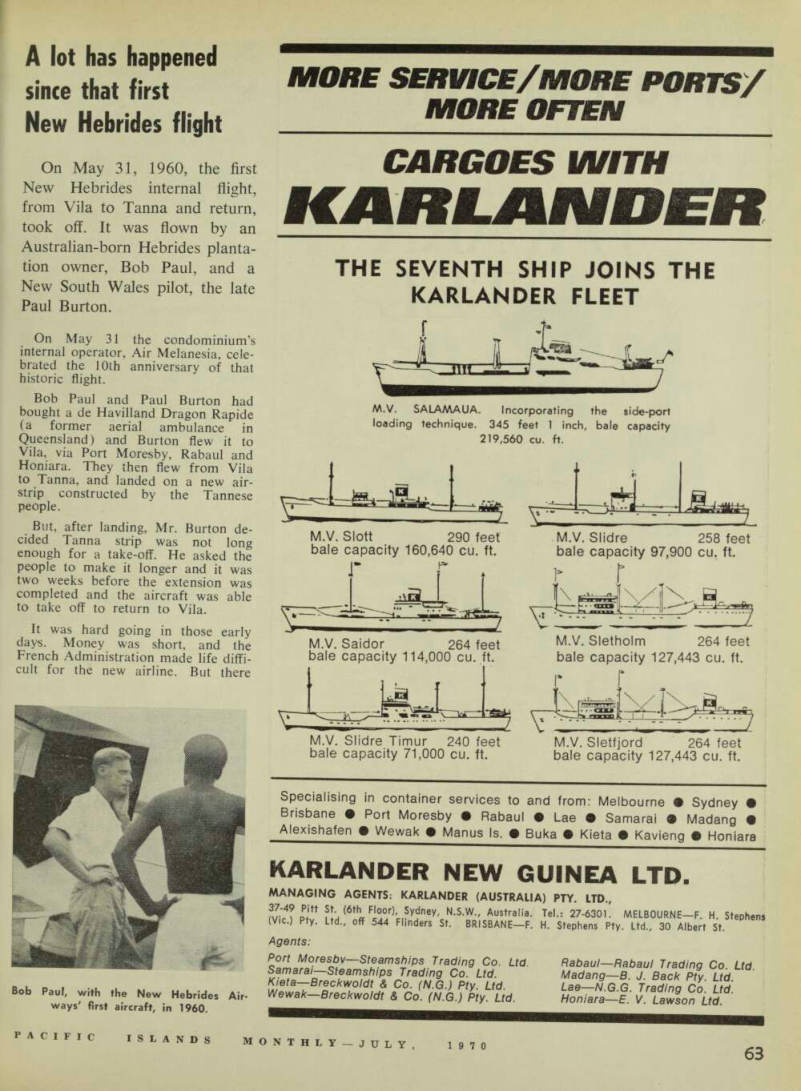
Bob Paul, with the New Hebrides Air ways' first aircraft, in 1960.
was much goodwill among the flying public.
Messrs. Paul and Burton called their operations New Hebrides Air ways, and about a year later they received some competition when a French group, Hebridair, started up with its own plane.
In June, 1966, these two companies combined to form Air Melanesia, but individual and involved British, French and Hebridean shareholdings in the two original companies re mained.
October, 1966, was New Hebrides aviation’s darkest hour when Air Melanesia’s three-engined Drover air craft crashed into rugged country in South Tanna. All eight aboard were killed, including NHA’s co-founder Burton.
Burton was mourned widely, and the crash was a shattering blow to Air Melanesia. Time, the perse verence of Mr. Paul and a few new shareholders, helped operations get back on their feet.
In the late 1960’5, Air Melanesia emerged as one of the promising Islands internal airlines, with its worth rather in goodwill and licence rights than in aircraft equipment.
The French made take-over ad vances, a New Zealand-backed, Suva based charter group showed interest and then the international Common wealth carriers, Qantas and BOAC, moved in.
Qantas bought up a controlling in terest in NHA, and resold about half its share to BOAC. And then Islands trader, BP’s took up a minor stake.
Mr. Paul kept his interest but it remains to be seen if Qantas and BOAC have bought in merely to stop someone else or to upgrade services and equipment. So far, their presence hasn’t been greatly felt.
The fact that New Hebrides has any service at all today is due to the tenacity and far-sightedness of planter Paul and the late Captain Burton.
New Pacific Cruises
Westours Inc., Seattle-based travel firm, has a new Pacific cruise service due to begin in November, with the firm’s ship, the MV West Star, in augurating operations between Tahiti and Fiji.
Westours is extending its one-way cruise programme to the South Pacific service by offering 11 and six day cruises operating in both direc tions between Suva and Papeete. In termediate cruise stops will include Tonga, American and Western Samoa, Bora Bora and Moorea.
Am. Airlines Start August
Perhaps Without Aust.
With its flights to Australia still undetermined, American Airlines will begin its flights to New Zea land, American Samoa and Fiji from August 1.
From Hawaii, American will fly its Boeing 707’s twice a week to NZ (once via Nadi, Fiji, and once via Pago Pago, American Samoa).
Also, from Hawaii, American will operate three terminating flights a week to Nadi and return.
To connect with Hawaii* from August 1 also, American will operate daily 707 non-stop flights from New York, Chicago and St. Louis to Hawaii, as well as daily one-stop (probably a West Coast US point) flights from Boston and Detroit to Hawaii.
From New York, American an nounced it planned a daily service out of Hawaii to “points in the South Pacific”, indicating at least two more flights south of Hawaii a week.
The initial American flights in dicate the airline’s confidence in Fiji as a destination tourist area and its determination to promote NZ, Fiji and Samoa, regardless of its proposed Australian flights.
Australia’s Department of Civil Aviation hasn’t yet agreed to an Aus tralian touch down because it thinks American is initially wanting too high a frequency, and that other Pacific airlines would suffer. • Mr. Tony Pinto, who left Air India as Australasian manager last year ( PIM , Dec., 1969, p. 45), has been appointed manager, schedule services, in the marketing depart ment of Nordair, one of Canada’s regional airlines. Mr. Pinto was first engaged with Nordair last October, developing new 727 services.
Talks Drag On Between
Ansett And Patair
Talks between directors of Papuan Airlines Pty. Ltd, NG’s biggest locally-owned airline, and Ansett Air lines, on a merger into the Ansett empire continued to their fourth week in late June.
Conferring in Port Moresby, neither airline’s directors indicated what had happened. The secretary of Mr. G. H. Ross Jones, Patair’s group executive director, told PIM it was expected the talks could con tinue for “quite a while” before any decision was reached.
Meantime, in Moresby and Mel bourne, Mr. Cliff Jackson (Patair) and Sir Reginald Ansett, principals
of the two groups, gave informal Press statements.
Mr. Jackson said Ansett had not made a takeover approach to Patair.
The approach had been more related to a “merger”, and it had come from Patair.
In a statement which the Melbourne Stock Exchange queried as it was not an official one, Sir Reginald said Ansett would take over Patair and “clean up Patair’s mess of aircraft and lift profitability to viable levels.”
Ansett would exchange its 50 cent shares for 240,000 $2 units in Patair at par, transforming Patair into an Ansett subsidiary.
Ansett would dispose of many of Patair’s aircraft to outside interests and possibly use others elsewhere in its business. By gaining Patair’s NG concessions, Ansett would challenge its competitor, TAA, in all areas.
Patair’s profitability, Sir Reginald said, had been “patchy” for several years, with recent operations produc ing little more than break-even earn ings.
Mr. Jackson’s and Sir Reginald’s statements were followed by silence all round, but should the deal eventu ate, it could be a major step for Ansett’s case as THE independent NG airline (and overseas routes?).