are 'political poison'
pp. 63-65 · Read in the full issue

Land sales for tourism are 'political poison'
By Ken Mcgregor
“They’re committing political poison, you know.” The travel consultant gestured with his hands across his shiny new desk at his Sydney headquarters.
“I was in Kenya for many years and I saw it happen there. The year before Kenyan independence Euro peans and overseas residents bought up most of the freehold land. After independence, Kenya’s leaders found that the best land in their country was not owned by Kenyans.
“Kenya had to borrow a huge amount from her former colonial master, Britain, to buy this good land back from outsiders. It hardly helped European-Kenya relations. And, of course, when most other African countries became independent, any land their leaders wanted, they ap propriated. . . .”
We weren’t talking about Kenya to start with at all. I had dropped in for a talk about travel and the increasing lists of land sales to over seas residents of Fiji islands, planta tions and properties.
However, the consultant was anxious to point out that while his firm was generally highly confident about Fiji’s tourism prospects, he couldn’t understand why so much land was being allowed to pass into overseas hands on the eve of the colony’s independence.
Nor can several other people I talked to.
In May and June The Fiji Times produced a wealth of stories on local land sales. Savusavu land sold. , . .
US-backed company buys land. . . .
Rakiraki land deal. ... 89 sections from new subdivision. ... Resort plan by NZ investors . . .”, and so the headings poured out.
The biggest sale of all, of course, was the buy for about SFI million of some 7,500 acres of freehold at Deuba, 30 miles from Suva, on Viti Levu.
Canadian and British were the purchasers and Indians and several Europeans, the vendors (PIM, June, p. 116).
Other sales have included: • A 505-acre plantation at Buca Bay, Vanua Levu, to American backed Nukudamu Estates Ltd., for about $50,000.
• 495 acres of land formerly owned by Mrs. Sarah Florence Barrack to Nukudamu Estates for $20,000 (Nukudamu’s two directors are Mr. Brian Larsen, now a resident of Suva but formerly of Hawaii, and Mr. Henry Achilles, a US naval officer who also owns Nawavi Island, near Savusavu). ’ • 87 acres of coastal land at Nadroga to American Investments Ltd. for $31,600. American is a holding company which controls American Pacific Corporation Ltd., which owns a sawmill at Deuba. • 921 acres of freehold on the
outskirts of Savusavu township to General Investment Corporation (Fiji) Ltd., for $65,000. This land was from the estate of Mr. Peter Derbyshire. General also owns a small island off Labasa. • 3,791 acres of land near Raki raki, northern Viti Levu, to Kappock Investments Ltd., for $250,000. Kap pock bought the land from Mrs.
Harriet Burness and co-owners.
Registered in Suva, Kappock has British directors and was formed in Nassau, Bahamas, in 1967. • Yanuca Island, off Rakiraki, to South Seas Lands Ltd. for $28,575.
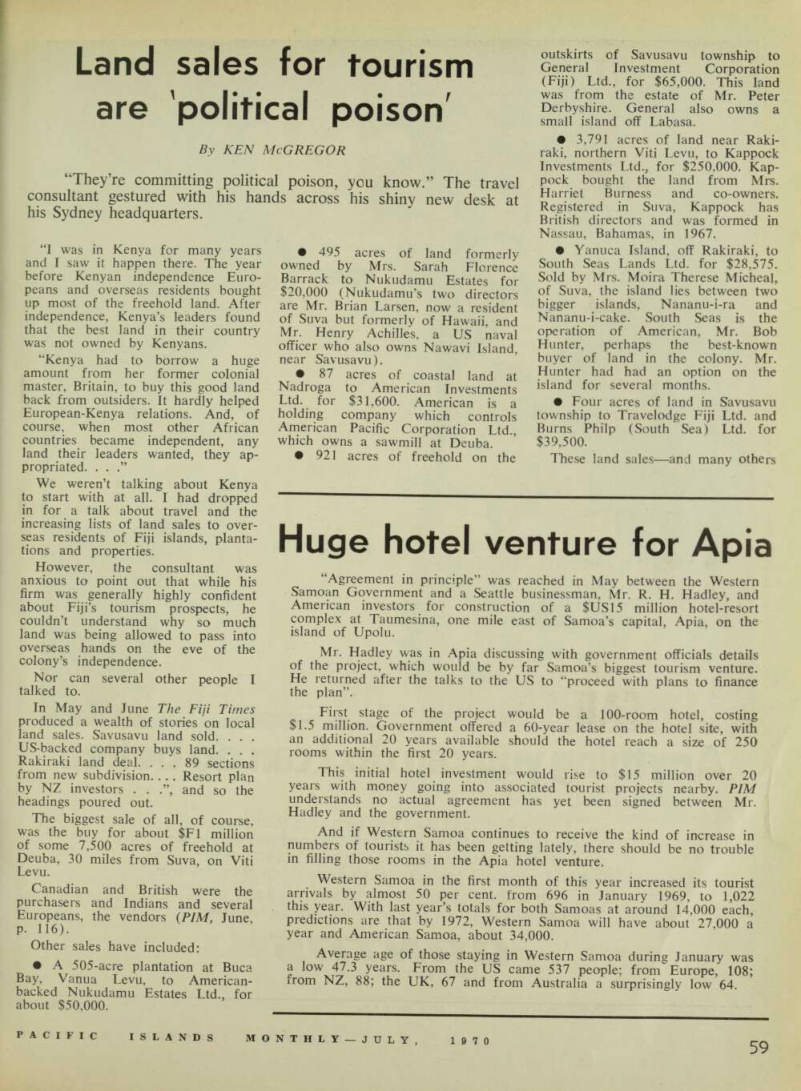
Sold by Mrs. Moira Therese Micheal, of Suva, the island lies between two bigger islands, Nananu-i-ra and Nananu-i-cake. South Seas is the operation of American, Mr. Bob Hunter, perhaps the best-known buyer of land in the colony. Mr.
Hunter had had an option on the island for several months. • Four acres of land in Savusavu township to Travelodge Fiji Ltd. and Burns Philp (South Sea) Ltd. for $39,500.
These land sales—and many others
still going on—have sent values spiralling in Fiji especially around Suva and the Coral Coast area, from Suva to Nadi. Many owners of small blocks who would have been happy to have received $lO,OOO for their property two years ago are now asking double—and they will prob ably get it.
Mr. Jim Mair, managing director of J. H. Mair Ltd., of Suva, paid a Sydney visit in May and said real estate values in Fiji were booming.
He expressed surprise that more Australians weren’t participating in the boom.
Mr. Mair said American investors, both individuals and companies, were buying large tracts of Fiji land for residential sub-division, confident that independence would see an expansion of the country’s economy.
“There is also the advantage of no land tax, and both company tax and individual income tax are at a low level,” he said.
However, many in Fiji see the big land prices pushing up a wide variety of prices, with current investments in land based on long-term potential, rather than on immediate returns in the next two years. And then there’s Fiji’s land shortage ratio to popu lation with the political intangibles of independence. Has anyone con sidered those?
Mr. Robert Hunter