Slit gongs, the prestige item
pp. 59-61 · Read in the full issue

prestige item of the New Hebrides
Gongs of various types are found throughout the New Hebrides, from small, hand-held undecorated bamboo gongs to large, elaborately carved varieties of Malekula and Ambrym.
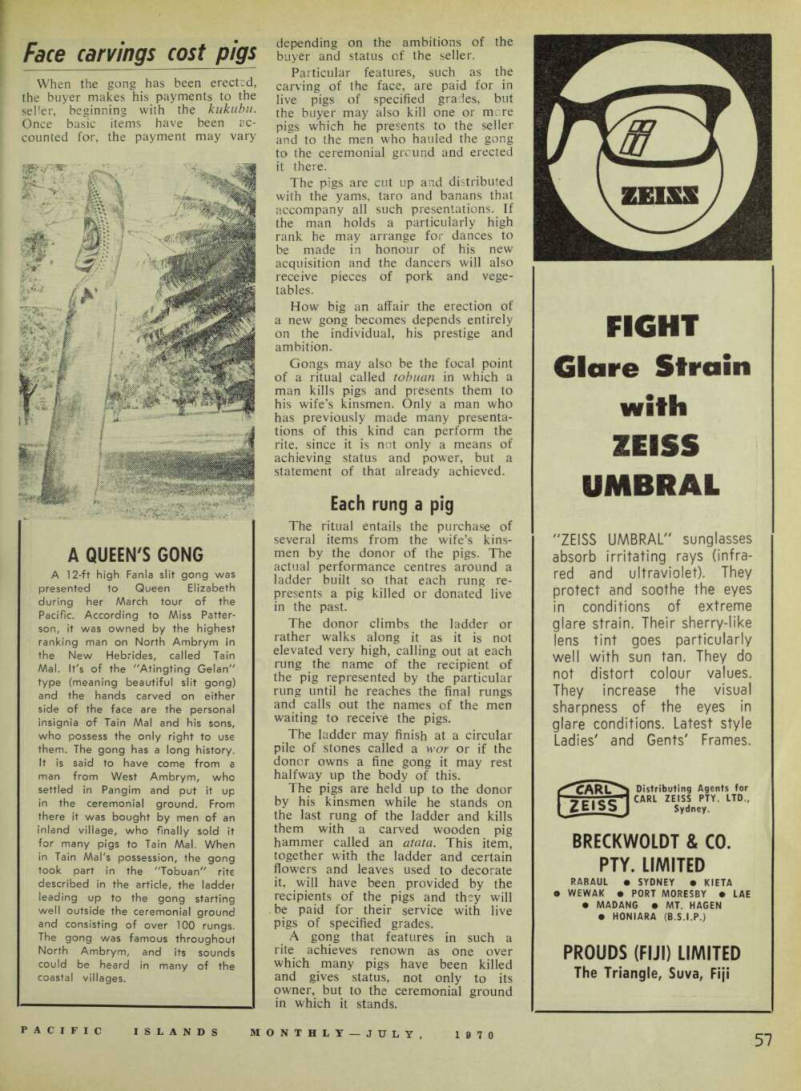
Ambrym gongs are distinctively carved and the Fanla gong is a particularly fine example of the style.
Small gongs with or without the carved face are owned by most Big Men and there is at least one in every ceremonial ground.
The smaller gongs are played with hard wood sticks and have a lighter tone than the large ones, which are played with the trimmed end of a dried coconut spathe. Unlike Male kula, where gongs may be left lying on the ground, in Ambrym they are always set upright, a portion of the base being shaped for the purpose, and it is in this position that they are always played.
Communication system
The gongs are an extremely effect ive inter-village communication system and gongs the size of the Fanla ones are audible for many miles; gong rhythms also play an integral part in all rituals and ceremonials.
Gongs are individually owned and since acquiring one entails consider able expenditure, it is usually only Big Men, that is those men who have achieved the higher ranks in the graded society, who possess them.
The gongs are not regarded as
sacred; however, a certain amount of a Big Man’s power and prestige ac crues to all his personal possessions and the slit-gongs are no exception.
They have a definite ritual signifi cance and, as in Malekula, the erec tion of a new gong may entail con siderable ceremonial.
A gong is acquired in the follow ing way: the prospective buyer ap proaches a man who already pos sesses one of the kind that he wants and requests that he make one for him. If the “seller” agrees, he gives the buyer a pig, a debt which will be cancelled by the return of a slightly larger pig when the actual payment for the gong is made.
The pig returned is called the kukubu or pay-back pig and the transaction is common to the many rituals entailing payments for parti cular rights and paraphernalia in both Ambrym and Malekula.
The seller’s first task is to negotiate for a suitable tree, if he does not have one of his own, and to pay the owner of the breadfruit in compensation for his loss of its fruit.
The felled tree is usually carved on the spot but if it is in or near a frequented spot it may be dragged further into the bush to ensure that only those with rights to carve the
particular kind of gong will have access to it.
Women are strictly excluded from the site and it is believed that should a woman see a gong before it is finished its tone will be spoiled. If the seller does not wish to carve the gong himself he may commission men who have reputations as skilful carvers provided that they or their fathers had previously purchased the right to carve such gongs.
The buyer visits the site from time to time to check the progress of the carving and, if he has never cut a gong himself, to learn the techniques.
Trunk hollowed out
The trunk is first hollowed out, leaving only a narrow slit, the right hand “lip” of which is the only one beaten. The upper part of the gong is then carved into the stylised face or faces that characterise Ambrym gongs.
When the carving and decoration are complete, the buyer arranges a day for payment and erection of the gong with the seller.
On the appointed day the buyer sends a party of men to transport the gong to his ceremonial ground where it will be set up. A long pole is lashed by the men to haul the gong. The pole juts out over the base of the gong and is used as a rudder by the team organiser who steers and calls out the hauling chants used by the team. (Over)
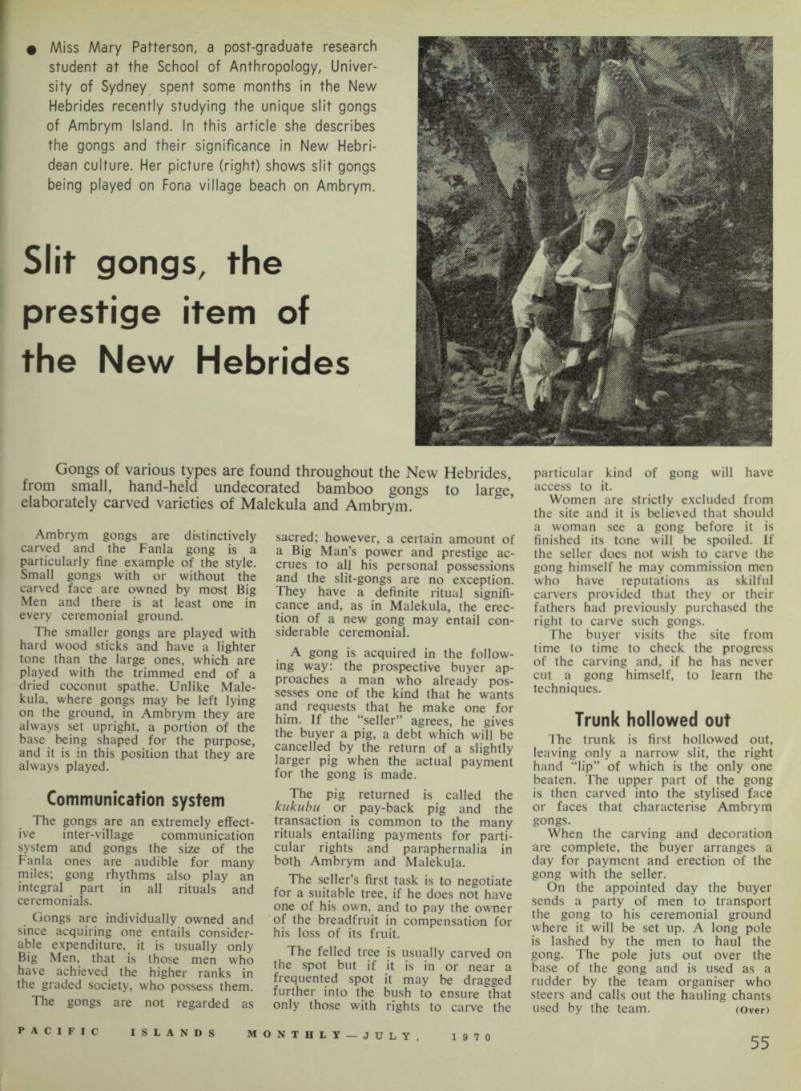
• Miss Mary Patterson, a post-graduate research student at the School of Anthropology, Univer sity of Sydney spent some months in the New Hebrides recently studying the unique slit gongs of Ambrym Island. In this article she describes the gongs and their significance in New Hebri dean culture. Her picture (right) shows slit gongs being played on Fona village beach on Ambrym.
Face carvings cost pigs
When the gong has been erected, the buyer makes his payments to the sel'er, beginning with the kukubu.
Once basic items have been ac counted for, the payment may vary
depending on the ambitions of the buyer and status of the seller.
Particular features, such as the carving of the face, are paid for in live pigs of specified grades, but the buyer may also kill one or mere pigs which he presents to the seller and to the men who hauled the gong to the ceremonial ground and erected it there.
The pigs are cut up and distributed with the yams, taro and banans that accompany all such presentations. If the man holds a particularly high rank he may arrange for dances to be made in honour of his new acquisition and the dancers will also receive pieces of pork and vege tables.
How big an affair the erection of a new gong becomes depends entirely on the individual, his prestige and ambition.
Gongs may also be the focal point of a ritual called tobuan in which a man kills pigs and presents them to his wife’s kinsmen. Only a man who has previously made many presenta tions of this kind can perform the rite, since it is not only a means of achieving status and power, but a statement of that already achieved.
Each rung a pig
The ritual entails the purchase of several items from the wife’s kins men by the donor of the pigs. The actual performance centres around a ladder built so that each rung re presents a pig killed or donated live in the past.
The donor climbs the ladder or rather walks along it as it is not elevated very high, calling out at each rung the name of the recipient of the pig represented by the particular rung until he reaches the final rungs and calls out the names of the men waiting to receive the pigs.
The ladder may finish at a circular pile of stones called a wor or if the donor owns a fine gong it may rest halfway up the body of this.
The pigs are held up to the donor by his kinsmen while he stands on the last rung of the ladder and kills them with a carved wooden pig hammer called an atata. This item, together with the ladder and certain flowers and leaves used to decorate it, will have been provided by the recipients of the pigs and they will be paid for their service with live pigs of specified grades.
A gong that features in such a rite achieves renown as one over which many pigs have been killed and gives status, not only to its owner, but to the ceremonial ground in which it stands.