Tontoua plans
p. 51 · Read in the full issue
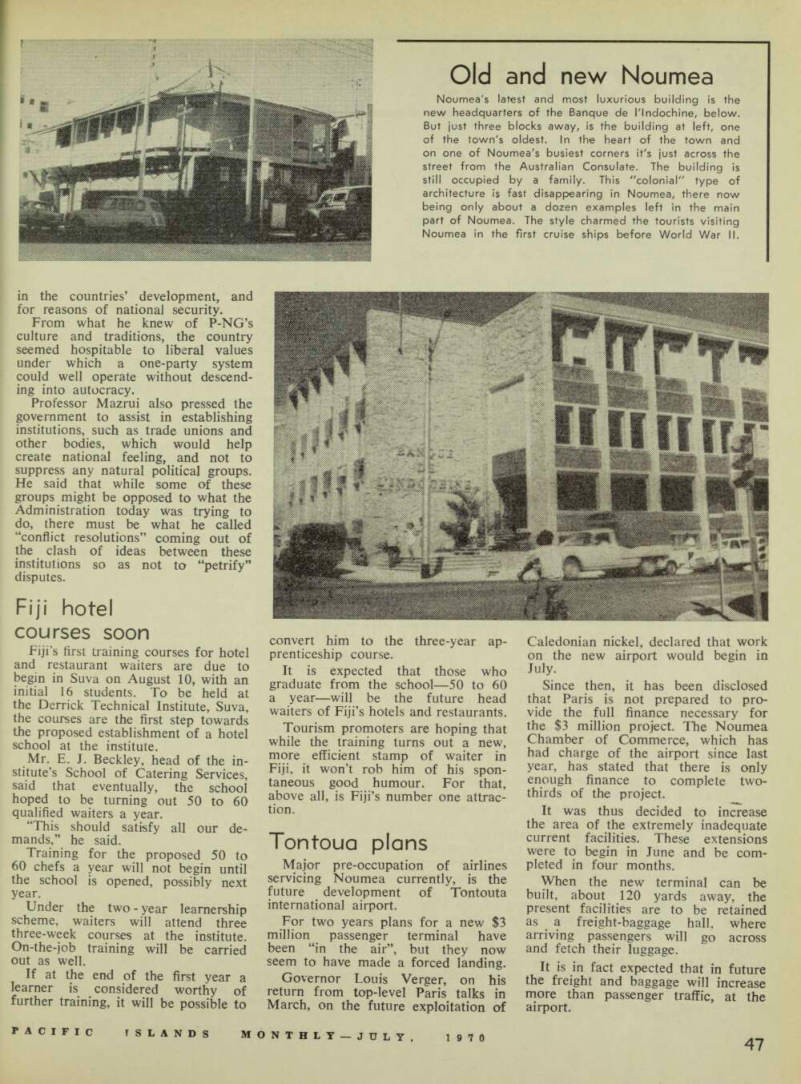
Old and new Noumea
Noumea's latest and most luxurious building is the new headquarters of the Banque de I'lndochine, below.
But just three blocks away, is the building at left, one of the town's oldest. In the heart of the town and on one of Noumea's busiest corners it's just across the street from the Australian Consulate. The building is still occupied by a family. This "colonial" type of architecture is fast disappearing in Noumea, there now being only about a dozen examples left in the main part of Noumea. The style charmed the tourists visiting Noumea in the first cruise ships before World War 11.
in the countries’ development, and for reasons of national security.
From what he knew of P-NG’s culture and traditions, the country seemed hospitable to liberal values under which a one-party system could well operate without descend ing into autocracy.
Professor Mazrui also pressed the government to assist in establishing institutions, such as trade unions and other bodies, which would help create national feeling, and not to suppress any natural political groups.
He said that while some of these groups might be opposed to what the Administration today was trying to do, there must be what he called “conflict resolutions” coming out of the clash of ideas between these institutions so as not to “petrify” disputes.
Fiji hotel
courses soon Fiji’s first training courses for hotel and restaurant waiters are due to begin in Suva on August 10, with an initial 16 students. To be held at the Derrick Technical Institute, Suva, the courses are the first step towards the proposed establishment of a hotel school at the institute.
Mr. E. J. Beckley, head of the in stitute’s School of Catering Services, said that eventually, the school hoped to be turning out 50 to 60 qualified waiters a year.
“This should satisfy all our de mands,” he said.
Training for the proposed 50 to 60 chefs a year will not begin until the school is opened, possibly next year.
Under the two - year leamership scheme, waiters will attend three three-week courses at the institute.
On-the-job training will be carried out as well.
If at the end of the first year a learner is considered worthy of further training, it will be possible to
convert him to the three-year ap prenticeship course.
It is expected that those who graduate from the school—so to 60 a year—will be the future head waiters of Fiji’s hotels and restaurants.
Tourism promoters are hoping that while the training turns out a new, more efficient stamp of waiter in Fiji, it won’t rob him of his spon taneous good humour. For that, above all, is Fiji’s number one attrac tion.
Tontoua plans
Major pre-occupation of airlines servicing Noumea currently, is the future development of Tontouta international airport.
For two years plans for a new $3 million passenger terminal have been “in the air”, but they now seem to have made a forced landing.
Governor Louis Verger, on his return from top-level Paris talks in March, on the future exploitation of
Caledonian nickel, declared that work on the new airport would begin in July.
Since then, it has been disclosed that Paris is not prepared to pro vide the full finance necessary for the S 3 million project. The Noumea Chamber of Commerce, which has had charge of the airport since last year, has stated that there is only enough finance to complete two thirds of the project.
It was thus decided to increase the area of the extremely inadequate current facilities. These extensions were to begin in June and be com pleted in four months.
When the new terminal can be built, about 120 yards away, the present facilities are to be retained as a freight-baggage hall, where arriving passengers will go across and fetch their luggage.
It is in fact expected that in future the freight and baggage will increase more than passenger traffic, at the airport.