Tropicalities
pp. 46-49 · Read in the full issue
Three million French Pacific francs, or approximately $A27,000, was the asking price for an away-from-it-all Pacific island, replete with white sandy beaches, which came on the market recently.
The island, which is in the remote Tuamotu Archipelago of French Polynesia, was advertised in the “classifieds” of the Papeete Press over a period of several weeks.
The advertisement (translated from French) read: “Tuamotu, south-east of Hao, island 26 kilometres in circumference, beaches of white sand, fresh water tank, small solid house.
Price 3 million French Pacific francs.
Possibility of credit”.
Although the island was unnamed, there seems little doubt that it is Ahunui Atoll, about 100 miles south east of Hao and some 600 miles from Tahiti. There is no other eligible island in that direction.
Ahunui is one of those Pacific Islands which is so far away from it all that virtually nothing has ap peared about it in print since its first discovery by Europeans.
Its discoverer was Captain F. W.
Beechey, of HMS Blossom, who came upon it in late February, 1826, and named it Byam Martin Island.
He had quite a story to tell about what he found there.
“As we neared the shore,” he wrote, “the natives made several fires.
Shortly afterwards three of them launched a canoe, and paddled fearlessly to the barge, which brought them to the ship. Instead of the deep coloured uncivilised Indians inhabit ing the coral islands in general, a tall well-made person, comparatively fair, and handsomely tattooed, ascended the side, and, to our surprise, familiarly accosted us in the Otaheitean manner. The second had a_ hog and a cock tattooed upon his breast—animals almost unknown among the islands of Eastern Poly nesia; and the third wore a turban of blue nankeen. Either of these were distinctions sufficient to excite considerable interest. . . .”
Inquiry revealed that the three men, together with a dozen other islanders on shore, were natives of Anaa Atoll, who had set off in a 30 ft double canoe two years earlier to go to Tahiti to pay tribute to Queen Pomare. Instead, they had been
Away From It All
-And Only
$27,000 caught in a storm and blown to Vanavana Atoll, about 500 miles in the opposite direction. After living on Vanavana for a year, the islanders had repaired their boat and had sailed homewards as far as Ahunui, a distance of about 100 miles, where they again temporarily settled.
They had been on Ahunui about a year when Captain Beechey arrived, and they begged him to take them home. Beechey half promised to do so, and next morning the islanders were waiting expectantly on the beach with their belongings.
However, Beechey finally consented to take only their chief and his family—the rest being left to find their own way home, to await the arrival of another ship (a fairly un likely occurrence), or simply to stay where they were.
History does not reveal whether the islanders ever did get home; but the Pacific Islands Pilot states that the island is now “uninhabited except during the copra harvest”.
As for whether anyone recently managed to raise the money to buy their island, we have no positive in formation about that, either.
After several weeks of regular appearances, the “for sale” notice in the Papeete newspapers quietly dis appeared without editorial comment.
Noumea tries new
school hours
A serious dispute between teachers and the Education Department over primary school hours in New Cale donia (PIM, May, p. 33) has resulted
in the trial of a new system. It follows a democratic consultation between authorities and parents.
Of the three systems proposed, the authorities have decided to test the so-called “Polynesian week”, begin ning in June. Primary children will attend classes every morning Monday- Friday until 11 a.m. They then return every afternoon except Wed nesday. This means the traditional Thursday holiday is replaced by a free Wednesday afternoon, with no more Saturday morning classes either.
The reverse is however maintained for high school pupils.
It’s a relief for the youngsters and parents who like to be free to travel inland on Saturdays, says a Noumea correspondent.
Fiji may start its
own Peace Corps
Fiji may have its own internal Peace Corps if an idea raised at the recent Student Christian Movement conference is followed up. Further discussions are taking place at the moment on the setting up of the student volunteer movement to give service to the community in Fiji.
Proposals for raising money in clude the suggestion that students give 1 per cent, of their pocket money to help get the scheme off the ground.
Rose and Eva,
two bright girls
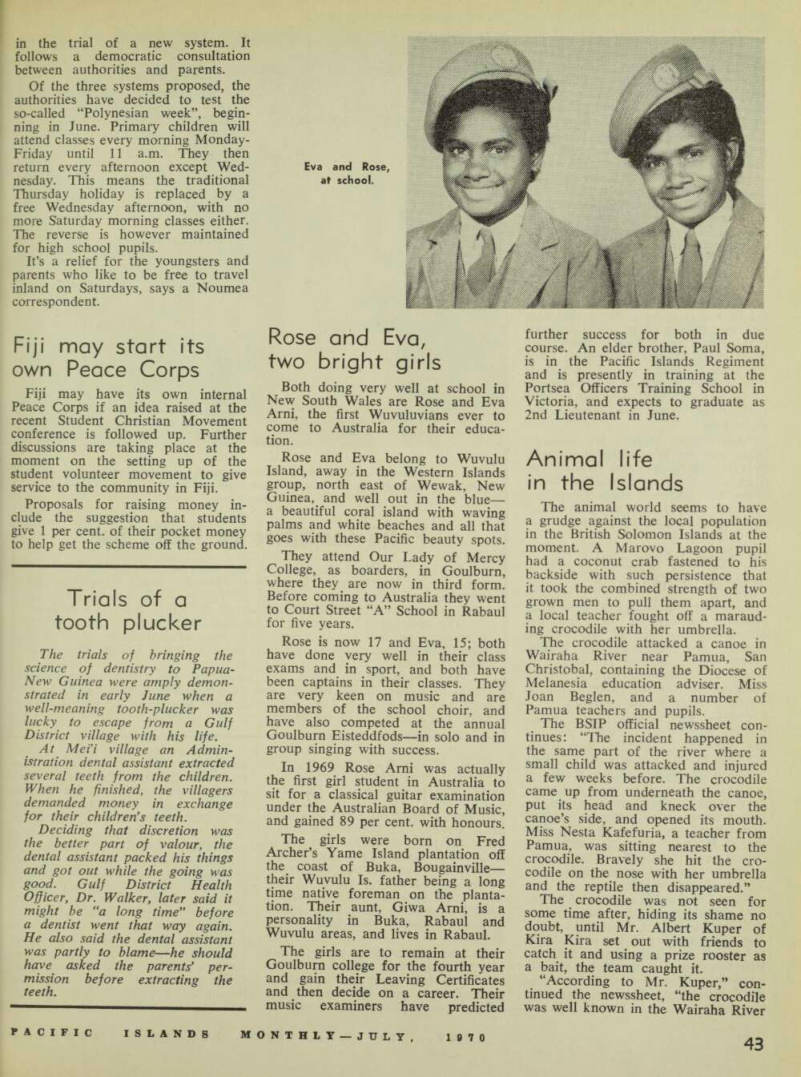
Both doing very well at school in New South Wales are Rose and Eva Arni, the first Wuvuluvians ever to come to Australia for their educa tion.
Rose and Eva belong to Wuvulu Island, away in the Western Islands group, north east of Wewak, New Guinea, and well out in the blue— a beautiful coral island with waving palms and white beaches and all that goes with these Pacific beauty spots.
They attend Our Lady of Mercy College, as boarders, in Goulburn, where they are now in third form.
Before coming to Australia they went to Court Street “A” School in Rabaul for five years.
Rose is now 17 and Eva, 15; both have done very well in their class exams and in sport, and both have been captains in their classes. They are very keen on music and are members of the school choir, and have also competed at the annual Goulburn Eisteddfods—in solo and in group singing with success.
In 1969 Rose Arni was actually the first girl student in Australia to sit for a classical guitar examination under the Australian Board of Music, and gained 89 per cent, with honours.
The girls were born on Fred Archer’s Yame Island plantation off the coast of Buka, Bougainville— their Wuvulu Is. father being a long time native foreman on the planta tion. Their aunt, Giwa Arni, is a personality in Buka, Rabaul and Wuvulu areas, and lives in Rabaul.
The girls are to remain at their Goulburn college for the fourth year and gain their Leaving Certificates and then decide on a career. Their music examiners have predicted
further success for both in due course. An elder brother, Paul Soma, is in the Pacific Islands Regiment and is presently in training at the Portsea Officers Training School in Victoria, and expects to graduate as 2nd Lieutenant in June.
Animal life
in the Islands
The animal world seems to have a grudge against the local population in the British Solomon Islands at the moment. A Marovo Lagoon pupil had a coconut crab fastened to his backside with such persistence that it took the combined strength of two grown men to pull them apart, and a local teacher fought off a maraud ing crocodile with her umbrella.
The crocodile attacked a canoe in Wairaha River near Pamua, San Christobal, containing the Diocese of Melanesia education adviser. Miss Joan Beglen, and a number of Pamua teachers and pupils.
The BSIP official newssheet con tinues: “The incident happened in the same part of the river where a small child was attacked and injured a few weeks before. The crocodile came up from underneath the canoe, put its head and kneck over the canoe’s side, and opened its mouth.
Miss Nesta Kafefuria, a teacher from Pamua, was sitting nearest to the crocodile. Bravely she hit the cro codile on the nose with her umbrella and the reptile then disappeared.”
The crocodile was not seen for some time after, hiding its shame no doubt, until Mr. Albert Kuper of Kira Kira set out with friends to catch it and using a prize rooster as a bait, the team caught it.
“According to Mr. Kuper,” con tinued the newssheet, “the crocodile was well known in the Wairaha River
Eva and Rose, at school.
and had been called ‘Uncle’ by the Rawake school girls, who considered him harmless until this year’s attacks.
The girls became angry with him after his unfriendly behaviour and so they ate heartily of the crocodile steaks given them by Mr. Kuper.”
In the case of the poor lad taken from behind by a coconut crab, the newssheet reports: “Education Week at Putukau Junior Primary School, Marovo Lagoon, was not without its excitement. One of the pupils, Berven Senu, was hunting coconut crabs with his friends for a feast to be held at the end of the week, when a large crab fell on his back and fastened his nippers into the boy’s buttocks.
“Poor Berven was in great pain and called for help. He tried to get rid of the crab by running this way and that through the bush, but the crab still hung there. Eventually after some minutes Mr. Green Jino, the head teacher, and our correspon dent, helped Berven to tear the front of his trousers and managed to pull both trousers and crab away at the same time.
“Apart from spoiling his trousers, there was no permanent damage to Berven, and he managed to enjoy the feast at the end of Education Week when 100 coconut crabs (including the one that bit him) and many other good things were eaten.”
A family search in
the Solomons
A young Queenslander is making inquiries throughout the Solomon Islands to find out if any of his relatives are still alive. The Queens lander is one Charlie Bobongi, who claims to be the grandson of people blackbirded from the Islands to work on the Australian canefields.
Charlie, said to look like a Malai taman, doesn’t know what part of the Solomon his people came from, but recalls that people called Fat nouna were friends of his family.
Charlie’s home is now Seaforth, near Mackay, Queensland, where, he says, there are several hundred descendants of Solomon Islanders living. Most of them are still cane cutters and fruit-pickers, but quite a number of the young girls work in the district hospital.
They are the descendants of people who stayed on in Australia after re cruiting for labour stopped in 1904.
The only clue Charlie has to his back ground is his name. Any Solomon Islanders who might help Charlie trace his lineage can contact the BSIP Newssheet, Honiara. We wish him luck.
Help for Solomons'
polio victims
A man who could bring new hope to the hundreds of Solomon Islanders who suffer from polio, arrived in Honiara recently. Professor Huck step, a world expert on polio, made a week’s visit during which he saw more than 600 patients, performed several operations and gave advice to medical staff on treatment for the disease.
He said that many of the Islanders who hitherto were crippled would be able to walk again after operations if they were provided with simple callipers or supports. He hoped to
set up a workshop at the central hos pital for the manufacture of such supports, once a cheap type suitable for use in the Solomons had been developed. Polio patients themselves could produce them.
Professor Huckstep said over 1,000 of the supports would be needed as in his experience twice the number of patients who had already presented themselves would come forward once the supports were available..
He said the Solomon Islands were lucky to a certain extent because at least polio vaccine was available in the protectorate. Many developing countries couldn’t afford to pay for it and the number of cases was in creasing, especially in the tropics.
Saying what you
think on NG
Black power in Papua-New Guinea? Black power in the Pacific?
It’s not so far off, and, in fact, there have been signs of its adherents in Papua-New Guinea for some time now.
They’re not advocating violence necessarily, although it appeals to some privately as the simplest way to overthrow the white who dom inate this country in every field at present.
It’s only a small ground swell at present, and its rise won’t be rapid.
A political forum at the University of Papua-New Guinea recently heard black power philosophy expounded by the Trobriand Islands’ most politically active student, John Kasaipwalova, although he didn’t give it that name. But he made no bones about his intentions in the title he gave to his subject, “Why We Should Hate Whites”.
Before more than 200 students and staff of all races, Kasaipwalova fluently and rationally declared that whites in the territory should be hated in the sense that they should be re jected, and their dominating power structure with them, so the native people could stand up with pride as members of their own race.
He rejected outright the colonial attitude that a good New Guinean could only be so if he was “a brown Australian”.
Dressed in a bright tunic-like garment made of a material printed with a native design, over trousers and thongs, Kasaipwalova said the acceptance by most New Guineans of this “brown Australian” idea was obvious in their apeing of Australian dress, manners and customs.
Meanwhile, a dapper, outspoken East African professor of political science has shaken to its foundations the acceptance by many involved in Papua-New Guinea’s future that the territory must adopt either the West minster or United States systems of government.
Professor Ali Mazrui, from Uganda, blew apart the contention put forward only the day before by eminent judge of the Australian Commonwealth Industrial Court, Mr. Justice Kerr, that the territory was moving with “implacable” force towards the Westminister form of government.
Professor Mazrui was the main guest speaker at a seminar on con stitutional development in Papua-
New Guinea, run at the end of May at the territory’s university in Port Moresby by the Council on New Guinea Affairs, a private group of people interested in P-NG’s develop ment.
The professor said he felt he owed it to his sponsors to comment positively, and he did just that. He opened up by saying that the prob lems of African countries approach ing independence (disunity, lack of polical parties, uneven development, poorly developed or undeveloped institutions such as trade unions and so on) were grotesquely illustrated in P-NG. New Guinea was at once a miniaturisation of Africa and an exaggeration, and was the one place in the world he knew of which was really relevant to Africa. (Years ago it was popular to try to compare P-NG’s problems with Africa’s to find solutions, but this lost popularity in favour of looking inwards).
The professor thought it would be Anglo-centric to discuss only the British and United States forms of government in trying to come up with a form for P-NG, especially as these two were more alike than different.
He urged there be a national language to help cultural integra tion. Pidgin was the obvious language to promote; but it needed to be re named to get away from the implica tion that it was a “broken” language, its rules needed to be set down and the language left to solidify and
become part of the country’s culture (through translations of Shakespeare, for example, and local writings), with English remaining a complementary language.
The professor was not kind to Australia as a colonial power. At least, he said, the British in Africa had contributed to national unity by their exploitative attitude to the colonies. But Australians took the only attitude that could be worse— they were indifferent, thus denying New Guineans even the shared anti colonial feeling that had been such an important contribution to nation hood in Africa.
There was practically nothing of this long tradition of exploitation to help P-NG combine its 700-odd separate cultures into a national feeling, there was no flag, no anthem or national song, no unifying cause.
The Australian Administration had in fact perpetuated differences through the artificial line between Papua and New Guinea, and the 18 districts which brought about un equal progress, and you had to add to these the linguistic differentiation, and the geophysical break-up of the peoples between Highlanders and coastal peoples.
But his main bombshell probably was his acceptance that the West minster system would be just as likely to fall apart because strong political parties were unlikely to develop. One party rule was now either current, or virtually so, in East African countries because of this “weakness”