New Guinea's
pp. 36-37 · Read in the full issue
House begins to get up and go
From a Port Moresby correspondent Liberal thinking and support for principles gained a sudden spurt in the June sitting of the House of Assembly.
The formerly government dominated house on the hill in Port Moresby this time showed more than just signs of independent thought, and actually supported the once despised “radical” Pangu Party in defeating the government on a motion which was not, perhaps, so important in itself, but which released a surprising amount of desire to put the government in its place for once.
Not that the government didn’t have things mostly its way as usual.
The government appointed Leader of the House, the Assistant Admin istrator, Mr. Tony Newman, is still running things behind the scenes, and manipulating the House quite blatantly when it suits his more urgent purposes.
One constant observer commented that his hamfisted approach would lose the government considerable sympathy in the next few meetings, unless modified drastically to allow members time to think and under stand, and vote according to consci ence, as well as be influenced the government’s way. (Newman stepped up into the Leader’s position when Administrator-elect, Mr. Les John son, moved out earlier this year).
A sight in the House is still watch ing one of the government-appointed Official Members (there are 10) work ing the strings on his half-dozen Highlands puppets, physically pull ing them down or pushing them to their feet in divisions when they un certainly vote the “wrong” way.
The Pangu motion, introduced by Mr. Joe Paul Langro (West Sepik) to change the name of the Public Ser vice Training Centre back to the Administrative College, received con siderable Highlands support when the government, after debating hard, stayed mum during the vote which came out 37 to 23 in favour Pangu’s nine members, which along
with the Rev. Percy Chatterton (Moresby), Mr. Ebia Olewale (South Fly), and Mr. Peter Johnson (An goram), provide the only consistent opposition of substance to the gov ernment point of view among the 94 members, have now come in out of the cold to find, at least, that the fire had been lit, even if its not par ticularly warm yet.
The Mataungan Association’s name this sitting was not greeted by the usual rumble of disapproval—per haps its sparking capacity had been worn in the hot debate on the War waram Affair. Ebia Olewale was able to argue Mataungan’s right to exist and expand in a democratic society, and added that the way to fight Mataungan if anyone disagreed was to form opposition groups.
Both Olewale and Pangu Parlia mentary leader, Michael Somare, de fended the rights of free speech and association, in particular for the Australian secretary of Bougain ville’s Napidakoe Navitu political society, which, among other things, advocates secession from the terri tory for Bougainville.
The secretary, Barry Middlemiss, was the subject of a motion by Bougainville Regional member, Joseph Lue, to have the government de port him on the grounds that he was trying to take the place of the elected members as the people’s leader, Lue was supported by Bougainville North MHA, Donatus Mola, who
was also annoyed at Middlemiss’! activities, including the Navitu’s at tempt to extend its unofficial refer endum, on whether Bougainvilh should secede, into Mola’s area.
However, fellow Navitu executiv< member Paul Lapun (Bougainvilk South), said Middlemiss was in fac doing for the people things whicl the two members had failed to do and the two members were afrak they would not be re-elected. H< added that Middlemiss was not seek ing membership of the House, anc had already turned down the presid ency of a local government council Lue’s motion was watered dowi by himself in the end to ask for at investigation of Middlemiss’s activities and this was passed.
Ebia Olewale, among Papuan anc New Guinean MHA’s, showed prob ably the biggest improvement in de bating ability this year. His obvious intelligence and searching, deep con cern for bigger issues make him £ man to watch closely during the re maining half-dozen meetings of the House before the next elections.
The Chairman of the House’s
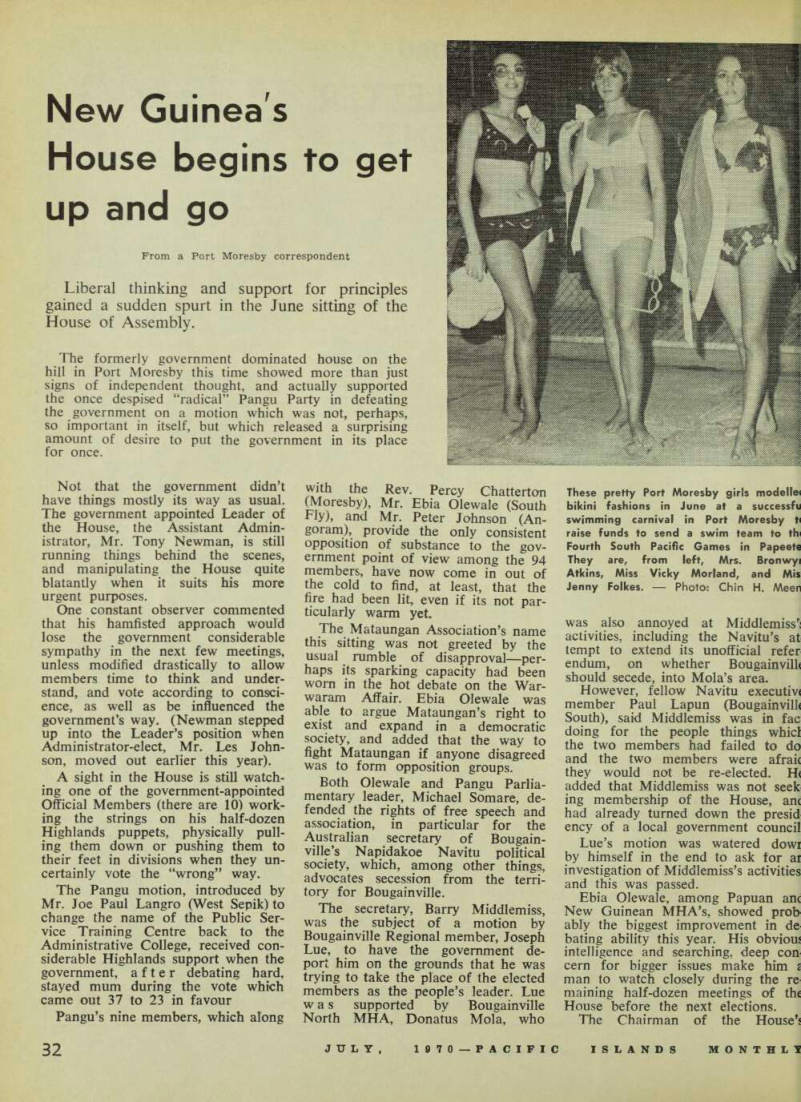
These pretty Port Moresby girls modeled bikini fashions in June at a successful swimming carnival in Port Moresby to raise funds to send a swim team to the Fourth South Pacific Games in Papeete[?] They are, from left, Mrs. Bronwy[?] Atkins, Miss Vicky Morland, and Miss Jenny Folkes. -Photo: Chin H. Meen.
Select Committee on Constitutional Development, Paulus Arek, who is touring the Pacific in July as part of the committee’s investigations, also stood up for the House’s right to make decisions on major consti tutional changes. He said that in future, any constitutional changes in volving amendments to the Papua- New Guinea Act (of the Australian Parliament) could come only after recommendations from the com mittee.
This may have stolen some thunder from the Australian Prime Minister, Mr. John Gorton, who was due in Papua-New Guinea in July in answer to the dramatic tour of the Australian Labour Party Opposi tion leader, Mr. Gough Whitlam, early this year.
Mr. Arek also echoed several lead ing citizens when he told the House that the government had been in effectual in educating the people about politics, as evidenced by the committee’s recent lengthy tours of the countryside, gathering opinions about the territory’s constitutional future.
Farewell speech
The retiring Administrator, Mr.
David Hay, made a farewell speech to the House, notable mainly for his emphasis on the need for a strong central government for a self-govern ing Papua-New Guinea, his determin ation to refrain from commenting on his successor’s way of doing things (unlike the former Administrator, Sir Donald Cleland, and former Assist ant Administrator, Dr. John Gunther, he obviously inferred), and his pleasure at being able to do even more for the territory as the new Secretary of the Department of Ex ternal Territories in Canberra work ing in liaison with the new Admini strator, Mr. Les Johnson.
Mr. Peter Johnson called for a House committee to enquire into practically all aspects of malaria eradication and control. It was a timely call, considering the woeful state of the malaria services, which have been losing ground in their fight because of insufficient funds, possible lesistance to DDT spraying, and lack of the dedicated staff neces sary to be effective. The Health Department told him that an internal investigation on what was needed to reform malaria services was going on, and he was promised that the report on the investigation would be tabled in the House before the end of this year. He reserved the right to call again for a committee if this wasn’t satisfactory.
Death Of President Soekarno
Former President Soekamo, of Indonesia, died on June 21, aged 69.
He was president for nearly 22 years —from the time of Indonesian in dependence in 1945, till he was re moved from power in March, 1967.
Soekarno was the man mainly responsible for Indonesia taking West Irian from Dutch control.