End of a Nauruan era
p. 34 · Read in the full issue
The control of Nauru’s economy—its phosphate industry— finally passed into the republic’s hands on June 30 for the first time since the phosphate was discovered on the island in 1900.
The end of an era was marked at a brief ceremony that day at the Melbourne office of the British Phos phate Commissioners, and after wards at a news conference called by Nauru’s president, Hammer De- Roburt.
It was the opportunity for the President to comment on the past and make predictions for the future.
Nauru’s phosphate was discovered as a result of a chance inspection of a lump of “fossilised wood” used as a doorstop. [For new light on that historic incident, see the panel on the opposite page.] Today Nauru produces two million tons of phosphate a year, and Presi dent Deßoburt estimated at his news conference that at the present rate of extraction the phosphate will be exhausted in about 20 years. In the meantime Nauru had given priority to establishing alternative source of income for the 3,000 Nauruans.
He said shipping was the repub lic’s first venture. The 6,000-ton Eigamoiya, named after a Nauruan queen of the old days, was now “profitably employed” on the Aus tralia-New Guinea route carrying cargo. The Rosie D., formerly the bulk phosphate carrier Triaster, was now in service between Melbourne and Nauru, and the recently pur chased 9,335 ton Princess Margriet, renamed Emma G., after the wife of a former Head Chief, the late Raymond Gadabu, would go into service later this year between Aus
tralia and South Pacific ports. She carries 100 passengers.
The President said there were good possibilities of a fishing industry being established on Nauru, if a port could be created. The Japanese Mit subishi company was interested in the fishing scheme, which needed further investigation.
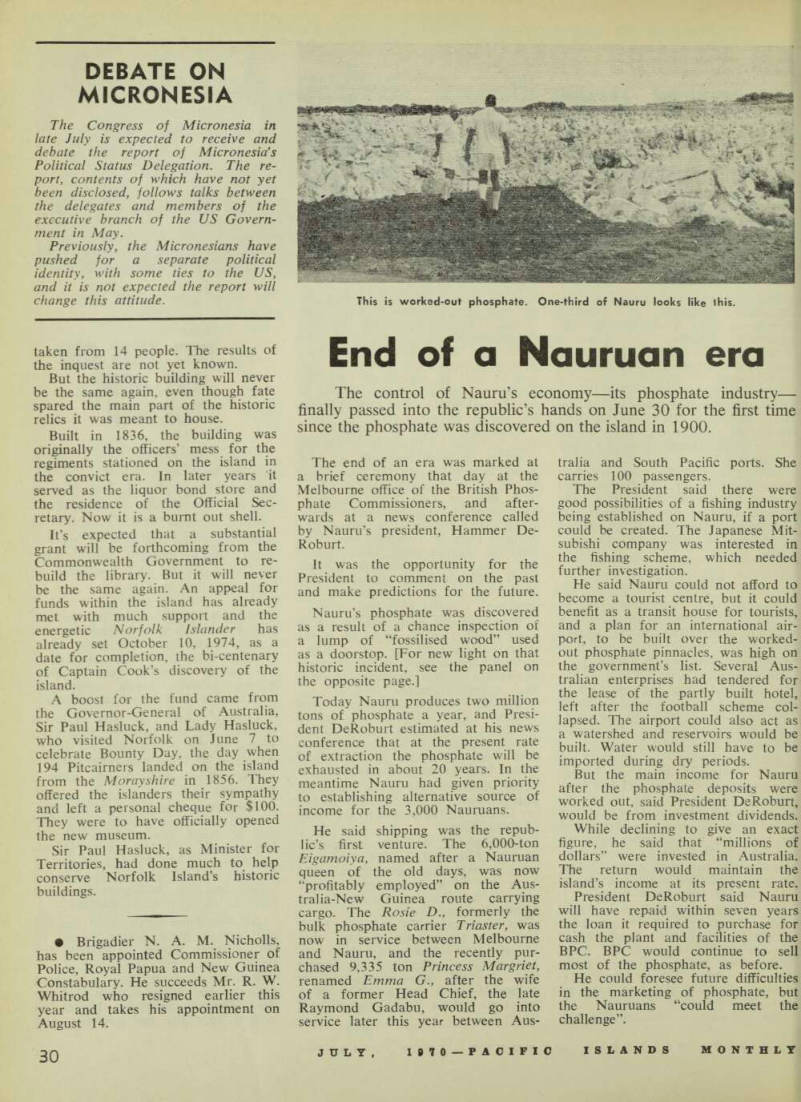
He said Nauru could not afford to become a tourist centre, but it could benefit as a transit house for tourists, and a plan for an international air port, to be built over the worked out phosphate pinnacles, was high on the government’s list. Several Aus tralian enterprises had tendered for the lease of the partly built hotel, left after the football scheme col lapsed. The airport could also act as a watershed and reservoirs would be built. Water would still have to be imported during dry periods.
But the main income for Nauru after the phosphate deposits were worked out, said President Deßoburt, would be from investment dividends.
While declining to give an exact figure, he said that “millions of dollars” were invested in Australia.
The return would maintain the island’s income at its present rate.
President Deßoburt said Nauru will have repaid within seven years the loan it required to purchase for cash the plant and facilities of the BPC. BPC would continue to sell most of the phosphate, as before.
He could foresee future difficulties in the marketing of phosphate, but the Nauruans “could meet the challenge”.
This is worked-out phosphate. One-third of Nauru looks like this.