The Practical Planter
pp. 149-157 · Read in the full issue
The Importance Of Mineral Manure
In Coconut Growing
y M. POMIER for a book on coconut growing in the Pacific to be published by the South Pacific Commission.
Nutrition plays a very important part in coconut growing and in most of the coconut palm regions is a limiting factor of growth or production. Agricultural experiments have shown that it is worth hile to correct any deficiencies by the application of fertilisers. This, however, represents a financial jrden for the planter, and should only be used as an adjunct to other cultivation operations; for stance, to apply fertilisers in a coconut grove overrun by the bush or in a badly drained plantation ill not achieve any improvement in yield.
Since fertilisers are expensive, only e lacking elements should be iplied; with this end in view there e several methods of discovering e deficiencies affecting a coconut antation.
Soil examination
Information obtained as a result soil analyses carried out by ecialised laboratories should be terpreted with caution for, in a yen soil, a particular plant may veal a deficiency in a given element tiereas another would show little in of it.
Agricultural experiments carried it by research stations show that ery category of soil is prone to a rtain number of deficiencies: • Coral atoll soils show serious ficiencies in iron and average ficiencies in manganese.
Depending on how far decomposed ganic matter has been depleted, the trogen deficiency will be average strong. The potash deficiency is erage. • The coral fringes of high ands, mixed with alluvial mountain posits, show slight nitrogen ficiencies, becoming average to ■ong as the soil grows poorer in composed organic matter. The rtash deficiency is slight. • Raised coral soils, covered with ack, brown or reddish-brown clay, ow slight deficiencies in manganese id nitrogen, and average deficiencies potash. • Raised coral soils covered with llowish to red clay show serious
deficiencies in potash, and slight deficiencies in nitrogen and phos phorus. • Sandy volcanic soil show serious deficiencies in nitrogen and sulphur. • Deep red latosolic soils show average deficiencies in nitrogen, phosphorous and potash. • Alluvial soils show deficiencies in nitrogen, potash and sulphur.
The planter should remember that the above criteria are merely indicative, and he should take into account how far the soil reserves have been exhausted. If, in new soil, the deficiencies are slight, they will be much more serious in the case of an old coconut plantation, and more serious still where a young coco nut plantation has been established to rehabilitate an old one.
Visual examination
An examination of coconut palm fronds will reveal the deficiencies in certain elements.
NITROGEN: In the case of nitrogen deficiency, the fronds are yellow in varying degrees. The old fronds are yellowish orange in colour, while the young ones remain green, but a paler green than those of a tree in good condition. A close examination of the leaflets will show a very slight yellowing in the vicinity of the middle rib in the case of the young fronds, whereas the mature ones are an even yellow all over.
Young coconut palms are stunted, they produce few fronds and even these die rapidly, POTASH: As in the case of nitro
gen deficiency, discolouration is visible on the adult fronds which are yellow, whereas the central cluster remains green. The difference, how ever, will be revealed in a close examination of old coconut palms: yellowing is more pronounced on the circumference of the frond than along the rachis, the leaflets being greener at the base than at the tip, and ending in a cankered point; within a leaflet, yellowing is more pronounced on the circumference than along the central rib.
SULPHUR; The fronds are yellow to yellowish orange in colour, few in number, and are all affected; but above all, the surest indication of sulphur deficiency is the examina tion of the copra produced by these trees; this is generally thin and rub-
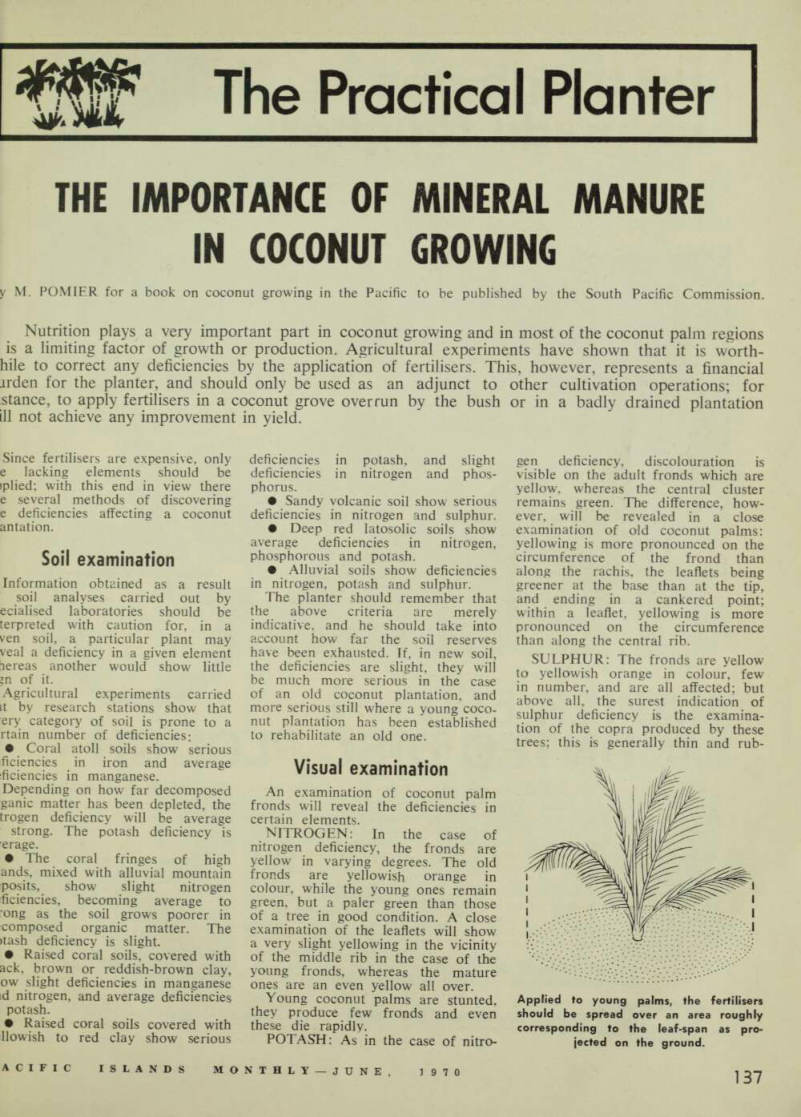
Applied to young palms, the fertilisers should be spread over an area roughly corresponding to the leaf-span as pro jected on the ground.
on deficiency in coral
y, whereas the kernel is normal appearance (it is to be noted that ; characteristic does not apply to arf coconut palms which always Id a certain proportion of rubbery >ra).
RON: This deficiency occurs y in coral soils. The colour of the nt ranges from a pale green to a den yellow, and this discolouration cts all the fronds equally. The tral cluster is, however, some at greener.
Plant analysis
Ihis is the most reliable method liscovering deficiencies in elements, t rests on the analysis of the nents provided to the plant by soil: N, nitrogen; P, phosphorus; potassium; Ca, calcium; Mg, Emesium; Na, sodium; S, sulphur; iron; Mn, manganese, toughly, the principle involved is follows; the analysis of certain ts of the plant (fronds, water, lale flowers, etc.) shows that ;n these contain more than the imum percentage of each element, ►wn as the critical level, the rition of the palm may be arded as satisfactory.
This is demonstrated by the fact t an application of the correspond fertiliser has no effect on growth production. The same analysis lied to a coconut grove whose rition needs to be improved, show ich are the elements whose tent is below the critical level, consequently which fertilisers are be applied. planter wishing to use this mique should contact the agri diral services in his area.
Fertilising content
lie main characteristic of a dliser is its fertilising element tent—i.e. the active part which be used by the coconut palm, n industrial countries where tones are close at hand, it is letimes more economical to use ilisers which are not very highly centrated. In the South Pacific jre the transport costs represent a y large proportion of the price the fertiliser, it is almost always advantage to use the most highly icentrated forms.
NITROGEN: Nitrogen deficiency often the consequence either of presence of graminaceae which large nitrogen consumers, or of lack of decomposed organic tter in the soil caused by the nate or, more often than not, by >r cultivation methods.
Since nitrogen fertilisers are very expensive, the planter should know that a good legume cover is the most economical way of correcting a nitrogen deficiency.
However, as regards young coconut palms planted in poor soil (parti cularly coral soil) where their growth is considerably stunted because of the nitrogen deficiency, it is essential that fertilisers be applied during the first five years, their action being subsequently taken over by the legume cover. The dosage to be applied is 50 g of nitrogen in the first year, increased to 200 g in the fourth and fifth years.
Nitrogen fertiliser
These are: Ammonium sulphate at 20 per cent ammoniacal N. Urea at 45 per cent ammoniacal N. Sodium nitrate at 15 per cent, nitric N.
Ammonium nitrate, the most current dosage being 11 per cent, nitric N and 11 per cent, ammoniacal N.
Ammoniacal nitrogen has the property of being retained in the soil by the clay associated with the decomposed organic matter, whereas nitric nitrogen is not retained; but only the nitric form is capable of absorption by the coconut palm roots, while the ammoniacal form must first of all be converted into nitrate under the action of soil bacteria.
These characteristics will guide the planter in the choice of fertiliser to be employed.
Under the action of soil bacteria, ureal nitrogen is converted into ammoniacal nitrogen fixed by the soil.
Thus these two fertilisers are to be used in soil containing clay; they are to be avoided in coral soil lack ing in clay, for ammoniacal nitrogen is not retained therein and a part would be lost through leaching before it could be converted into absorbable nitrate.
It should be noted, however, that in certain types of clayey soils urea is not very effective and should be replaced by ammonium sulphate or nitrates. Only the agricultural services of the area will be able to advise the planter on this point.
Sodium nitrate and ammonium nitrate are two nitric fertilisers capable of immediate absorption by the coconut palm. They should be used mainly in coral soils. In
This article is from "Coconut Production In The South Paci fic", edited by Mr. M. Lambert and published by the SPC.
ammonium nitrate at 22 per cent. N half the nitrogen is in ammoniacal form; in coral soil only a part of the ammonia is converted into nitrate, the remainder being washed into the ground by rain.
In practice it may be considered that these two fertilisers, sodium nitrate and ammonium nitrate, have the same 15 per cent. N content, and the planter’s choice will be deter mined solely by cost and supply facilities.
In heavy rainfall regions where the dry season is not very pronounced, ammonium sulphate, urea and nitrates should be applied at the end of the heavy rainy season. If the dry season is marked, they should be applied at the beginning of the rainy season, the most favourable period being between one and two months after the onset of the heavy rains.
In coral soil it will be advisable to divide the application into two separate processes, at an interval of one month, in order to reduce losses through leaching.
Since these fertilisers are applied to young coconut palms they should be spread manually over a circular area, the radius of which corresponds to the leaf-span as projected on the ground.
Their action will usefully be com pleted by mulching (husks, coconut fronds or vegetable debris) which maintains the moisture of the soil and reduces nitrogen losses.
Young coconut palms planted at the beginning of the rainy season in impoverished land should, at the end of the rainy season, receive an application of 50 g of nitrogen (urea of ammonium sulphate or nitrate) which will help them through the dry season.
PHOSPHORUS: The most econo mical form of phosphorus is triple
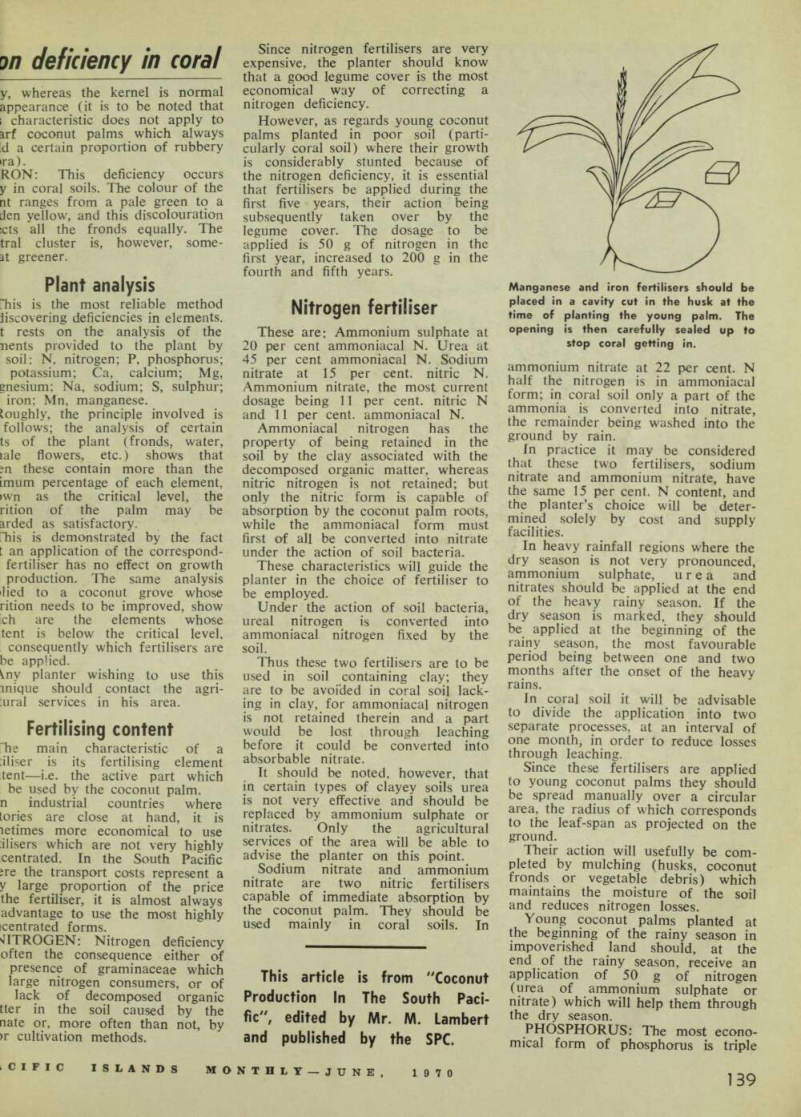
Manganese and iron fertilisers should be placed in a cavity cut in the husk at the time of planting the young palm. The opening is then carefully sealed up to stop coral getting in.
erphosphate, for it has the highest centration of soluble phosphoric 1: (45 to 50 per cent soluble )b). n the South Pacific, phosphorus ciencies are never very great, is the annual dosage of triple erphosphate should be: 100 g at year of age and should increase 500 g at five years of age and ing maturity. his fertiliser should be applied hand over a circular area while palm is very young in the same r as nitrogen fertiliser. When the ns are fully grown, the fertiliser i be applied evenly over the whole rrow area by mechanical means, /ill then be partly absorbed by the ime cover, resulting in an im ved supply of nitrogen which will sequently return to the coconut ns through plant residues, f there is no cover, the application have to be made around the foot the coconut palm over a circular i 2 m in radius, for in concentrat the superphosphate over a small i in this way, there is less risk of egression (i.e. of its becoming »luble through reaction with the jstone in the soil).
"Makes the nuts"
OTASH: This is the fertiliser ch “makes the nuts”. It should applied annually to fully grown Dnut palms at rates varying from to 2 kg per tree depending on magnitude of the deficiency, in form of potassium chloride at per cent. K 2 Q. In fact, all coconut itations in active production □ld receive at least the 0.5 kg s, even if there is no potash ciency, so as to avoid exhausting soil reserves. otash will be applied as soon as
the first inflorescences begin to appear. In soil where there is a strong deficiency, however, it is advisable to apply it in the very first year and thereafter at yearly inter vals at the rate of 150 g per annum until such time as the plantation begins to yield, when the normal dosage should be applied. As in the case of nitrogen fertilisers, potash will be applied at the end of the rainy season in heavy rainfall regions, but if the dry season is very marked, it should be applied at the beginning of the rainy season.
As in the case of nitrogen fertilisers, application will be manual over a circular area surrounding the coconut palm or mechanical over the whole interrow area.
In coral soil it is advisable to divide the application into two separate processes, at an interval of one month, in order to reduce losses through leaching.
SULPHUR: Sulphur enters into the composition of several fertilisers:— • ammonium sulphate contains 2-3 per cent, sulphur • potassium sulphate contains 18 per cent, sulphur O ordinary superphosphate con tains 10-12 per cent, sulphur.
In the regions where there is a sulphur deficiency it may be tempting to apply it in combination with fertilisers.
Increase in price
However, account must be taken of the increase in the price of the fertili sing unit N, P or K when a fertiliser containing sulphur is being used.
For example: to substitute ammonium sulphate at 20 per cent. N for urea at 45 per cent. N or an ordinary superphosphate at 14 per cent, or 20 per cent. P 2 Or, for triple superphosphate at 48 per cent. P 2 Oo or a potassium sulphate for chloride of potash increases the unit price of N, P or K.
It is thus preferable to turn to the most highly concentrated fertilisers and to use pulverised sulphur which is an inexpensive product. In soil which has a strong sulphur deficiency, the latter will be applied every year at the rate of 100 to 500 g depending on the age of the coconut palm, over a circular area.
It is not necessary to mix it with the soil, but mulching improves absorption of the sulphur by main taining the soil moist.
IRON and MANGANESE: There are iron and manganese deciencies in coral soils, but they are not due to the fact that the soil is lacking in these elements; rather to the fact that they are rendered insoluble through reaction with the limestone.
Manganese and iron cannot be broad
[?]soon as the stem exceeds 12 cms. in [?]neter near the crown, a hole is dug [?]cms. from the palm and, to ensure supply of trace elements for the next years, the fertilisers are placed in it and carefully covered up.
aced in the husk
t like other fertilisers, for they jld also become insoluble, n the case of young coconut ns they should be placed in small es in the husk, which will isolate n from the coral; in the case of jr coconut palms, they should be lied in larger doses to the soil, concentrated in a single point ch will then be penetrated by roots of the palms.
"he most economical forms are i sulphate with a 19 per cent, iron tent and manganese sulphate with 4 per cent, manganese content, n the case of young coconut palms fertiliser is applied at the time planting; for this pfurpose a dow is cut out of the husk and ) the cavity are placed 10 g of i sulphate and 5 g of manganese )hate; the opening is then care y sealed up again with the piece husk in order to prevent the al from getting in, and the young n is planted in the normal way.
'his operation is carried out again ;n the tree is one and two years , the same cavity in the husk being i for the purpose.
Carefully covered up
is soon as the stem exceeds 12 in diameter near the crown (at age of about two or three years) ole is dug with a pickaxe 40 cm ly from the coconut palm, and > it are placed 200 g of iron )hate and 50 g of manganese )hate, the whole being carefully ered up again with earth packed m by foot. This operation will are the supply of trace elements three to five years, n the case of adult coconut ns, 40 cm away from the base the stem a 10 cm deep hole is with a pickaxe. Into this hole placed together 400 g of iron )hate and 100 g of manganese >hate. The hole is then carefully ed up again with earth packed /n by foot.
Tiis operation is to be repeated ry five years. It is very important ; the hole in which the iron and manganese are placed be sealed again carefully, for otherwise the tlets will not penetrate the site; ;here is an air pocket, they will ier away and die.
Tie first application of iron and iganese is made at the time of nting in the rainy season. The sr applications should be made ing the dry season, for in the ly season the iron would be
)ply every year
>rbed too rapidly and would cause ling.
Action of fertilisers
/hen the planter has diagnosed, er by visual examination or by ir analysis, the deficiencies from :h his coconut palms are suffer and determined the doses of esponding fertilisers to be applied, should undertake to apply them y year; for these deficiencies are to the fact that the soil is lacking ;ertain elements. he fertiliser doses indicated in article correspond to the coco palms’ requirements for one year r (except as regards iron and iganese in the case of old coconut as); thus, for a coconut planta to be in good condition, it is fiutely essential that fertiliser be ied every year. the plantation has been set again and has begun to produce >od crop of nuts, fertilisers should inue to be applied—otherwise, deficiencies will reappear, the is will drop and it will take ral years again before production be restored to its former high L i fact, after four or five s, a good planter should have a at foliar analysis made with a i to modifying, if need be, the User doses to be applied. For nple, correcting a nitrogen :iency raises production; but, by easing the potash consumption, it give rise to a slight deficiency hat element which will be dis ed by the foliar analysis; produc can be further increased by a t potash application.
Time required
he time required for a particular iliser to act depends on what Dn is required of it: to improve vth, or to improve production.
Drder clearly to demonstrate this :ess here is an example: n application of iron and iganese in the case of young )nut palms suffering from •rosis and planted on good land result, two months after the lication, in the appearance of a c green spear and a first green , the rest of the foliage remaining ; green to yellow. Six months r all the fronds will be green the size of the coconut palm have increased appreciably, year later the coconut palms be in perfect health.