Pacific Shipping
pp. 115-121 · Read in the full issue
Bp's Under Pressure From
Tonga And Australia
While the influence of Burns Philp in Islands affairs may have lessened slightly in recent years, the Big Firm is still a major force in wide areas. In May, two major shipping developments both con cerned BP’s and they will affect trade and shipping in New Guinea, Fiji, Western Samoa and Tonga.
Predictably, the Big Firm had little or nothing to say on either story.
However, a prolonged strike on one of the company’s ships kept story No. 1 in Sydney newspapers and de layed goods worth $400,000 for New Guinea. Story No. 2, which con cerned the Tongan Government, made not one paragraph in the government - controlled Tonga Chronicle (or in Sydney).
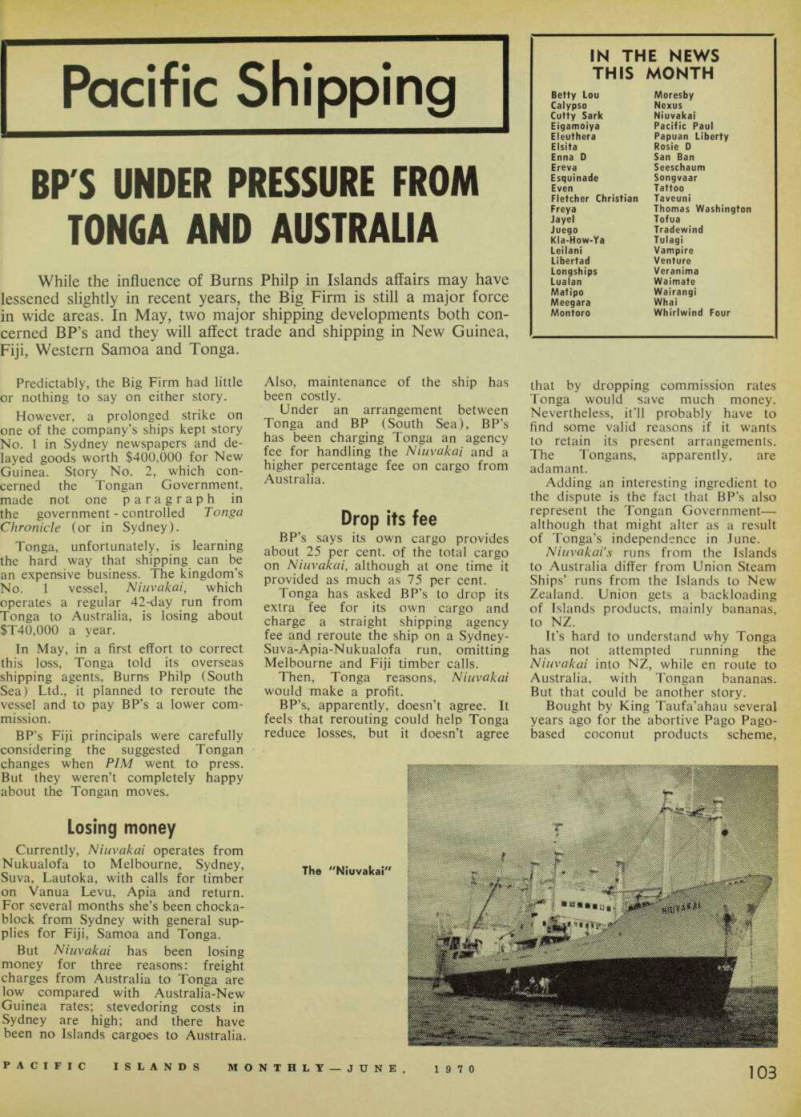
Tonga, unfortunately, is learning the hard way that shipping can be an expensive business. The kingdom’s No. 1 vessel, Niuvakai, which operates a regular 42-day run from Tonga to Australia, is losing about $T40,000 a year.
In May, in a first effort to correct this loss, Tonga told its overseas shipping agents, Burns Philp (South Sea) Ltd., it planned to reroute the vessel and to pay BP’s a lower com mission.
BP’s Fiji principals were carefully considering the suggested Tongan changes when PIM went to press.
But they weren’t completely happy about the Tongan moves.
Losing money
Currently, Niuvakai operates from Nukualofa to Melbourne, Sydney, Suva, Lautoka, with calls for timber on Vanua Levu, Apia and return.
For several months she’s been chocka block from Sydney with general sup plies for Fiji, Samoa and Tonga.
But Niuvakai has been losing money for three reasons: freight charges from Australia to Tonga are low compared with Australia-New Guinea rates; stevedoring costs in Sydney are high; and there have been no Islands cargoes to Australia.
Also, maintenance of the ship has been costly.
Under an arrangement between Tonga and BP (South Sea), BP’s has been charging Tonga an agency fee for handling the Niuvakai and a higher percentage fee on cargo from Australia.
Drop its fee
BP’s says its own cargo provides about 25 per cent, of the total cargo on Niuvakai, although at one time it provided as much as 75 per cent.
Tonga has asked BP’s to drop its extra fee for its own cargo and charge a straight shipping agency fee and reroute the ship on a Sydney- Suva-Apia-Nukualofa run, omitting Melbourne and Fiji timber calls.
Then, Tonga reasons, Niuvakai would make a profit.
BP’s, apparently, doesn’t agree. It feels that rerouting could help Tonga reduce losses, but it doesn’t agree
that by dropping commission rates Tonga would save much money.
Nevertheless, it’ll probably have to find some valid reasons if it wants to retain its present arrangements.
The Tongans, apparently, are adamant.
Adding an interesting ingredient to the dispute is the fact that BP’s also represent the Tongan Government— although that might alter as a result of Tonga’s independence in June.
Niuvakai’s runs from the Islands to Australia differ from Union Steam Ships’ runs from the Islands to New Zealand. Union gets a backloading of Islands products, mainly bananas, to NZ.
It’s hard to understand why Tonga has not attempted running the Niuvakai into NZ, while en route to Australia, with Tongan bananas.
But that could be another story.
Bought by King Taufa’ahau several years ago for the abortive Pago Pago based coconut products scheme,
The "Niuvakai"
r iuvakai is prestigious for Tonga, but ’s a good thing the Tongan Govern ient has at last decided that it should so attempt to operate her as a com icrcial proposition.
The other story concerned the 34iy strike on BP’s 3,175-ton vessel loresby ( PIM, May, p. 105). Wharf id in Sydney because of a protest / the Seamen’s Union of Australia ;ainst BP’s sale of the Moresby to ngapore’s Neptune Orient Line, 'oresby finally left in mid-May for ;r last return run to NG.
The strike cost BP’s about $70,000, $2,000 a day, and delayed K)0,000 worth of Australian exports NG for five weeks.
Part victory
The seamen partly got their way.
P’s agreed that when its other ader, Montoro, returned from a NG n in late May, Montoro’s Chinese alay and Papuan crew would be dd off and replaced by about 40 ustralian seamen, cooks, ship rights and stewards.
BP’s daily wage bill for the ontoro for Australian crew (as com tred with its previous crew) will ie from $525 a day to over $9OO day, a rise of about $150,000 a ar in costs.
BP’s also agreed it would “seek to quire or build” a specialised vessel r the Island trade to be manned by 1 Australian crew.
Mr. P. Geraghty, assistant federal cretary of the union, told PIM his lion’s aim was to maintain Aus ilian crew participation in shipping NG. Papuan seamen were paid 6 a month by BP’s and Chinese amen, $52.20 a month, he said.
Australian seamen used to man o-thirds of BP’s ships; now with 2 sale of the Moresby they would Jy man one ship in the Australia- G trade operated by all companies BP’s Montoro.
Papuans, Mr. Geraghty said, re ived the lowest wage for any sea an in the world.
During the strike, BP’s chairman directors, Mr. J. D. O. Burns, ade direct requests—without much suit —to senior Australian Ministers Canberra, calling on the Aus ilian Government to intervene and orten the strike.
Mr. Burns asked Mr. McEwen, astralia’s Deputy Prime Minister d Minister for Trade, to save BP’s am “serious financial loss”.
Mr. Burns told Mr. McEwen that r s regarded the strike as an “illegal d intolerable confrontation and an ;empt at usurping power”. He said
BP’s had lost over $300,000 on the Moresby’s operations last year.
Approval in principle to sell Moresby by the Australian Govern ment had been given to BP’s on July 10 last year and agreement of sale to Neptune was made on April 10 this year.
Mr. McEwen, in a delayed reply to Mr. Burns, said Mr. Sinclair, Minister for Shipping and Transport, was examining the Moresby strike.
The strike was discussed in Federal Parliament, where government said it supported Australian participation in NG shipping and added that should BP’s not continue to use Aus tralian seamen, requests would be made to other shippers (Australian National Line?) to enter the trade with Australians.
Meanwhile, two of the BP ships, Tulagi (Solomons run) and Montoro (NG run), are also destined for the chopper. Waterfront rumour is that Tulagi will be sold by the end of this year, and Montoro next year.
When that happens BP’s will not have a ship to its name—except for those it might charter.
New Cutter May Become
Standard In The Pacific
A ferro-concrete auxiliary cutter adapted by Mr. Arne Sannergren in Fiji from a New Caledonian design, might become a standard boat for fishermen in many parts of the Pacific. Work on construction of a prototype is expected to begin in Suva soon.
Mr. Sannergren, a UN consultant to the Ministry of Commerce, In dustry and Co-operatives, says the prototype will be 27 ft in length.
He has designs also for 24-ft and 30-ft versions.
The South Pacific Fisheries De velopment Agency is interested in the development of a fishing boat which could become standard in the Islands.
Its project manager, Mr. Alan Tubb, has expressed considerable interest in the new design, which is an adaptation of a wooden-hulled fishing boat popular in New Caledonian waters.
Mr. Sannergren said the ferro concrete design would make the boat cheap to build and pose few main tenance problems. He hopes to see one of the boats on test, probably in the Lau group, later this year.
The cutter would carry about 350 sq. ft of sail in the 27-ft version and would have an auxiliary air-cooled diesel engine of about 20 to 25 horsepower.
New Cooks Barge, And
Lighterage Company
A 40-ft self-propelled barge to replace the worn out lighters in use at Aitutaki, Cook Islands, has been ordered from Fiji at an approximate cost of SNZI3,OOO. Indications are that a lighterage company to serve Aitutaki interests will be formed in the near future.
The aging government launch has proved unequal to the task of towing lighters through the long passage and out to ships offshore when seas are rough. Also, leaking lighters do little to ensure that their banana cargoes will reach their New Zealand markets in good condition.
So it was decided that a barge of 15 ft beam, and powered with two 60 hp diesels could replace both launch and lighters. Fully loaded with a cargo of 25 tons the barge will draw only 2 ft 8 in. She should achieve quicker turn-arounds by visiting vessels; those bringing inward cargoes as well as those up lifting banana exports.
Aitutaki Growers Association had contributed $3,100 to the cost of the barge in early April, and its inten tion was to seek a loan from the recently-established Rarotonga branch of the National Bank of New Zea land.
It’s understood that the money already raised will be put into $lO shares, and that these shares will be confined to members of the Aitutaki Growers Association, lighter owners and other Aitutaki people interested in investing money in the lighterage company.
The local shipping company of Silk and Boyd, which was one of the prime movers for the new barge lighterage service, will also form part of the proposed company.
Union Steam Ship
Puts Up Charges
In its second freight rise in 17 months, P&O-controlled Union Steam Ship Company has increased charges by 10 per cent, on NZ- Islands cargoes, and by five per cent, on cargoes carried between Islands ports.
The new rates applied from May 28 and effected cargoes on Union’s three vessels, Tofua, Taveuni and Waimate which service Fiji, both Samoas, Niue and Tonga regularly.
In late 1968 Union increased freight rates between NZ and Islands ports by five per cent.
The new rises will accelerate rising costs of imported and exported goods of the Islands. However, traders in Apia, at least, agreed that Union’s
reason for the new charges—increased costs —was a genuine one. Stevedor ing labour was the major inflationary influence, Mr. E. Annandale, president of the Western Samoan Chamber of Commerce, said.
Samoan rates are now: Auckland- Apia, 5W516.84 per ton general cargo; $2.69 per 100 lb freezer cargo.
Announcement of the new charges corresponded with talk in NZ in May that a NZ-owned shipping line ought to be started to compete on Union routes. (On overall operations, Union makes a minimal profit, com pared to its paid-up capital).
NZ exporters complained they had to wait six weeks for space for Suva and Apia-bound cargo.
Holm, which services French Poly nesia, the Cooks and New Cale donia, is about the only NZ company giving the dominion a semblance of and overseas shipper (P&O has a small shareholding in Holm, PIM understands).
Backing from the Pacific Islands Producer’s Association and NZ ex porters would be vital for a new line aiming at the Islands trade.
Neither of these groups is satisfied with current shipping schedules— however neither would have the capital and expertise to operate such a run.
"Libertad" In The
Islands
Noumea returned briefly to a vision of its early discovery days with the visit of the Argentine sailing ship Liber tad in May, en route from the Cook bi-centenary celebrations in Sydney (picture, p. 97).
Not all the old atmosphere could be revoked, however, as this was a NEW sailing ship—eight years old.
Moreover, while the Libertad oc cupied one of the three precious berths at Noumea’s busy main wharf, as many as 11 trading vessels were anchored midstream, awaiting berth ing facilities.
During its five day Noumea visit the Argentine ship received a con tinual stream of admiring Cale donian visitors.
High above the city rose its three masts—the tallest being 150 ft—their colour strings of flags fluttering gaily by day and twinkling lights glittering at night.
The 101 cadets aboard enjoyed underwater fishing expeditions in Noumea, a soccer match against the Caledonians (the Argentinians, losing 3-1, claimed they had put on too much weight aboard) and visits to nickel mining and smelting works.
In addition, a detachment of cadets
oved the star attraction of this lar’s Armistice Day parade at nse Vata beach on May 10.
Strong winds on the five day ►yage out of Sydney had torn three their smaller sails. (They had a tal of 27, offering 3,000 square jds to the wind). Because of this ugh weather, they made half the Dssing to Noumea on their engines.
Departing on May 13, the bertad headed north for Japan, th a day’s stop for water and □visions scheduled in Port Moresby.
Ajor Wharf
Ir Noumea
Noumea harbour authorities expect )rk to begin in June on a major it development project.
This is for the construction of a sp-water wharf, which will cater * large passenger liners currently liged to moor mid-stream, and erate launch services for disem rking tourists.
The new wharf, which will accom )date one ship, is to be built at ; present disembarkation point for ssenger liners, at right angles to ' existing quay at its northern end.
The new wharf is expected to cost 2 million.
King A Close Look
The Sea Bed
\stronauts are getting all the head ;s these days, but the moon is not only place in the universe where iting discoveries could be made. ;ht on this earth, this year, in the fific an expedition is under way ich may well have a far reaching uence on the lives of all in the a. l Seyen-Tow” is the name of the •edition which, sent out by Scripps
titution of Oceanography, a
nch of the University of Cali nia, left San Diego in January I is spending nine months of this r studying the Pacific Ocean.
Vmong the fields of knowledge ich will be explored by “Seven v” under the direction of Dr. John die is the geography of the seabed h emphasis on deep sea trenches, t is expected that a much clearer lanation of volcanic action and thquake activity will emerge. iTie nature of deepsea currents also be studied. The movements these rivers in the sea has a very nite relation to Pacific weather can also be of prime importance the world fishing industry. up-to-the-minute as a spaceship the expedition’s vessel, Thomas shington, which was built in 1965 jcially for oceanographic re ch and carries a crew of 25 and cientific complement of 17.
Air-conditioned throughout, Washington is in reality a floating laboratory. In addition to such usual oceanographic equipment as deepsea samplers and winches, precision echo sounders, magnetometers and sediment reflection profiles, she has an IBM computer that will enable data to be recorded and maps to be made while the trip is m progress.
The computer also works as part °f V l6 lte , navigation system which enables the ship to fix her position precisely, independent of weather.
The expeditions name comes from a new instrument oceanographers call a “fish”. It’s a sensing element which, connected to the Washington and her computer by a multichannelled electrical conductor, is lowered by cable to a great depth so that it hovers as little as 10 ft a °Sy e “I® s f a fl° or - The fish can determine both the water depth, the true bottom relief of the sea and can show horizontal irregularities such as volcanic flows and vaHeys . „ When the fish is m use, says marine geologist Or. Robert Fisher, who will lead the expedition during its work on the Tonga Trench, “the laboratory on Washington resembles Mission Control in Houston during a moon landing, with scientists and technicians bent over their consoles —and the excitement is just as great.”
The particular scientific problem that the “fish” solves is making accurate measurements of objects such as knolls, precipices and gullies and determining characteristics such as local magnetic field or small scale textures.
In the past such observations have been nigh impossible because instru ments on ships have tried to measure things on the sea bottom several miles down. “Seven-Tow”, however, takes the instruments to the near seabottom and relays the information back to Washington’s computer, Qne of the most exciting parts of “Seven-Tow’s” explorations will be 0 f Capricorn Guyot. This seamount, taller than Mount Everest and one G f the largest mountains in the world, lies about 180 miles east of Vavau, Tonga’s northerly group. its highest point lies 450 meters below sea level, John Brodie, of the New Zealand institute, dredged Miocene corals from its summit in the 1960’s and former Scripps expeditions have made soundings to establish its height. “Seven-Tow” will chart it more completely. j t j s expected new discoveries in connection with Capricorn will also tell scie ntists more about the formation and movements of the nearby Tonga Trench.
Transmission Troubles
cnD // T rn a ■/a /#
Itkaka
With the Gilbert and Ellice Islands Resident Commissioner, Sir John Field, aboard, the colony’s merchant marine training vessel Teraka recently got into strife off Arorae, in the Southern Gilberts, and had to be towed back to its Tarawa base by the GEIC 70-tonner, Temauri.
Sir John transferred to the Protestant mission ship, John Williams VII, for his return to Tarawa.