Diving For Scrap Is Big
pp. 113-114 · Read in the full issue
Business Again
By Ken Mcgregor
Guadalcanal Salvage Ltd. isn’t the Islands most sophisticated company, and its joint owners, Cyril Ashton and Wally Gibbins, feel more comfortable 50 ft under a Pacific breaker than drawing up a company report.
But things are jelling pretty well for the two-year-old firm, based a few miles outside Honiara, capital of the Solomons.
With help from two younger skin divers-turned-salvagers, Brian Bailey and Warner Power, of Sydney, Guadalcanal is recovering about $BO,OOO of scrap metal from sunken Japanese warships and freighters, and American warships, in the Solomons, each year.
And every piece of copper, lead, bronze, manganese and aluminium found by the group is being bought up quickly by metal buyers in Sydney. Supply can’t fill the demand.
An enthusiastic shell collector and a stickler for safety while diving, Wally is typical of the many Aus tralian skindivers today making a living as salvagers in the Solomons, New Hebrides, New Guinea and New Caledonia.
He and his partner have almost finished stripping a 2,000-ton Japan ese submarine off Guadalcanal. Next project is a group of 40 Japanese freighters nearby. Then there is a huge US carrier in the Florida Group.
Former destroyer
He has just located what seems to be a former destroyer, converted for carrying cargo, in 100 ft of water near Lungga Point, Honiara, and there’s at least five propellers, weigh ing nine tons each, waiting to be picked up.
Guadalcanal Salvage, under agree ment with the BSIP Government, has exclusive underwater salvage rights in the protectorate, except for a couple of areas, such as Tulagi. Its divers use everything including float ing devices, winches, jemmies, span ners and explosives to free valuable metal from World War II debris.
It has two workboats, employs up to 12 Islanders and plans for a bigger boat, the 47 ft Danielle, now being operated by an associate company in the New Hebrides, and said to be worth $20,000.
Costs are high and losses and damage to equipment, tools and gear is heavy. The return is big.
Working up to 200 ft underwater, with only minutes at this depth per day, is dangerous, particularly as the remedy for the dreaded “bends” a compression chamber—is unheard of in the Solomons.
In his 24 months in Guadalcanal, Wally, a bachelor, has generated much local interest in skindiving.
He’s formed a local club and mem bers dive regularly under coaching and supervision. In Wally’s mind is the thought the growing numbers of local divers might one day, make the government or someone, buy an ex pensive compression chamber.
But luckily, so far, because of
careful safety regulations and luck, no accidents have happened.
The Gibbins - Ashton show is typical of the upsurge over the past two years of Australian divers or Islands agents buying wartime scrap metal from NG, the Solomons, Caledonia, the Hebrides and Western
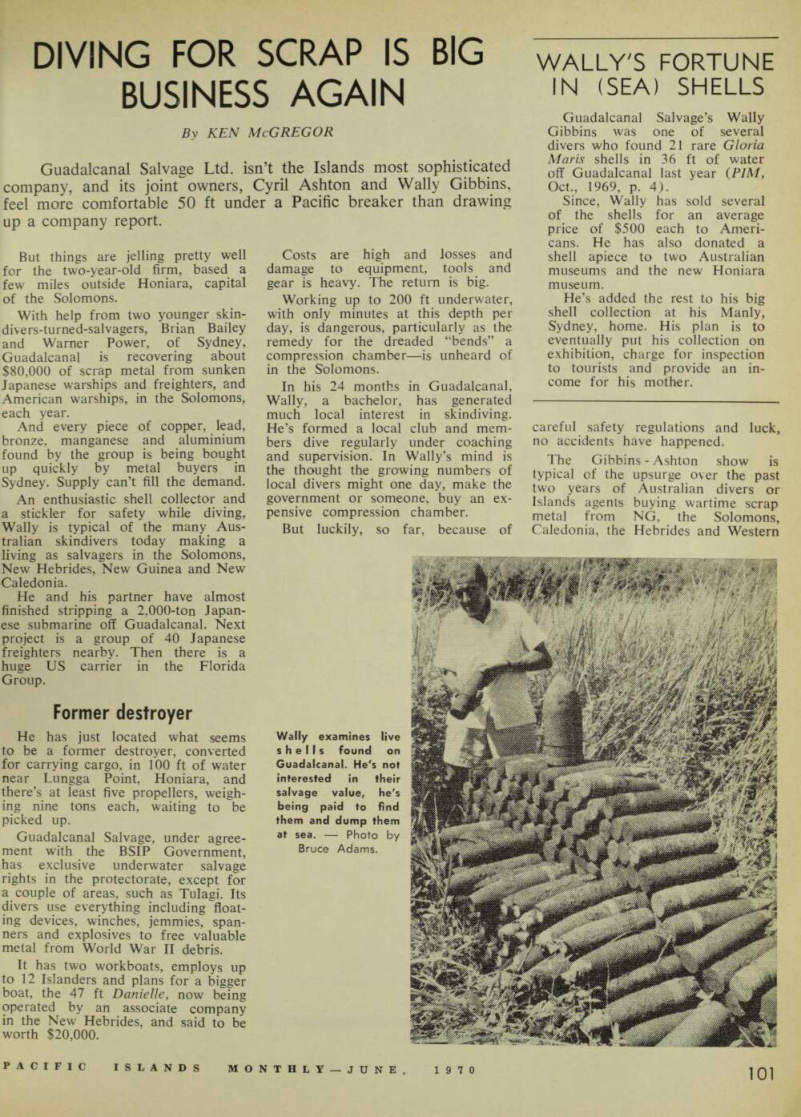
Wally examines live shells found on Guadalcanal. He's not interested in their salvage value, he's being paid to find them and dump them at sea. -Photo by Bruce Adams.
Samoa or domestic scrap from Fiji, Locals, too, are in it and many sell to C. Sullivan (Export) Pty. Ltd., who re-sell, for a commission, to Sydney metal buyers.
In Papua-New Guinea Sullivan has given New Guineans not familiar with the types of metal wanted, magnets. The New Guineans apply their tiny magnets to metal scraps in the bush and, if attraction is negative, collect the scraps.
Buyers in Sydney are paying about $200,000 a year for about 300 tons of Islands scrap. Prices vary from $2OO to $220 for lead per ton, to over $l,OOO a ton for good copper.
Main buyer is Carmichael Metal
Company, and minor buyers are Simsmetal Ltd. and Metal Traders (A/asia) Pty. Ltd. Carmichael, with London and Japanese connections, processes its scrap into ingots, which go into a variety of uses, such as bearings, and castings.
In Vila, New Hebrides, another Australian group. Pacific Diving and Engineering Co. Ltd., has cornered most of the Australian import market with big capital, many divers and modern workboats.
This firm is also doing work in
Use magnets to collect scrap
NG and New Caledonia. Its most interesting job at present is the wreck of the 33,000-ton American warship, President Coolidge, sunk in water between 180 ft and 240 ft down, 300 yards off the coast outside Luganville, Santo, New Hebrides.
Divers Bob Delander, Reg Thomas, Allan Power, Ray Abbott, Barry May and navigator John Smith have so far recovered two propellers weigh ing between 15 and 20 tons off the Coolidge.
No bodies have been found but one of the first things Barry saw when he dived, was a Coca Cola bottle, with a “Made in Michigan” label, balancing on the Coolidge’s rudder.
He said diving conditions in the Hebrides were good because of the clear, “unpolluted” water at that depth.
Wartime scrap
Pacific Diving’s other interests include salvaging Mr. Athol Rusden’s freighter Poranui, in New Caledonia, using divers Des Woodley, Bill Martin and Barry Tweenchain aboard the 70 ft workboat Onewa, and work with a 66 ft workboat, Pacific Seal, in the Milne Bay and Bougainville areas of New Guinea.
Shareholders of the company are Barry, Des and Mr. Dave Barnett, of New Guinea.
Both companies would like a go at the extensive wartime scrap of the US Trust Territory. They could get better prices than the Japanese, who dominate the market there, but there’s little chance of moving in with Australia-Micronesia shipping connections almost non-existent.
Meantime, divers are optimistic that their scrap metal mini-boom will continue for several years yet; Sullivans and Carmichael don’t fully share these hopes and feel it will last until about 1973, and then level off.
Certainly the reason for the boom —a world-wide shortage of copper and other metals—will have much to do with this.
But the increase in metal prices is not the only reason for the increased interest in salvage in the South Pacific. Men like Wally Gibbins and his fellow Australians have graduated from skin-diving as a hobby around the Australian coast to professional diving—using new skin-diving tech niques. It is cheaper than “hard hat” diving because it doesn’t require the same equipment or supporting man power.