Fiji: A boom, yes; a new Hawaii, no
pp. 50-51 · Read in the full issue
• American journalist John Griffin, editor of the editorial page of the Honolulu Advertiser , has been travelling the Pacific under an Alicia Patterson Fund award, and his articles have been appearing regularly in PIM. Here he discusses Fiji tourism and its effects on the colony-cum-dominion.
In Fiji tourism, one is again
reminded of Hawaii 15 to 20 years ago when the numbers
were starting to multiply rapidly
but the big hotels, conventions,
and mass tours were still way off.
“We are just on the edge of the sound barrier in tourism,” said an official who traced the growth up from the days when Fiji was basically a stop for cruise ships or airline passengers passing between Hawaii and Australia. Last year there were about 80,000 tourists, well oyer twice the number who visited Tahiti, but a world away from Hawaii’s 1.3 million.
Either by desire or prospects, Fiji tourism will remain far from Hawaii; perhaps fortunately, there is no central Waikiki beach, so develop ment is spreading more. Still the most dramatic aspect of Fiji tourism is its growth. The number of tourists is jumping more than 20 per cent, a
year. A variety of big hotel com panies, airlines, well-heeled dreamers and some doubtful operators are pro ducing plans ranging from mammoth resort and residential complexes to tiny exclusive hideaways.
Because of Fijian ownership, land is hard to get. Prices being paid for available islands and choice beach locations are dazzling by local standards. But with dozens of islands, lovely lagoons, and eager, friendly people who work (albeit not always with sophisticated skills) for low wages, Fiji offers still unex plored tourism horizons.
At the same time, tourism in Fiji is not growing without some ques tions, The government’s Minister of Finance recently pointed out that half the money tourism brings in goes back out of the country for import goods. He added: “Even though by 1970, gross earnings from tourism may well exceed those from sugar (about $25 million), this does not mean tourism will equal sugar as a contributor to gross domestic
product ... it will be seven to 10 years before tourism equals sugar in its contribution . . .
Both parties in Fiji recognize a nee d f or foreign investment, but there have been increasing questions i n recent months about whether local people? especially the Fijians, are sharing enough in tourism’s benefits.
A nd R a tu Mara, who will lead Fiji’s government in independence, has commented eloquently that “national pr id e ” must come before “expatriate profit”.
Recently he said: “Let us have tourism—yes! Let us have profit— , g ut tourism and profit at the expense G f o ur customs, culture and traditions—never! These things must be preserved and protected. There must t> e no insidious undermining t h em — nQ gnaw j n g awa y at their f ounda tions with the termites of tour j s t profit till they topple and die degraded and debased.” • h dvnamism hard
Big!™i “J!letfSe But
to control once it gets rolli g.
Benefit from Hawaii
in combining awareness with eager ness, Fiji, like Tahiti, at least offers the hope of benefiting by mistakes made elsewhere, including Hawaii.
It’s a measure of something that more Fijian participation in hotel owner ship and a small tax on arriving tourists for a Fijian cultural pre servation fund have both been dis cussed in the legislature.
Some worry that Fiji is banking too heavily on tourism for its eco nomic future. (“1 remember Cyprus when the racial trouble started; it killed a budding tourist industry,” says one European observer). Still there are other prospects. Fiji has great timber reserves and some economists think forestry will ultimately catch and pass tourism.
Gold remains the third largest export (after sugar and copra). It’s a relatively small and unstable industry.
But there is the feeling that Fiji, on land or under the sea, has major mineral potential. Less dramatic but more sure and significant is the fact 3f progress in rice growing and live stock.
It's happening
In small ways you can see the iconomic momentum growing in Fiji: secondary industries and ship ping routes give it new importance is a distribution centre, a small South Seas Chicago. In contrast to )ast years, the labour movement is juiet and non-political, concentrating >n getting its share of the boom, fhings have picked up to the point vhere people think the government :an afford a TV station and Suva msinesses and banks are feeling >usy enough to stay open during the unch hour, a relatively momentous lecision.
As everywhere, however, Fiji’s conomic growth rate of more than per cent, must be measured against he rising expectations and needs of growing population.
“Right now we’ve got 10,000 eople coming into the labour market ach year and only 4,000 jobs vailable. That’s a gap that’s got to e filled, even allowing for marriage nd the family system that takes care f people,” says a government conomist.
Along with economic growth, one right spot in this situation has been ne of the most dramatic birth con rol programmes in the Pacific.
In 1958, the live birth rate among 'iji’s Indian population was 44 per ,000; the Fijian rate was 35. The gures are now 29 for the Indians nd 31 for the Fijians—which also
means the Indian population has stopped growing faster than the Fijian. The goal is bringing the overall rate of 29 per 1,000 down to 25 by 1972.
These are amazing developments compared to a decade ago when many were so concerned that Fiji’s popuLtion explosion and seeming lack of economic opportunities might heighten and eventually explode the delicate racial situation. Now the oppcsite seems true. The changes are an important asset in a vital period.
Hftnn anrl
Hope and apprehension
Anyone who has been touched by Fiji can’t help but feel a mixture of hope and apprehension in this, its most important year of approaching independence. I admit a bias for these islands of so much beauty, so much promise and so many deep problems—-a personal involvement.
Yet there is the paradox that I have written in better, warmer style of such places as Tonga and Guam over the past two years.
Maybe my failure is in the paradox of Fiji’s contrasts and its people. . . . The Fijians of such great charm and human talents yet also with such deep frustrations and flickering shadows of violence as they sit in far-out villages or stand
drunk and broke on a Suva street corner contemplating what history has made them amid the success of others. . . . The Indians, from unctuous city merchants with soft smiles and hard bargains, to a hard working Suva landlord who talked straight and honest, to the cane farmers sweating on a few drought plagued acres that seem much like the India his father gladly left not speaking English, yet honestly friendly. Yet all so hard to really know. . . . The few Chinese, typically apolitical but with their children taking a new interest. . . . The colonial British with a tradition of lj ? w ’ racial stiffness and dedlcatl °n. . . The entrenched Europeans with reactionary attitudes, ™ ho m J ore often, than the temporary d °-gooders will be the ones to stay °?’ „. arn and nmp make something °* Eh l - • • • Its a maddening mixture, super ficially simpler, yet much more of an uncertain quantity than Hawaii two decades ago. The honest odds seem to be that there will be some racial trouble in coming years after the current pre-independence honey moon. But there is also a good chance for a happy surprise. And beyond that hurdle Fiji may well become a real centre of the South Pacific.
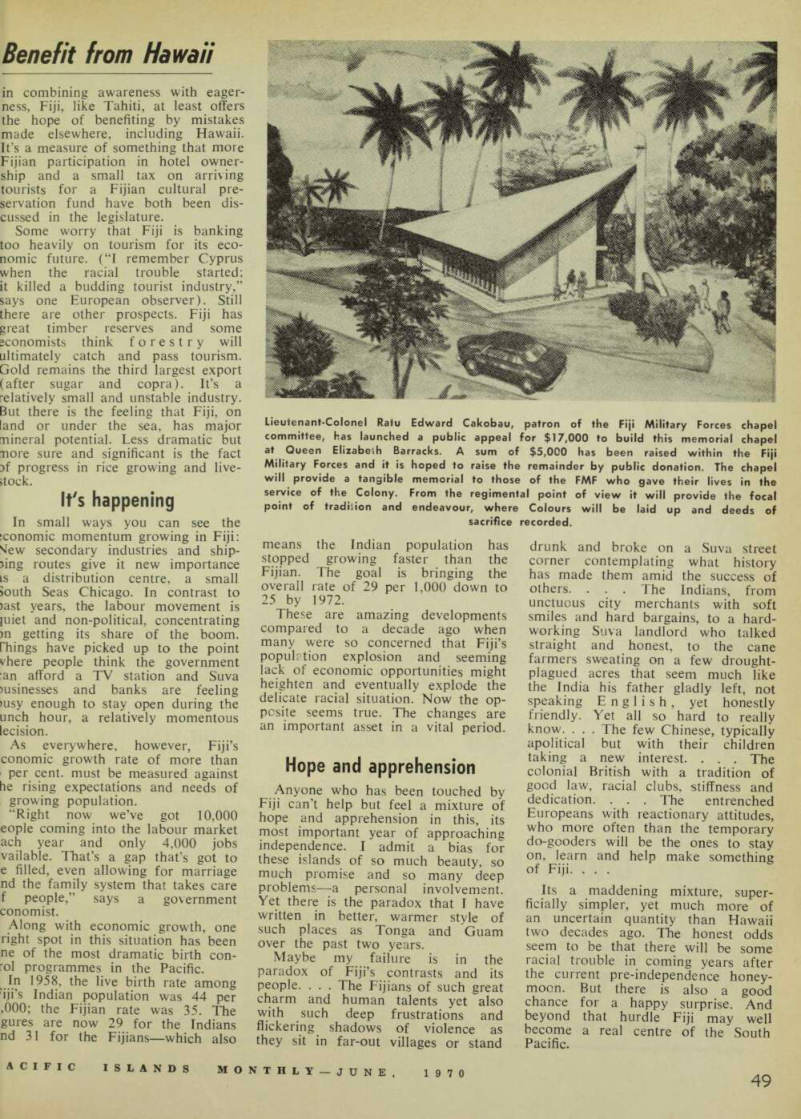
Lieutenant-Colonel Ratu Edward Cakobau, patron of the Fiji Military Forces chapel committee, has launched a public appeal for $17,000 to build this memorial chapel at Queen Elizabeth Barracks. A sum of $5,000 has been raised within the Fiji Military Forces and it is hoped to raise the remainder by public donation. The chapel will provide a tangible memorial to those of the FMF who gave their lives in the service of the Colony. From the regimental point of view it will provide the focal point of tradition and endeavour, where Colours will be laid up and deeds of sacrifice recorded.