As Their Political Future
pp. 48-49 · Read in the full issue
What New Guineans Want
New Guinea’s Parliamentary Select Committee on Constitu tional Development, which has been touring the territory, has found that most village people support a move towards self-government, but are against early pushes for independence.
But there is still some considerable opposition to immediate self-govern ment, one surprise being that many Bougainville villagers are against an early date.
At present the Napidakoe Navitu political organisation on Bougainville is conducting an unofficial referendum on the island on whether Bougain ville should break away from the rest of the territory.
Secretary of the organisation, Mr.
Barry Middlemiss, last month ap proached the Administrator, Mr.
Hay, and asked that the Administra tion conduct a referendum on the secessionist question on Bougainville.
Break away
Mr. Hay “buck-passed” the re ferendum proposal to the select com mittee for consideration.
Mr. Middlemiss claimed that in areas where the unofficial referendum had been held, it was clear that Bougainville villagers wanted to break from the rest of the territory.
Mr. Middlemiss told the select committee in April that the territory should have self-government by 1972.
It was the best way the people could learn to run the country.
Many Bougainville university students have also supported the referendum move, but Mr. Donatus Mol a, MHA for North Bougainville, Buka, has come out strongly against a referendum. He claimed that most Bougainville people did not want a referendum.
Students in Port Moresby hit back at Mr. Mola and pointed out that he was one of the 25 who in 1968 sought a referendum for seces sionism.
Most of the people who spoke to the select committee supported regional (or “State”) governments or councils in a federation of Papua and New Guinea.
But people against regional gov ernments claimed that the more advanced areas would be tempted to “go it alone” when independence
came. Other speakers claimed that people did not know enough about the forms of government that could be established in the territory.
Many have asked that there be more political education before the> are asked to give opinions on whai form of government would suit the territory.
Independence was practically ignored by most people. They fel that self-government was the mail issue and that independence shoule be considered as something far ii the future.
But the few who brought forwar< independence suggestions wer adamant that more political educa tion was needed, and most linke< independence with a presidentia system of government.
An Upper House was also wide! discussed.
No real plans have ever been pi before the people for an Uppe House but speakers claimed the there was a need for a house c review, once power had been take away from Canberra.
Others wanted the Administrator Executive Council to be enlarged an given more power by Canben before self-government came in.
More representation
People from most centres wei practically unanimously in agreemei for larger representation in tl House of Assembly, both at region and open electorate levels.
But its appears that the sele committee, headed by Mr. Pauli Arek, MHA for Ijivitari Open, w have a mammoth task during tl rest of this year, hearing the opinio: of expatriate and indigenous peop throughout the territory, then sortii out all the recommendations.
Many thousands of people st have ideas to present. It will then up to the committee to sift throuj all recommendations and come i with recommendations of its own present to the House of Assembl —New Guinea News Service.
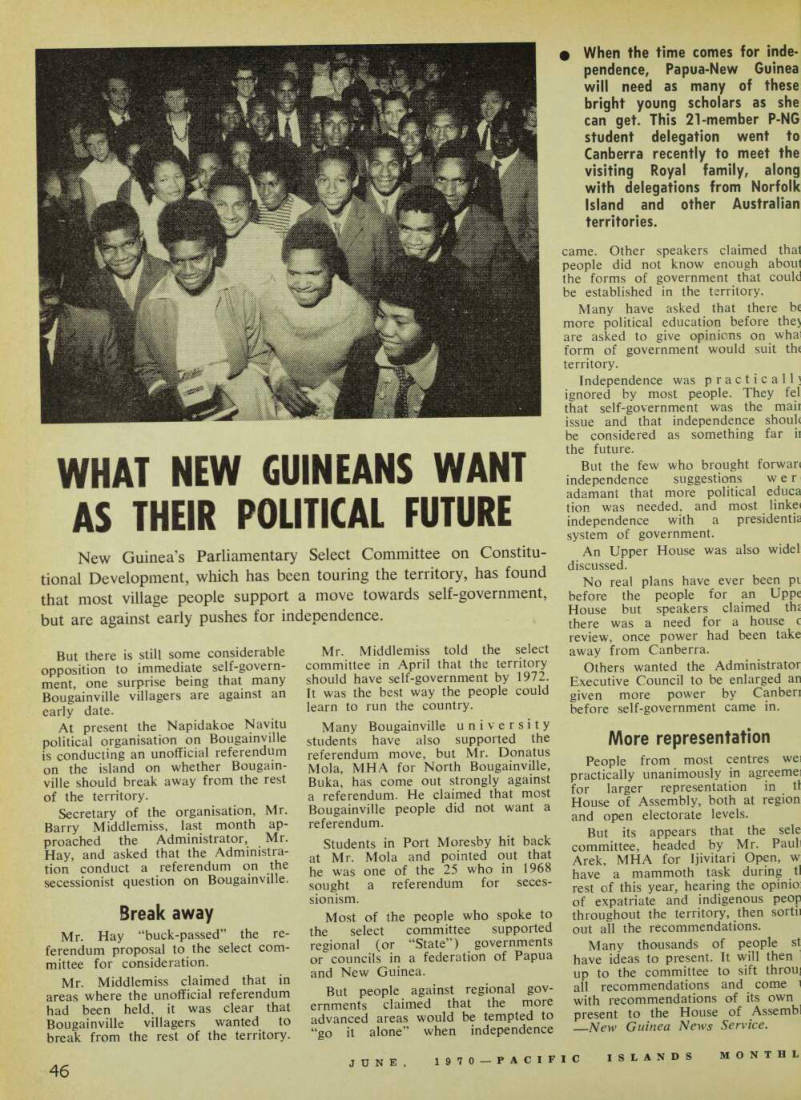
• When the time comes for inde pendence, Papua-New Guinea will need as many of these bright young scholars as she can get. This 21-member P-NG student delegation went to Canberra recently to meet the
visiting Royal family, along
with delegations from Norfolk Island and other Australian territories.
100.000 in
Port Moresby
by 1977 ?
If Port Moresby continues to expand at the rate that it has between 1966 and 1970, it will have a population of over 100.000 in seven years.
Commissioner for Local Govern ment in New Guinea, Mr. K. R.
Williamson, has said this in announc ing the preliminary results of a popu lation count of Moresby, conducted earlier this year as part of the urban council electoral roll count.
Mr. Williamson said that a total of 56,206 people had been counted in the town. This represented an average annual growth rate of 8.2 per cent, since the census of June, 1966, when the population was 41,848.
Major areas of population growth included Waigani, which had grown by more than 2,800, and the Gordon’s Estate-Gordonia suburbs, which had grown by more than 4,200. Both of these areas had virtually no popu lation in 1966.
Females increase faster
Mr. Williamson said the indigenous population had grown by 7.9 per cent, a year from 31,983 in 1966 to 42,616 in 1970. The non-indigenous population had increased at a slightly faster rate—8.8 per cent, a year from 9,865 to 13,590.
One of the most interesting results was that the female population had increased at a much faster rate than the male population. Indigenous females had increased at 9.6 per cent, a year (from 11,240 to 15,858), while indigenous males had increased at only 7 per cent, a year (from 20,743 to 26,758).
Non-indigenous females had in creased at 10.5 per cent, a year (from 4,138 to 6,034), while non indigenous males had increased at only 7.6 per cent, a year (from 5,727 to 7,556).
Mr. Williamson said that for various reasons it was probable that these figures represented a small understatement of the true popula tion.
But the result demonstrated the rapid rate of urban growth in the territory compared with rural areas.
Figures already released for the Feb ruary and March population counts of Madang and Lae show a similar trend. (Madang’s rate of growth was 7.2 per cent, a year and Lae’s was 11.9 per cent.).