"If there's one medal for the French, it'll be
pp. 46-47 · Read in the full issue
French, it'll be for hospitality"
By DON BARRETT, just back from Papeete
Games organisers of the South Pacific Games are determined that competitors and officials from 13 countries expected to send teams to Tahiti next year, will get the “full treatment”.
I didn’t find any antipathy to the Games in the week I spent in Tahiti.
I did find a lot of enthusiasm; and it wasn’t all confined to the Games organisers.
Tourist Development Board chair man, Jacques Drollet, for example is sure the Games will mean a big advertisement for Tahiti. He’s look ing forward to welcoming many visitors who will go to “support” their teams, but probably lured just as much by tales of Tahiti’s attrac tions.
With 16 months to go preparations are well advanced in Papeete. New Guinea (site of the last Games) organisers would have been sighing with relief had they been as far ahead at the same relative time.
But Organising Committee chair man, Dr. Pierre Cassiau, and Direc tor of Organisation (and Games Council Chairman), Lysis Lavigne, are too old at the business of sports administration to sit back and take things easy.
Mindful of the anxious moments— and indeed near panic—that Aus tralian waterfront disputes caused the 3rd Games organising committee when essential stores were held up
for over two months, the Papeete organisers have allowed an even greater lead time for their main essentials.
The sporting facilities will be good —there‘s no question of that.
A new stadium at Pater, less than two miles from the centre of Papeete, is near completion. The main (covered) stand is in fact finished but for some fittings. The central ground is grassed, the inner curb for the athletic running track is laid.
Additional open concrete seating tiers are being built for a total seat ing capacity of 10,000. The running track will be grass—a fact that will please New Guinea, Fiji, and the old Nauruan fox, Morgan Morris.
Less than half a mile from the Pater stadium is the “old” Fautaua stadium which will be the venue for much of the football competition and which also includes the concrete cycling track.
In the same complex will be four new tennis courts and an indoor stadium seating 1,500. This will be the venue for boxing and for basket ball and volleyball finals.
Right on the waterfront, and with
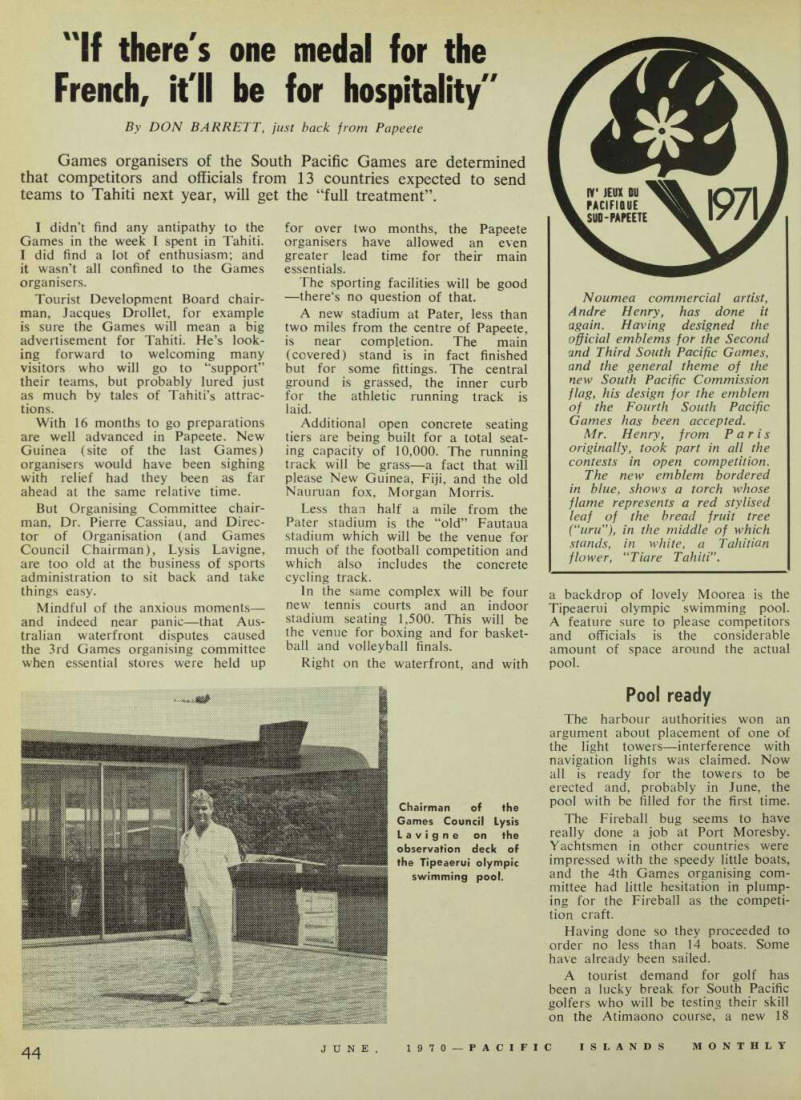
a backdrop of lovely Moorea is the Tipeaerui Olympic swimming pool.
A feature sure to please competitors and officials is the considerable amount of space around the actual
pool.
Pool ready
The harbour authorities won an argument about placement of one of the light towers —interference with navigation lights was claimed. Now all is ready for the towers to be erected and, probably in June, the pool with be filled for the first time.
The Fireball bug seems to have really done a job at Port Moresby.
Yachtsmen in other countries were impressed with the speedy little boats, and the 4th Games organising com mittee had little hesitation in plump ing for the Fireball as the competi tion craft.
Having done so they proceeded to order no less than 14 boats. Some have already been sailed.
A tourist demand for golf has been a lucky break for South Pacific golfers who will be testing their skill on the Atimaono course, a new 18
Chairman of the Games Council Lysis Lavigne on the observation deck of the Tipeaerui Olympic swimming pool.
Golf a lucky break
hole layout some 25 miles from Papeete.
All volleyball and basketball com petition will be indoors. A second but smaller covered stadium is available, for preliminary matches.
Being impossible to please every one, there is sure to be heartburning in New Guinea, Fiji and the Solo mons, with netball dropped from the list of sports to be staged.
Neither netball nor softball are played in Tahiti. At the Games Council meeting in Port Moresby last August the Tahitian delegates indicated they would not be able to stage both these sports.
It’s certain that the troubles over netball at Port Moresby influenced the decision to stage softball in pre ference. And, of course, American Samoa and Guam had indicated con siderable technical help to the organisers if softball was chosen.
Games headquarters will be in the just completed Papeete Youth Centre, also on the waterfront and a quiet stroll from the Olympic pool.
As at Port Moresby, each sport technical committee will have its own meeting room. These will be at the Paofai pre-school centre—right in town and not far from main venues.
There’ll be segregation of the sexes at the Papeete Games villages.
Male competitors and officials will be housed in the Paul Gauguin College complex, with three storey dormitory blocks, spacious kitchens and mess rooms and ample facilities for recreation.
The female village will be in an
annexe of the Catholic, Anne Marie Javouhey College. Again spacious ness is the keynote, and tree-shaded lawns.
All those living in the villages will sleep in two-tier bunks. There will be a commandant at each, with his own staff and there’ll be radio and television lounges, canteen and souvenir shop, and postal facilities.
First copy of a Games News Bulletin has been produced, a bi monthly publication designed to keep member countries abreast of preparations.
In April, I was reminded of Port Moresby 16 months before Games time. A handful of people working flat out, lots of people offering vocal encouragement, but doing nothing practical. And the big majority not really sure that the Games can or will happen.
It could and did at Port Moresby: It can and will at Papeete.
And one thing is sure. There WILL be the biggest welcome that any host country has ever given visiting teams. For as Lysis Lavigne says, “one medal we are going to win is the medal for hospitality”.
Nauru developments
In Nauru, runners Tony Bowditch and Robbie Morgan-Morris are pre paring keenly for the Games.
No Olympic standard tracks for these well-known athletes: Morgan- Morris is reported to be taking two to three runs around the island (1(H miles circumference) in a night’s training—good preparation for the next encounter with Caledonian marathon champion Auguste Goe.
Meanwhile Mrs. Lois Lax, gold medallist in the discus throw over the past few years, has now left Nauru and will not be competing for Nauru next year.
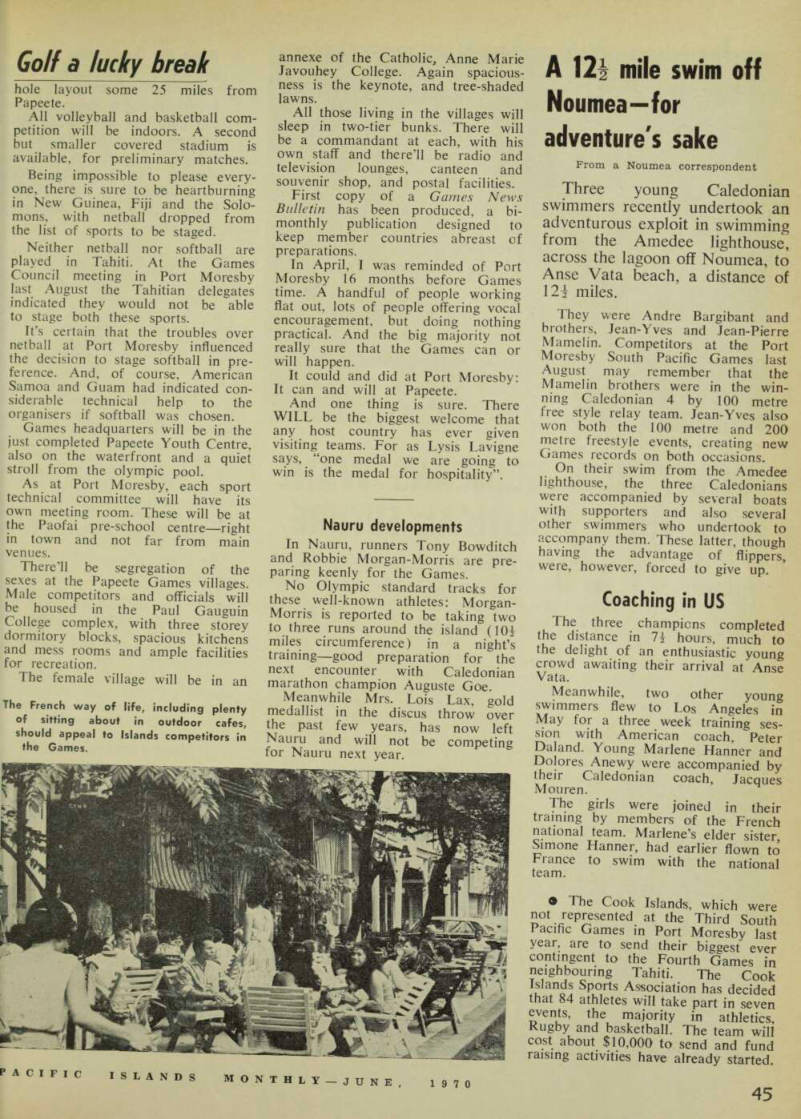
The French way of life, including plenty of sitting about in outdoor cafes, should appeal to Islands competitors in the Games.