Business and Development
pp. 119-135 · Read in the full issue

Political Events Hurt The
Big Islands Traders
By Ken Mcgregor
Share prices of the three major Islands traders, BP’s, Carpen ers and Steamies, hit their lowest levels in two years in April, ronically, the reasons for the falls weren’t poor prospects or trading, /hich is buoyant, but political and indirect.
Fiji’s coming independence and le intense political discussion fol
ding the Australian Opposition
eader, Mr. Gough Whitlam’s, anuary visit to New Guinea has weakened share market confidence i the big firms, particularly BP’s nd Steamies.
And the announcement of the 1972 ullout from Fiji of the huge Aus alian sugar refiner, CSR, has made IP’s and Carpenters re-evaluate their onsiderable financial stakes in the olony.
Carpenters, in particular, is pes imistic of Fiji prospects. A year ago n unsuccessful attempt was made y it to sell its three major copra lantations outside Viti Levu for bout 5F240,000 to an American roup, and at around this price, the states remain for sale.
Increased taxes
Late last year ( PIM, Dec., 1969, . 31), Carpenters and BP’s protested dthout avail to the Fiji Government ver an increased tax of profit ividends remitted overseas from 'iji.
Although BP’s has become a minor artner in Fiji hotels (Travelodge), Carpenters has not and has preferred o invest heavily instead in hotels in Australia.
Under an independent Fiji, both an expect to be taxed heavier, partic ularly on profits made in Fiji lestined for re-allocation overseas.
In April, BP’s $1 shares fell to !3.40, from a high earlier this year >f 54.30. They lost 30 cents in two lays and looked to be falling to lear the S 3 mark. Carpenters 50 «nt shares decreased from a ’7O ugh of 52.60 to 52.10.
Steamies 50 cent shares made a pirited rise to 74 cents following an
excellent interim report, before receding to 67 cents, where they had languished for several weeks.
In their interim, while declaring the usual five per cent, payout, Steamies directors said: “Problems have been highlighted by statements made from within and without New Guinea and directors again express their concern at the effect some of these statements, which do not always reflect a balanced view, have had on the in vestment image of the territory.
“Directors have confidence in the part that private enterprise must play in the territory’s future.”
For the six months ended Dec ember 31, 1969, they said group turnover and unaudited net profit were “well in excess” of the cor responding period of last year.
Turnover in merchandising and industrial divisions increased eight per cent, and the unaudited net profit showed an increase of 121 per cent.
Improved results came from these divisions and also from hotels, ship ping and stevedoring.
Directors expected this trend to continue in the current half year with the coffee operations in parti cular showing “considerable improve ment.”
PIM understands Steamies’ rubber interests will also pick up.
Carpenters interim said the group achieved a “steady net profit” for the six months to December 31.
Merchandise turnover increased by Si per cent, but seasonal and climatic conditions and commodity prices affected primary products.
Copra and cocoa production on the group’s estates was lower, but coffee and tea production was up.
Dividend was increased from nine to 10 per cent, indicating main tenance of the 20 per cent, annual payout.
As usual, BP’s didn’t issue an interim report, but it paid out. 6i per cent., indicating a 12i per cent, annual rate.
For investors wishing to buy in or increase their BP’s-Carpenters hold ings, the downtrend in these com pany’s prices is likely to continue to S 3 and S 2 levels. They then will be good buys.
Steamies shares, with over a seven per cent, yield are unlikely to fall further, much to the relief of that company’s directors.
Caledonia to import
Indonesian workers
Governor of New Caledonia, Louis Verger, recently told a Noumea Press conference that the territory will need to build over 13,000 dwellings within the next five years.
This will be necessary to house a Caledonian work force, expected to increase 50 per cent, during that period, from the present 38,000 to 57,000.
The Governor was discussing France’s plans for the island, fol lowing his three week visit to Paris in March. France is determined to develop the island’s nickel resources, so that last year’s production of 39,000 tons will have risen to 180,000 to 200,000 tons by 1975. This would be one-quarter of the world’s pro duction.
After a top-level French cabinet
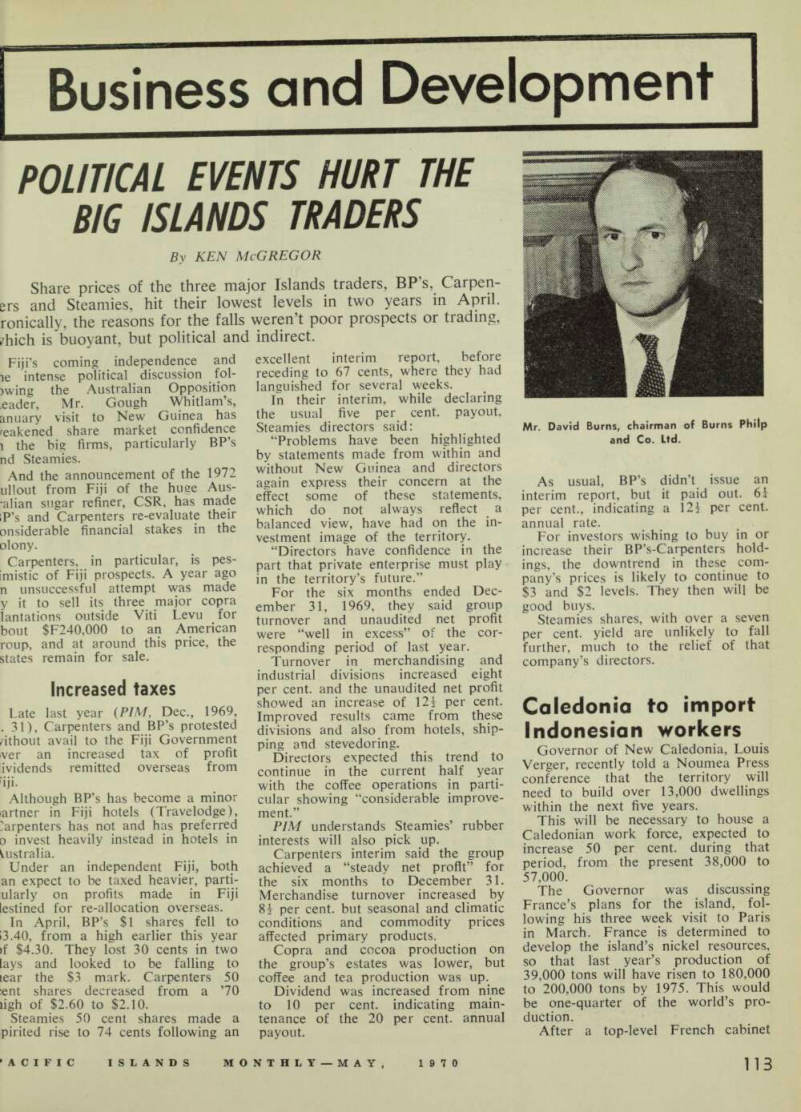
Mr. David Burns, chairman of Burns Philp and Co. Ltd.
neeting on March 9, presided over >y President Georges Pompidou, the jovernor declared that a high level our-man French Government mission yould visit the island “in early Vpril” to recommend credits neces ary for development projects.
This mission would hand in its eport early May, in time for another op level cabinet meeting. In June, he French Minister for Overseas rerritories, Mr. Henri Rey, would isit New Caledonia, Mr. Verger de lared.
In the meantime, the Governor idmitted that the territory is “poorly irepared for the expansion which waits it.” He referred to the in idequacies of roads, Noumea harbour ind Tontouta international airport, elephone services and housing.
As a first step, the Governor stated hat construction of the new Ton outa passenger terminal will begin n July. (This project, originally esti nated to cost about SA3 million, has >een hanging in suspense for two r ears, awaiting loan money).
To recruit labour, the Governor tated that Paris has given approval or “several hundred” Indonesians o come and work in the territory, in one-year contracts.
The total 19.000 workers required vould be sought in French Pacific erritories, France and Europe, be ides other Pacific islands.
From its mixed population, Gov irnor Verger stated that “New Caledonia should be an example of vhat France can do with a multi acial society”.
For "Nioouli" now
read "Gomenol"
Visitors who travel along New Caledonia’s west coast—including Noumea and the international air jort—often remark that the land icape is not unlike the Australian cutback.
With only 40 inches annual rain fall on this side (the lush east coast las 80 inches) the scenery is rather ?are, except for a sprinkling of »narled paper bark trees —niaouli to he Caledonians, Melaleuca laucaden iron to the botanists.
The bark of this tree was originally ased to make roofing material on ;arly settlers’ homes. Some years ago, he Japanese had plans for using this :imber as woodshavings, to be made into brown paper in Japan. Already m essence was being extracted from he leaf of the tree, for pharmaceut ical use.
The Japanese never reached agree ment with the French over this project and it seems their paper pulp nterest has been successfully trans
planted to timber in Papua-New Guinea.
However, the Territorial Assembly has just made a move to promote the manufacture of niaouli essence, It seems there are half a dozen settlers in the north of the island who are interested in developing this business, which in 1968 earned about SA 10,000 on the export market.
The assembly has thus voted a subsidy of over 5A5,000 to help labour costs. This grant is to ensure a price of 4 francs per kilogramme of niaouli leaves picked and 340 francs (about $3) for every litre
(1.8 pints) of essence produced.
Gomenol, which is the trade name for this essence, is said to have antiseptic properties and is used against colds.
Papuan rubber
profits up
Reflecting improved world prices for natural rubber, four Papuan rubber producers have announced greatly increased profits for the year ending December 31, 1969. One company has maintained annual
dividend at 10 per cent, and the other three have re-introduced dividends after breaks of up to four years.
Rubberlands Ltd. increased profit from 57,380 to $24,220, to return 12.1 on capital. It’s re-introduced dividend at 5 per cent. Kerema Rubber Ltd. increased profit by $30,561 to $39,324 and re-intro duced dividend at 7i per cent.
Mariboi Rubber Ltd.’s profit rose $19,846 to $32,502, and an interim payout of 2i per cent, will be paid.
Sogeri Rubber Plantations Ltd. lifted profit by about $12,000 in the six months to December 31 and held interim dividend at 2i per cent., in line with the annual payout of 10 per cent.
With all, except Sogeri, selling at well below par value on Australian stock exchanges, their dividend yields must be attractive for investors.
Meat shortage
in Caledonia
Special cargo jets were flown to Noumea in April to help overcome the meat and vegetable shortage.
The first Qantas Boeing brought 32 tons of meat. The second flight, a week later, brought meat and vege tables.
Last year, Qantas regular passenger flights flew nearly 700 tons freight into Noumea from Australia, main items being foodstuffs.
Between them, UTA and PanAm flew in over 300 tons from Aus tralia, while 200 tons were freighted on by Air New Zealand, from Auck land.
In the meantime, to overcome the shortage of another item difficult to procure in France, the local authorities have now completely liberalised the import of rice.
Record liquor sales
in New Caledonia
After a particularly hot and water less summer, Noumea’s brewery is registering record sales and prepar ing to increase its output five-fold.
The “Grande Brasserie Cale donienne” last year produced over 270,000 gallons, or 2.7 gallons for every person in the territory. In addition, New Caledonia imported over 900,000 gallons of beer from Europe. If one adds to this figure the amount of wine and spirits im ported—B7o,ooo gallons—one reaches an average of 20 gallons alcoholic beverages for every man, woman and child in the territory, which is almost half a pint daily.
Before drawing too many hasty
conclusions, however, one must re member that a certain quantity of this liquor (an undetermined quantity, however) is consumed by visitors or ships taking on supplies. The Noumea brewery is also exporting some of its beer, as yet in minor quantities, to the Wallis Islands and New Hebrides.
The brewery adopted its new “Ancre Export” label last December, following affiliation with the Esper ance Brewery in Alsace, France.
Since Christmas, Tahiti also has been producing Ancre beer.
Master brewer, Claude Fertig, a jovial young Swiss, who has worked in German-Swiss and French breweries, told PIM this his Noumea plant flies samples every month to Alsace, to make sure the Noumea beer matches the home product. He said the beer has a 3-4 per cent, alcoholic content, in keeping with the warm Caledonian climate. He finds Ancre less bitter than some beer he tasted in Australia. The Grande Brasserie Caledonienne im ports malt from Australia, hops from France and Germany, and filtration material from the US. The company is currently awaiting automatic brew ing equipment from Germany, which will permit a possible five-fold in crease in production.
Meanwhile, Ancre is the only brand selling draught beer in Noumea. The usual glass is un demi, containing 25 centilitres (nearly half a pint).
To order his drink, “un demi, pression” is all a beer-fancier has to ask a French barmaid.
American finds Aust.
playing tough
American Airlines will probably not begin its South Pacific flights in June, although New Zealand has given the airline permission to operate two flights a week into Auckland from that date.
One NZ flight is to be via Hawaii and American Samoa, and the other, via Hawaii and Fiji (with permission already granted by the Fiji Govern ment).
American Airlines is being held up by Australia. To May, despite prolonged and tough talks among a myriad of officials of the US and Australian Governments, Qantas, PanAm and American, no schedule of flights for American into Aus tralia had been agreed.
American doesn’t want to begin South Pacific flights without calls to Australia finalised, and it will probably delay its NZ inaugurals until this happens.
The bargaining for Australian schedules saw Australia’s Department
of Civil Aviation give little away.
Qantas urged the department to argue that American and PanAm divide the US’s current nine flights a week between them —the department did so.
PanAm, of course, taking losses on operations and finding competition increasing on many of its world-wide runs, is hardly happy with proceed ings.
In late April, American’s Fiji man, Mr. Ron Hunt, announced in Suva that the Australian Government had granted the US four extra flights a week into Australia. This means, PIM understands, the US Civil Aviation Board has to award the flights to a US carrier, or hold them over to a later date.
Most probable is that American will be given all four flights and PanAm will keep its current nine flights.
Drive-in bank
for Noumea
Noumea’s latest bank, fully air conditioned and with drive-in facili ties, was opened on March 16.
Tlie new building, on the corner of Rue de I’Alma and Avenue Marechal Foch, was the new headquarters of the Banque de I’lndochine. This be comes the bank’s fourth new office opened in Noumea in the last five years. The Bank of Indochina also recently opened its first inland bank at La Foa. Second bank to enter the territory was the Banque Nationale de Paris, which began operations in Noumea at the begin ning of last year.
Is there nickel in
Santa Isabel?
Have the nickel traces on southern Santa Isabel, Solomons, proved to be mere traces, or do they represent real deposits for a commercial min ing operation?
Many Solomons residents were asking these questions recently. Inco, the world’s biggest producer of nickel, had relinquished its 10-year prospecting licence over 112-square miles of the area.
The Solomons Government had declared the area “protected”, and, in the words of the BSIP News sheet, “had stopped prospecting
operations until a definite proposal for mining can be made”.
Inco in Sydney wouldn’t say if it had proposed a mining operation to the government. The company, how ever, didn’t consider it had “lost” the area and a spokesman said the pro tected area status didn’t rule out “further developments at a later date”.
Inco said it had applied for and received from the Solomons Govern ment an area close to the southern Isabel-San Jorge area, amounting to 322 square miles. A reconnaissance permit had been granted and, in April, “field explorations had begun”.
To residents, it seemed unlikely
Mr. Guy Stockdale, manager in Australia of American Airlines.
Inco would have let its original licence lapse if indeed commercial deposits of nickel had been located.
Government thoughts on a nickel find were pessimistic.
On the other hand, government thinking could be that if nickel was there in the 112 square miles, it would be more discreet not to leave it all in the licence of one firm.
There was also the feeling Inco was not conducting exploration quick enough, Inco has prospected the area for several years. It reported a “dis covery of important quantities of nickel and associated metals” in late ’67 ( PIM, Jan., 1968, p. 124). Then it said it would mine and stockpile 50,000 tons from the area and studies would be made later.
Search for copper
•p• • •
in Fiji
Copper in them there hills? That’s the hope of Barringer Fiji Ltd., which has taken over a Nadi mining prospect called the Kingston Mine.
Barringer Fiji Ltd. is a subsidiary of the Canadian company which is currently carrying out a SF2 million aerial minerals search in Fiji.
Dr. A. R. Barringer, president of Barringer Research Ltd., said Kingston held “interesting potential for copper”.
He said his company had also completed an option agreement with Sharma Syndicate, of Ba, for a detailed exploration programme on a prospect near Balevuto.
He said the aerial search was “proceeding well”. Total coverage of Viti Levu was to be completed by July.
Ten thousand rock samples had been gathered and analysed. Detailed map-making was being done with the help of a computer in Toronto, Canada, where magnetic tapes re corded during sweeps of Viti Levu and Vanua Levu were sent daily.
ANG shores go
up at- last
It was a good thing ANG Holdings’ $1 shares picked up from a three-year low price of 82 cents, to reach $1.12 in April.
With poor results and no dividends in its first three years, ANG in late March announced an issue of one share of $1 at par for every three shares held on April 17.
The issue, to raise paid-up capital from $914,000 to $1.3 million, was primarily to provide new funds for a joint venture with Morobe Construc tions Pty. Ltd. to build 446 houses at Arawa, the copper project town
at Bougainville.
The Arawa contract, worth $7 million, was strategically announced two weeks before the share issue.
Had ANG’s share prices remained below $l, in the light of its performance so far, it would have had trouble raising its $386,000.
Its interests include coffee growing, rubber planting, timber, shipping and office leasing in Moresby.
Anr»fh<ir Innlr nf MllOTner BOOK, ar Fin FIJI manganese An Australian company, Nchenga Mines Pty. Ltd., is planning plants
in Fiji for upgrading manganese ore from abandoned mines, A network of small plants is planned, with the first one for 1972.
A Nchenga director, Mr. J. F.
Blackburn, said several small mines on Viti Levu had been worked out of high-grade ore but there had been no organised market for their low grade ore.
It seemed that a large amount of low-grade ore could be upgraded.
The company had applied the special prospecting licences covering 26,000 acres in Nadroga/Navosa and 33,000 acres in the Y asawas. An airborne geophysical survey of the Yasawas was planned.
Commerce briefs
wummcnc uncr* . 11™ u™ • Magellan Petroleum Co. has been granted a personal authorisation in the New Hebrides, giving it the right to apply for prospecting and mining leases in the condominium, except Tanna. It’s the first time an oil company has shown interest in the Hebrides. • Southland Mining Ltd., Fiji manganese exporter, hasn’t lived up to prospectus forecasts for its output of manganese, but the operation would still be “highly profitable”,
the com P an y’s Chairman, Mr. M.
Messara, said in April. Meantime, Southland’s shares on Australian t k exchan p es crashed recently
S recently,
fallm S from slo ' 7o t 0 s4 ' • Australia may spend $1.3 million on improvements to Manus naval base, New Guinea, according to Port Moresby’s Post Courier, and not $3.5 million, as announced in 1967 ( PIM , May, 1967, p. 105). The paper says the original big Manus plan has been scrapped for a similar project at Madang, on the NG main land.
• Savoy Corporation Ltd., the Melbourne-based group examining timber potential behind Vanimo, New Guinea, with Japanese paper company, Oji Paper Co., says negotiations have begun with the NG Administration for a “multi-million dollar project” which could give it “very big returns”. The company’s Sydney representative said he “didn’t know” how far plans had gone to develop the timberlands. • As reported in PIM for Feb ruary, page 122, demand for trochus shell is strong. Burns Philp (New Hebrides) Ltd. and World Trading Company, Star House, Hong Kong, are now buyers.
BP’s are offering Sioo a ton for good clean shells between 3 and 5 in. World Trading is after 20 tons monthly for shells 3 to 5 in. No price is stipulated but the company wants a maximum two per cent, defective shells and no dead or worm eaten shells. Shells should be packed in strong gunny bags. Papuan trochus is drawing the highest price—$170 a ton. • A conference among the six oil companies given permission to form a consortium to explore oil possibili ties in Tonga (Shell, BP, Aquitane, Republic, Gulf and Ampol), the Tongan Government and its UK oil advisors will be held in Nukualofa in May. It will determine the final consortium agreement. • Dylup Plantations Ltd., New Guinea cocoa and copra producer, has reduced dividend for the year to January 31 from 17i per cent, to 15 per cent., following a 41.3 profit decline. Profit for 1969 was $79,182, compared with $135,054 in 1968. Cocoa, copra, and shell carbon production all fell in ’69; coir fibre production rose. • American - controlled Cottees Passiona (NG) Ltd. recently began using new processing facilities at its Goroka plant in the New Guinea Highlands. New machines will handle the passionfruit crop from the four Highlands Districts and it’s hoped fruit worth $lOO,OOO and producing 120,000 gallons of juice extract will be reached by 1973. Concentrated export juice by then should be worth about $500,000. • The Honiara - based BSIP Chamber of Commerce has an nounced it opposes any government attempt to introduce price control in
More Commerce on p. 129
he Solomons. This follows a gov ;rnment decision to set up a com nittee to investigate price control.
Allegations were some traders were jiving preferential prices to Euro leans and variations in prices accord ng to times of monthly pay days. • Australians working on Nauru vill avoid home taxes after all.
Australia has agreed, following pro onged talks dating back to mid ast year {PIM, Oct., 1969, p. 119), :o extend the special transitional ncome tax agreements currently in ? orce, up to June 30, 1975.
These arrangements allow re nission of Australian income tax layable on Nauruan earnings by •esidents of Australia working on Nauru has no income tax. • New South Wales’ Department :>f Decentralisation and Development is organising a delegation of about 15 representatives from small manu facturing firms in NSW to put in a three-week trade mission to New Guinea, the Solomons and Fiji in September-October. • The Bainings and Gazelle local government councils recently began reviewing applications on behalf of the New Guinea Administration for 302 land development blocks in the Keravat area of the Gazelle Peninsula, west of Rabaul.
The blocks, covering about 9,000 acres, will be suitable for cocoa and :opra production, as well as market gardening crops.
There are four sections involved —three undeveloped plantations, Japlik, Vunapaladig and Mandres, and 5,600 acres from a forestry reserve. Blocks will be from 20 to 90 acres and the Administration will build 13 miles of medium standard roads to the area, giving access to all blocks, except those on Mandres. • Mr. Derek Lumbers, master of the Cook Islands trading bessel, MV Bodmer, was fined a total of SNZ2SO in the High Court at Avarua in mid- April for smuggling offences.
The charges followed the seizure of liquor, cigarettes and perfume by Customs officers on February 16
after the return of the Bodmer to Rarotonga from Tahiti.
Mr. Lumbers defended himself against 14 charges the main ones of which were smuggling, knowingly making a false declaration with intent to defraud the revenue of Customs, and unlawfully importing liquor into the Cook Islands.
Chief Judge J. A. Fraser convicted Lumbers on the three principal offences. Convictions were entered on other charges but no penalties imposed and the remaining charges were dismissed.
O Mr. S. L. M. Eskell, former chairman of New Guinea newspapers South Pacific Post and Times Courier, and a director of Sangara (Holdings) Ltd., appeared in Sydney’s Central Court in April charged with various offences against the Companies Act, with two other directors of Australian Factors Ltd.
He was associated with early moves by NG’s recently-formed Territory United Brewery Ltd., but was omitted from its board ( PIM , Feb., p. 119).