When An Islander Is
p. 102 · Read in the full issue
Not An Islander
By JOHN ECCLES, just back from Lord Howe.
Lord Howe Island, part of New South Wales and lying about 300 miles off the main land, is a recreational paradise for jaded Australian tourists. But on the tiny island, seven miles long and just over a mile wide, the tourists remain largely un aware that the small population is split into two camps, Islanders and non-islanders.
The 70-odd non-Islanders who re side more-or-less permanently on Lord Howe have had to live with this label since the Lord Howe Island Act was passed in 1953 giving only residents who leased land before the act the right to call themselves Islanders, with all the advantages that go with the title. But the 70 have now become more articulate and, with an eye to the tourist boom which has hit the island, have formed them selves into a Non-Islanders Associ ation, dedicated to having the act changed.
At the island’s only “pub”, the Bowling Club, you’d never think there was any friction. There, all are welcome and non-islander rubs shoulders happily with the most jingoistic Islander. But in matters of land and status there is plenty of bitterness.
I asked Nick Potter, who runs a thriving store not far from the beach, what it meant to be a non-islander on Lord Howe. The answer came
back that to those who are Islanders there is an automatic free “perpetual lease” of five acres (all land is owned by the crown) for residential pur poses and a loan of $8,500 for development. Islanders alone serve on the Island Committee (the only body to advise the Lord Howe Island Board of Control, which runs the island as part of NSW). Islanders have priority over the purchase of land and under law they can buy any land up for sale at a nominal price, even though a non-islander is pre pared to pay more.
Protects the island
The act was passed to protect the Islanders, their island and the quiet, easy-go-lucky life which goes with it. Hie Islanders claim this is exactly what it does do.
The non-islanders, some of whom have been on the island for as long as 14 years, say it is a ridiculous situation that an Islander may leave Lord Howe and settle in Australia and yet his wife and children will remain Islanders, while a non islander may remain on the island all his life and even his descendants have no chance of being called Islanders—and all because of a piece of legislation.
Tourism, a new airstrip and general prosperity are coming to Lord Howe and the subject of land, who owns it, and who gets the chance to reap the most benefit from the tourist dollar, is now a matter of paramount importance. The non-islanders want: © All non-islanders to become Islanders after 10 years residence
on the island. Subsequent absence from the island for more than six consecutive years would revoke Islander status. This, says the asso ciation, would mean Islandership im mediately for only seven or eight people, but it would bring a sense of belonging to residents who might otherwise remain “different” for all time. • All non-islanders to be entitled to enrol for island elections after a 12 months’ residence. • Non-Islanders to be entitled to be elected to the Island Committee after three years residence, and to the board after five years. • All leaseholders, regardless of status, to pay the same land rent as Islanders from the date of initial occupancy. • All non-islanders to have equal claim to the transfer of existing leases with Islanders after three years resi dence.
Many of these proposed changes deal with land questions. The Islanders feel, with plenty of examples to support their point, that islands which give “foreigners” a finger in the land pie, end up with nothing to call their own and a place to live which bears little relation to the happy place they once knew.
First priority
The act, they say, gives them first priority to do what they like with their own land and gives them the right to run the island their own way, instead of being swamped by a spreading population from the main land. That population problem can be further complicated, theoretically by the fact that any Commonwealth subject can work and stay on Lord Howe as long as he likes. In fact, few visitors are even allowed to board the flying-boat to Lord Howe unless they have evidence of a place to stay and money to pay for it.
The non-islanders in this war claim, of course, that not all Islanders are angels. They are just as capable of making a mess of the place as any one else, and are just as capable of selling the island out to make money as any visitor.
Whatever the merits of either argu ment, some sort of change is needed in the status of non-islander residents on Lord Howe.
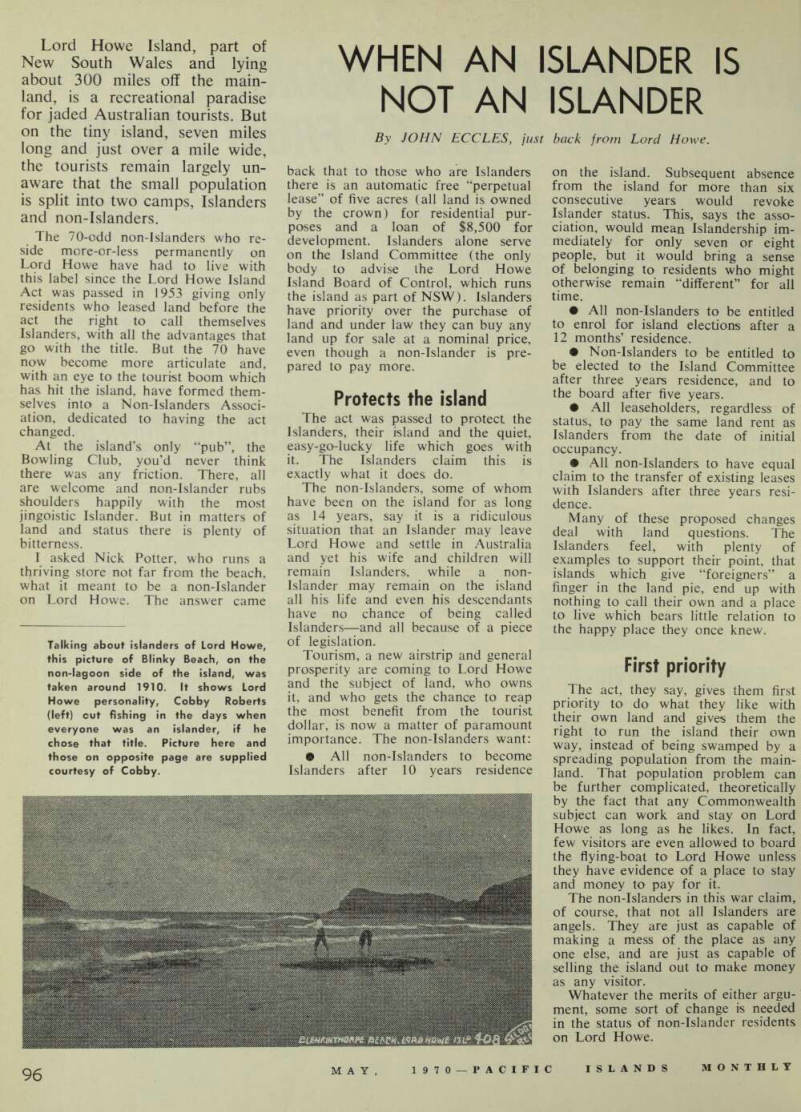
Talking about islanders of Lord Howe, this picture of Blinky Beach, on the non-lagoon side of the island, was taken around 1910. It shows Lord Howe personality, Cobby Roberts (left) out fishing in the days when everyone was an islander, if he chose that title. Picture here and those on opposite page are supplied courtesy of Cobby.