"Tarzan the Ape Man"—who
p. 91 · Read in the full issue
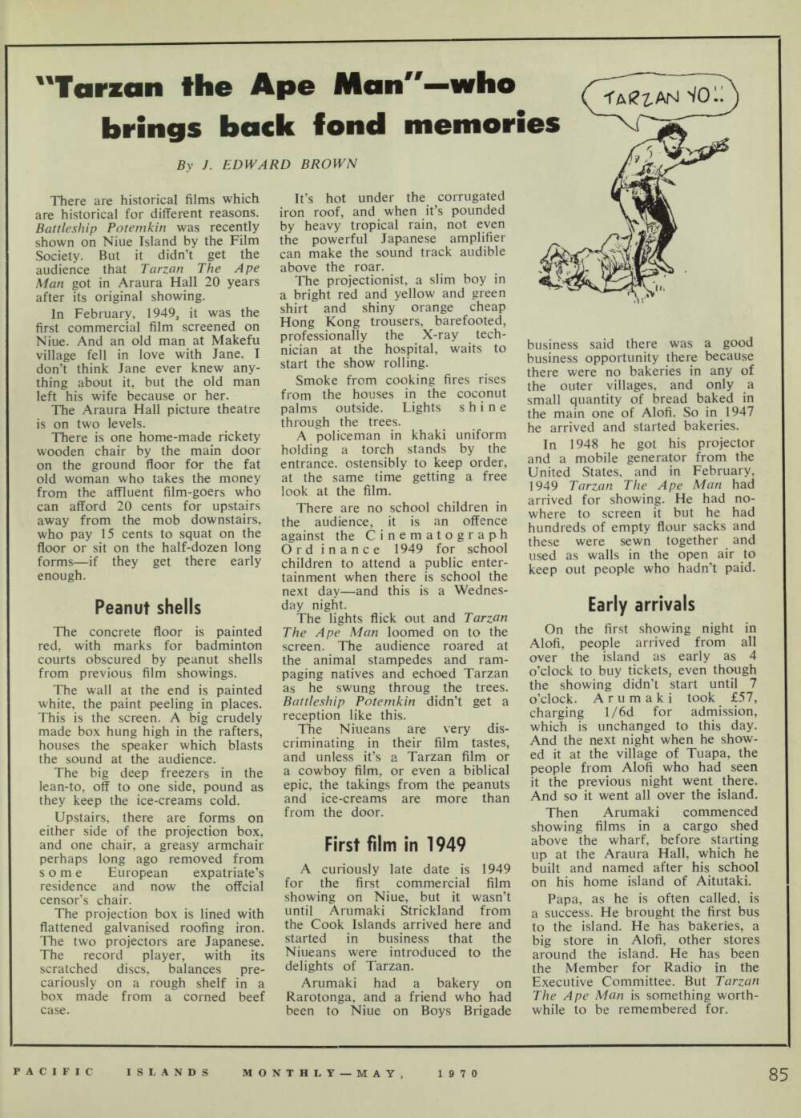
brings back fond memories
By J. Edward Brown
There are historical films which are historical for different reasons.
Battleship Potemkin was recently shown on Niue Island by the Film Society. But it didn’t get the audience that Tarzan The Ape Man got in Araura Hall 20 years after its original showing.
In February, 1949, it was the first commercial film screened on Niue. And an old man at Makefu village fell in love with Jane. I don’t think Jane ever knew any thing about it, but the old man left his wife because or her.
The Araura Hall picture theatre is on two levels.
There is one home-made rickety wooden chair by the main door on the ground floor for the fat old woman who takes the money from the affluent film-goers who can afford 20 cents for upstairs away from the mob downstairs, who pay 15 cents to squat on the floor or sit on the half-dozen long forms—if they get there early enough.
Peanut shells
The concrete floor is painted red, with marks for badminton courts obscured by peanut shells from previous film showings.
The wall at the end is painted white, the paint peeling in places.
This is the screen. A big crudely made box hung high in the rafters, houses the speaker which blasts the sound at the audience.
The big deep freezers in the lean-to, off to one side, pound as they keep the ice-creams cold.
Upstairs, there are forms on either side of the projection box, and one chair, a greasy armchair perhaps long ago removed from some European expatriate’s residence and now the offcial censor’s chair.
The projection box is lined with flattened galvanised roofing iron.
The two projectors are Japanese.
The record player, with its scratched discs, balances pre cariously on a rough shelf in a box made from a corned beef case.
It’s hot under the corrugated iron roof, and when it’s pounded by heavy tropical rain, not even the powerful Japanese amplifier can make the sound track audible above the roar.
The projectionist, a slim boy in a bright red and yellow and green shirt and shiny orange cheap Hong Kong trousers, barefooted, professionally the X-ray tech nician at the hospital, waits to start the show rolling.
Smoke from cooking fires rises from the houses in the coconut palms outside. Lights shine through the trees.
A policeman in khaki uniform holding a torch stands by the entrance, ostensibly to keep order, at the same time getting a free look at the film.
There are no school children in the audience, it is an offence against the Cinematograph Ordinance 1949 for school children to attend a public enter tainment when there is school the next day—and this is a Wednes day night.
The lights flick out and Tarzan The Ape Man loomed on to the screen. The audience roared at the animal stampedes and ram paging natives and echoed Tarzan as he swung throug the trees.
Battleship Potemkin didn’t get a reception like this.
The Niueans are very dis criminating in their film tastes, and unless it’s a Tarzan film or a cowboy film, or even a biblical epic, the takings from the peanuts and ice-creams are more than from the door.
First film in 1949
A curiously late date is 1949 for the first commercial film showing on Niue, but it wasn’t until Arumaki Strickland from the Cook Islands arrived here and started in business that the Niueans were introduced to the delights of Tarzan.
Arumaki had a bakery on Rarotonga, and a friend who had been to Niue on Boys Brigade
business said there was a good business opportunity there because there were no bakeries in any of the outer villages, and only a small quantity of bread baked in the main one of Alofi. So in 1947 he arrived and started bakeries.
In 1948 he got his projector and a mobile generator from the United States, and in February, 1949 Tarzan The Ape Man had arrived for showing. He had no where to screen it but he had hundreds of empty flour sacks and these were sewn together and used as walls in the open air to keep out people who hadn’t paid.
Early arrivals
On the first showing night in Alofi, people arrived from all over the island as early as 4 o’clock to buy tickets, even though the showing didn’t start until 7 o’clock. Arum a k i took £57, charging l/6d for admission, which is unchanged to this day.
And the next night when he show ed it at the village of Tuapa, the people from Alofi who had seen it the previous night went there.
And so it went all over the island.
Then Arumaki commenced showing films in a cargo shed above the wharf, before starting up at the Araura Hall, which he built and named after his school on his home island of Aitutaki, Papa, as he is often called, is a success. He brought the first bus to the island. He has bakeries, a big store in Alofi, other stores around the island. He has been the Member for Radio in the Executive Committee. But Tarzan The Ape Man is something worth while to be remembered for.