Magazine Section
pp. 87-89 · Read in the full issue
Cleaning Up The Memory
Of "Good" King Binoka
By Ken Mcgregor
“His corpulence is now portable; you would call him lusty rather than fat; but his gait is still dull, stumbling and elephantine . . . a beaked profile like Dante’s in the mask, a mane of long, black hair, the eye brilliant, imperious, and inquiring; for certain parts, and to one who could have used it, the face was a fortune. . . .
“I am told the king is a crack shot; that when he aims to kill, the grave may be got ready; and when he aims to miss, misses by so near a margin that the culprit tastes six times the bitterness of death. .
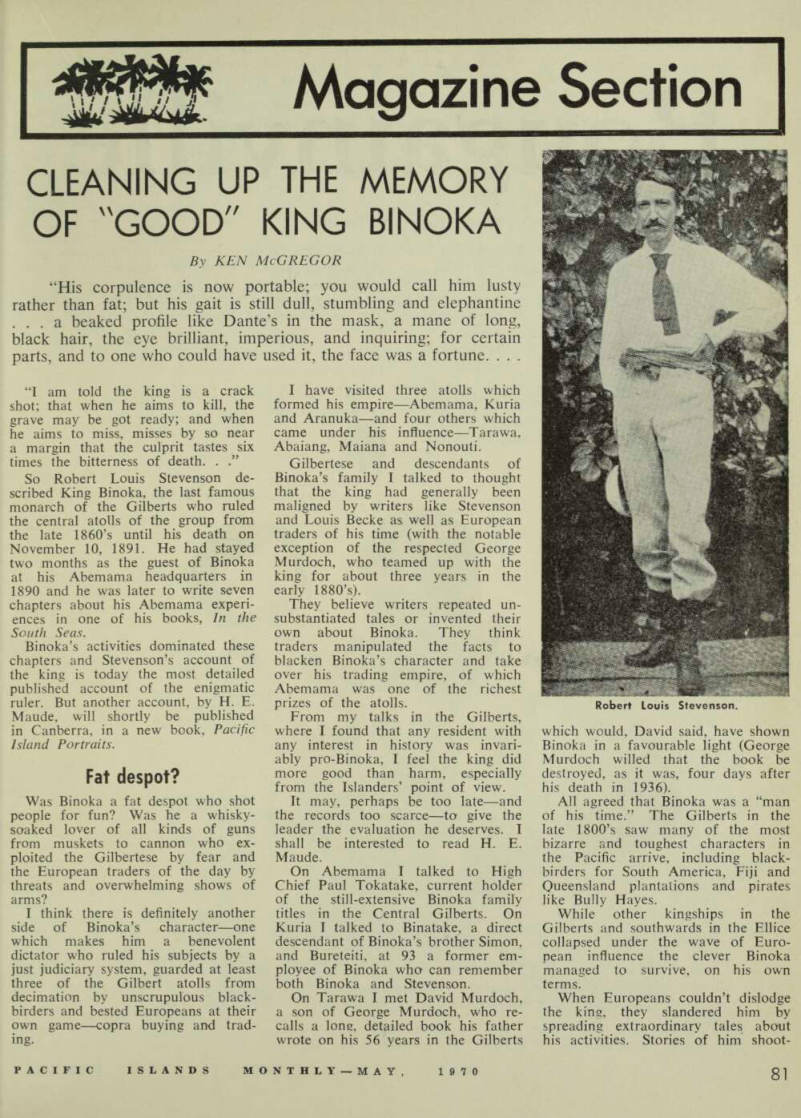
So Robert Louis Stevenson de scribed King Binoka, the last famous monarch of the Gilberts who ruled the central atolls of the group from the late 1860’s until his death on November 10, 1891. He had stayed two months as the guest of Binoka at his Abemama headquarters in 1890 and he was later to write seven chapters about his Abemama experi ences in one of his books, In the South Seas.
Binoka’s activities dominated these chapters and Stevenson’s account of the king is today the most detailed published account of the enigmatic ruler. But another account, by H. E.
Maude, will shortly be published in Canberra, in a new book, Pacific Island Portraits.
Fat despot?
Was Binoka a fat despot who shot people for fun? Was he a whisky soaked lover of all kinds of guns from muskets to cannon who ex ploited the Gilbertese by fear and the European traders of the day by threats and overwhelming shows of arms?
I think there is definitely another side of Binoka’s character—one which makes him a benevolent dictator who ruled his subjects by a just judiciary system, guarded at least three of the Gilbert atolls from decimation by unscrupulous black birders and bested Europeans at their own game—copra buying and trad ing.
I have visited three atolls which formed his empire—Abemama, Kuria and Aranuka—and four others which came under his influence—Tarawa, Abaiang, Maiana and Nonouti.
Gilbertese and descendants of Binoka’s family I talked to thought that the king had generally been maligned by writers like Stevenson and Louis Becke as well as European traders of his time (with the notable exception of the respected George Murdoch, who teamed up with the king for about three years in the early 1880’s).
They believe writers repeated un substantiated tales or invented their own about Binoka, They think traders manipulated the facts to blacken Binoka’s character and take over his trading empire, of which Abemama was one of the richest prizes of the atolls.
From my talks in the Gilberts, where I found that any resident with any interest in history was invari ably pro-Binoka, I feel the king did more good than harm, especially from the Islanders’ point of view.
It may, perhaps be too late —and the records too scarce—to give the leader the evaluation he deserves. 1 shall be interested to read H. E.
Maude.
On Abemama I talked to High Chief Paul Tokatake, current holder of the still-extensive Binoka family titles in the Central Gilberts. On Kuria I talked to Binatake, a direct descendant of Binoka’s brother Simon, and Bureteiti, at 93 a former em ployee of Binoka who can remember both Binoka and Stevenson.
On Tarawa I met David Murdoch, a son of George Murdoch, who re calls a lone, detailed book his father wrote on his 56 years in the Gilberts
which would, David said, have shown Binoka in a favourable light (George Murdoch willed that the book be destroyed, as it was, four days after his death in 1936).
All agreed that Binoka was a “man of his time.” The Gilberts in the late 1800’s saw many of the most bizarre and toughest characters in the Pacific arrive, including black birders for South America, Fiji and Queensland plantations and pirates like Bully Hayes.
While other kingships in the Gilberts and southwards in the Ellice collapsed under the wave of Euro pean influence the clever Binoka managed to survive, on his own terms.
When Europeans couldn’t dislodge the king, they slandered him by spreading extraordinary tales about his activities. Stories of him shoot-
Robert Louis Stevenson.
Tales were 'inventions'
ig Gilbertese out of trees for sport nd forcing couples to copulate on ibemama beaches in front of his ollowers were all “good stuff”.
As was the one of Binoka punish ig a Gilbertese who was seen to lance at one of his 36 wives, linoka was supposed to have had le man strapped underneath a bridge d a lagoon toilet and then had 0 men excrete on him before the lan was speared to death.
This particular yarn, when I re lied it to part-European residents f Tarawa, caused more than a few iughs at the Betio Club. It was invented”, I was told, by someone dio had a scant meeting with Binoka d a friend who had only heard molly tales of the king.
Binoka’s own life sheds some light n his many-sided character.
He is generally believed to have een the son of King Baitake of Lbemama, a small and warsome lonarch of the big atoll in the 860’s. However, Stevenson throws ome doubt on this and hints that tinoka was in reality the son of laitake’s brother, Binatake, a huge iilbertese who was a champion warrior and the real power of the amily.
Adopted nephew!
Stevenson wrote: “How if the heir of Baitake, like tie heir of Binoka himself, were not son, but an adopted nephew? . . . low if on the death of Baitake, the wo stronger natures, father and son, ;ing and kingmaker, clashed, and linoka, when he drove out his uncle, Irove out the author of his days?” lere is at least a tragedy four quare.
However, in my conversations in he Gilberts I was told that when linoka came to power on Baitake’s leath, he banished Binatake, pre umably to consolidate his own lewly-won power. In turn, when linoka died over 20 years later, be ;ause he left no children it was the on of his brother Simon who won iventual succession.
Kuria’s current-day Binatake told ne Binoka had a brother, Simon, md a sister, Tea. Neither Binoka lor Tea had any children, but Simon lad two—Paul (no children) and Rita one, Tokatake, who later had five :hildren, George, Binatake, Molly, Charles and John).
By the early 1870’s Binoka, from lis Abemama headquarters, had sstablished complete power over the learby atolls, Kuria and Aranuka.
He was running his own schooners, trading and buying all the coconut oil and later copra from these three atolls.
At first he employed two Euro peans—a German carpenter Hoffman and a boat-builder, Tom Ree.
In the 1880’s he was to employ many other Europeans for various periods. They included Sukong, a Chinese cook and steward, George Murdoch, as trader, supercargo and turtle-catcher, Captain Henty as master of one of his vessels, and Charlie Turk as a seaman.
Lavish homes
Binoka very early set about build ing himself lavish headquarters near the site of Abemama’s present-day government station as well as houses on Kuria and Aranuka. On Abemama he put up his palace, a big European style two storey building, several sheds and two trading stores to house big supplies of liquor, arms, trade goods and copra waiting for shipment overseas.
Vessels out of Australia, Fiji and New Zealand called regularly to drop off trade goods and collect copra.
Binoka sold copra measured in houseloads and bought almost any new possession he could lay his hands on. He was always in the market for guns of all descriptions and once bought a huge safe which was never used because it was subsequently locked with the key inside.
Twice —once by a German war ship and once by a British warship —all his cannon and guns were con fiscated and dumped into Abemama or Kuria’s deep lagoons. The war ships fined the king huge amounts of copra for keeping the guns.
Inevitably soon after, Binoka was armed again, once with the help of European traders from Butaritari, Bureteiti, who has lived most of his life on Kuria, told me Binoka had 36 wives. For them he had a massive pool built behind his Abemama palace. Water was carried to the pool by servants and pumped in half a mile from the lagoon by an elaborate pipe system.
Only Binoka was allowed to see his wives romping in the pool and men were strictly banned.
“He called the pool ‘Tekaburoro’. which means brain,” Bureteiti said.
“In Gilbertese the brain or head is sacred and the pool was sacred to evervone except the wives and Binoka.”
Bureteiti said playing cards was one of Binoka’s favourite pastimes. “The king divided his wives into two groups—a high and low class. Then he would play cards with wives
from each class separately for cash or tobacco.
“Binoka used to play against Stevenson in the Abemama palace on the floor. The king always won because he had choice of both hands of cards.”
Bureteiti and Binatake said Binoka fought only one “war” during his reign. A chief of Tarawa, Kalakalia, had gone to Honolulu and returned to the Gilberts with several followers.
Kalakalia had been trained in the use of firearms and brought many guns back with him.
“Kalakalia went to Nonouti, south of Abemama, with his men and killed the local leaders. The people of Nonouti fled in canoes to Kuria but they arrived at a time of great poverty in the 1870’s because all the islands were having a great drought,” Bureteiti said, “The Nonouti people put a great strain on Kuria’s food and land re sources so Binoka decided to act.
“Binoka chartered a schooner from Fiji with a New Zealand skipper and with the schooner and armed men from Abemama he re took Nonouti with the loss of four lives. The Nonouti people were able to return home in peace but Binoka didn’t take control of Nonouti.”
This version of the Nonouti “war” differs from the more-widely held story that Binoka invaded the island with his own men for plunder and women.
I believe the Nonouti war and several other tales were made up to discredit Binoka. Certainly he was harsh: he had to be, to survive in the early days of the Gilberts,