Tourism Now Isn't A Dirty
pp. 53-54 · Read in the full issue
Word In The Cook Is.
The Cook Islands, the only nation to bear the name of Captain Cook, won itself a fair share of attention during the Cook Bi centenary celebrations in Sydney in April—thanks to Cook Islands Premier, Albert Henry.
Mr. Henry and his wife paid their first visit to Sydney at the invitation of the bi-centenary organisers, and the Premier soon became a well known figure as a result of Press, radio and TV interviews and public appearances at the theatre and department stores in support of the Cook Islands National Theatre, whose dancers were also in town.
Mr. Henry was guest of honour at the premiere of the National Theatre in Sydney, and a fortnight later was still in Sydney to farewell the team as they made a barnstorm ing series of one night stands in the country and interstate.
Mr. Henry got himself a good Press on the day of his arrival by Air New Zealand, when dancers gave him a colourful welcome at the airport while the television cameras whirred. At a news con ference there he told reporters that one of the reasons he was in Aus tralia was to tell people where the Cook Islands were, as he suspected Australians had never heard of them.
“We know New Zealand very well, but we don’t know Australia, and they don’t know us,” he said. “The world has got smaller, and the Pacific basin has got smaller. It is not now a case of the South Pacific or the North Pacific.
"One Pacific"
“The Equator is not a dividing line. There is one Pacific, and we smaller nations have been given the right to plan our future, and we think there must be togetherness in the Pacific. The Cook Islands have had no relations at all with the Austra lian Government—these are handled through New Zealand—but as a responsible person I also want to make my own contacts for the Cook Islands.”
Mr. Henry said Australian audiences would be fascinated by the National Theatre dancers, but it was not his government’s intention to export them. They were a sample of what tourists could expect to see in the Cook Islands by going there
themselves. The international airport at Rarotonga would open by the end of 1972 and the Cooks were now gearing up to welcome visitors.
Mr. Henry agreed something of the Cooks would be lost with tourism —“that unexpected leaves are often blown into your living room when the windows and doors are open wide, and we are opening ours very wide to the winds of tourism— perhaps too wide”. But it was a risk he was prepared to take. It was inevitable there would be changes.
Every time he visited Tahiti he saw something different which was not Tahiti—although he still continued to see the real islands outside of Papeete.
Tourist plans
At other interviews during his visit to Sydney Mr. Henry said he hoped to have 400 hotel and motel beds available in Rarotonga by 1972, in time for the opening of the airport.
He planned three types of accom modation beginning at $3 a day, with SB to $9 as a medium bracket, and $l2 to $l4 a day for high-class accommodation.
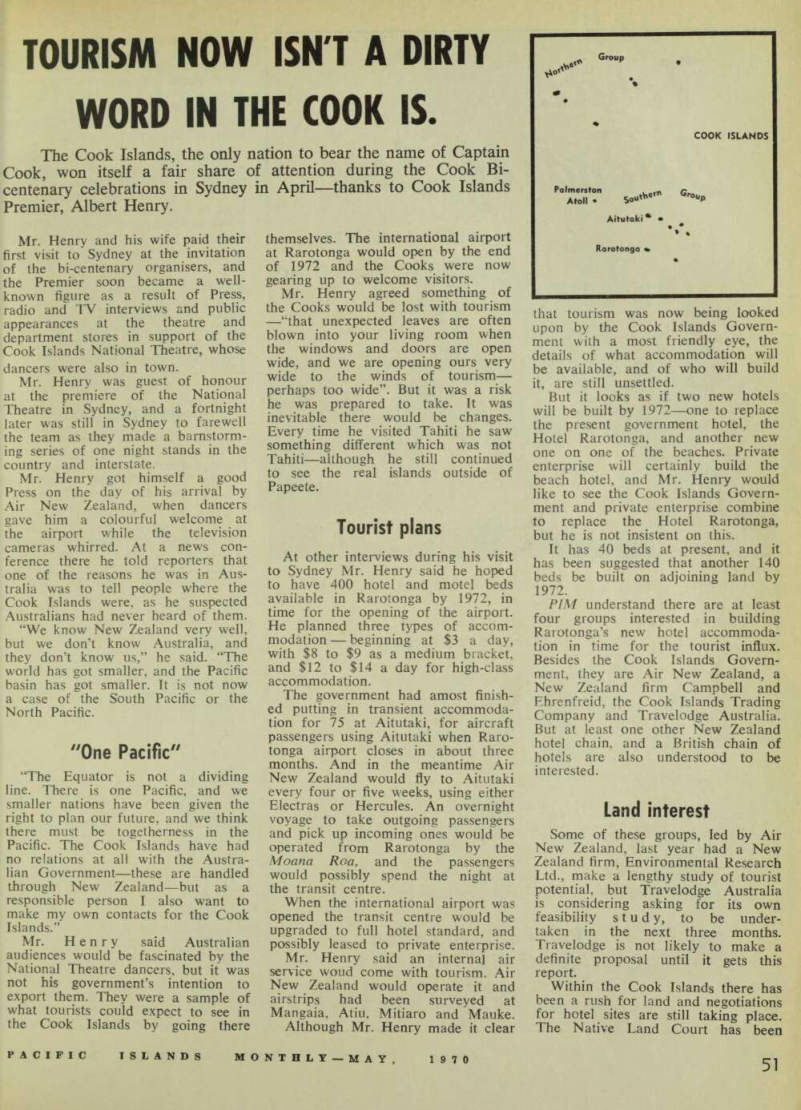
The government had amost finish ed putting in transient accommoda tion for 75 at Aitutaki, for aircraft passengers using Aitutaki when Raro tonga airport closes in about three months. And in the meantime Air New Zealand would fly to Aitutaki every four or five weeks, using either Electras or Hercules. An overnight voyage to take outgoing passengers and pick up incoming ones would be operated from Rarotonga by the Moana Roa, and the passengers would possibly spend the night at the transit centre.
When the international airport was opened the transit centre would be upgraded to full hotel standard, and possibly leased to private enterprise.
Mr. Henry said an internal air service woud come with tourism. Air New Zealand would operate it and airstrips had been surveyed at Mangaia, Atiu, Mitiaro and Mauke.
Although Mr. Henry made it clear
that tourism was now being looked upon by the Cook Islands Govern ment with a most friendly eye, the details of what accommodation will be available, and of who will build it, are still unsettled.
But it looks as if two new hotels will be built by 1972—0ne to replace the present government hotel, the Hotel Rarotonga, and another new one on one of the beaches. Private enterprise will certainly build the beach hotel, and Mr. Henry would like to see the Cook Islands Govern ment and private enterprise combine to replace the Hotel Rarotonga, but he is not insistent on this.
It has 40 beds at present, and it has been suggested that another 140 beds be built on adjoining land by 1972.
PIM understand there are at least four groups interested in building Rarotonga’s new hotel accommoda tion in time for the tourist influx.
Besides the Cook Islands Govern ment, they are Air New Zealand, a New Zealand firm Campbell and Ehrenfreid, the Cook Islands Trading Company and Travelodge Australia.
But at least one other New Zealand hotel chain, and a British chain of hotels are also understood to be interested.
Land interest
Some of these groups, led by Air New Zealand, last year had a New Zealand firm, Environmental Research Ltd., make a lengthy study of tourist potential, but Travelodge Australia is considering asking for its own feasibility study, to be under taken in the next three months.
Travelodge is not likely to make a definite proposal until it gets this report.
Within the Cook Islands there has been a rush for land and negotiations for hotel sites are still taking place.
The Native Land Court has been
swamped with hundreds of applica tions from landowners and others seeking occupation rights, and other legal rights. A correspondent says that, nevertheless, most Cook Islanders only have a vague under standing of what tourism will mean when it gets into full swing.
Sites being looked at for develop ment are the beautiful lagoon and beach area at Muri on the east coast of Rarotonga, and the McKegg lease hold in Titikaveka fronting the wide southern lagoon and reef flats. There has also been interest in a site in Arorangi, on the west side, for the development of a resort hotel.
Fullscale work on the Rarotonga airstrip will begin in the next few weeks. It’s expected the contractors.
Gammon and Milne, will use about 180 men for the construction, and many others will be needed, of course, when the hotels are being built.
Hotel training now
Present public accommodation in Rarotonga is only 40 beds at the Hotel Rarotonga and 30 other beds at several private motel units, all but one owned by Cook Islanders.
The Cook Islands Tourist Authority is gearing up for the 1972 influx.
The authority, whose general manager is Arthur Heim, licenses hotels restaurants, nightclubs, etc. The as sistant general manager, Percy Henderson, said in Sydney in April that the authority could control the numbers of tourists by restricting the numbers of rooms being built, and thus help to prevent things getting out of control. The authority’s policy was to see that tourist accommodation was designed to fit in with the local atmosphere, and it would not allow buildings more than two storeys high.
Added Mr. Henderson, “Three years ago, tourism was a dirty word in the Cooks, but now it is accepted.
We don’t intend to make the same mistakes as ethers. Control of architectural design will ensure that Rarotonga is not another Norfolk Island”.
Mr. Henderson said the authority had already started hotel training courses conducted by two ex perienced overseas people. The old hotel was being used as a training ground for waiters, housemaids, re ceptionists and barmen and those who passed the course would be given diplomas. The Tourist Authority would recommend only those with diplomas when new hotels wanted staff.