Modern life (Hondas and DDT)
pp. 50-51 · Read in the full issue
has been unkind to the Cooks
• Jackson Webb is an American who has a soft spot for the Cooks but is horrified at the problems he sees there. He sees the "garbage" of civilisation in a once un-spoilt island. It's not a new point of view, but he puts it well.
Over this past year in the Cook Islands, and particularly now that my own departure-date ap proaches, I feel a deep concern for what I have seen here. Now that I begin writing about it, I find that I constantly return to the word dream: dream-like, dreaming.
Not in the sense of a sleepy, easy life in the sun. But rather in the context of some unreality about the place, some kind of surrealistic dream-game in which the movements and sounds don’t fit the objects.
Slowly it takes shape in my mind as the past and, moreover, the present tragedy of all Polynesia.
You see it in the trading company stores, where the worn and gloomy clerks are standing dully, uncompre hendingly, under shelves filled with gay cheap goods. You see it on the deserted airport runway in Nikau village, where the tiny dots of children are running on the cut grass.
Or in three women riding glumly on a shiny blue Honda. Drums and drunken shouts and whoops mixing with the Sunday church bells. A gala opening of the new National Bank branch in an insanely beating rain. A sad, bewildered crowd of rainbow-coloured skirts and shirts under Soviet-like posters advertising the nightly American murder movies.
Concrete houses
A thatched kai cooking shack and an orange-flowering flame tree be hind a new concrete-slab house that is ill-suited to the climate, already gone old and sordid. A gang of stone breakers wearing flower-leis.
A statistical sort of dream is dreaming the Cook Islands these days. Even here, nobody quite be lieves what is happening. Sometimes it’s like a good joke: just $4O down and ride away a motorbike. Which is rather wonderful, when you don’t think about it. One day you’re riding one of the broken-down ponies from the village graveyard; the next day, you’re on a new motorbike that they say is yours. There are almost 2,000 motorbikes in Rarotonga alone.
Or you can build a cement or pasteboard-and-tin house in just a few days on government loan. Cheap and no leaks. The trading company of your choice will deliver the materials right to where your front door will be. A liquor store and two or three movie houses for every village. Just like New Zealand, only with the tropical sun and sea. Maybe even better than New Zealand. Al most America.
But other times, as with any good thing, the new dream-life sticks in the throat. The gossipy, quasi segregated European clubs, which offer a funny brick and tin parody of British India, could, I think, be called eyesores on two or three counts.
Tourist "boom"
And the international jet airport scheduled for mid-1972, the real coup-de-grace to the islands’ pre carious individuality, and the forth coming tourist boom, are sure to bring higher prices and a new money classed society. Natives, in their easy, slow native way, are just beginning to realise it.
Then, as always, there are the myriad larger problems of the modern age coming upon an un developed place in a haphazard, self interested rush. But these problems are still very hazy.
For example, who can say what will be the longrun harm of the nutrition robbing chemical fertilisers that are being added to the soil of the govern ment plantations? What will be the damage of even the most enlightened use of DDT and the dieldrin agri cultural pesticides which arrive in bulk from New Zealand, though they are considered dangerous enough to
be prohibited there, and in England, and in America?
Already one is lucky if one sees even a tiny prawn in Rarotonga’s poisoned inland streams, let alone in the lagoon, where fishing, which until quite recently was a major source of natural food, has now stopped almost completely. What about 10 years from now? What about next year?
What will be the effects of the mammoth Hong Kong concern slowly, quietly buying up control of various Cooks’ trading facilities? I don’t know myself, specifically.
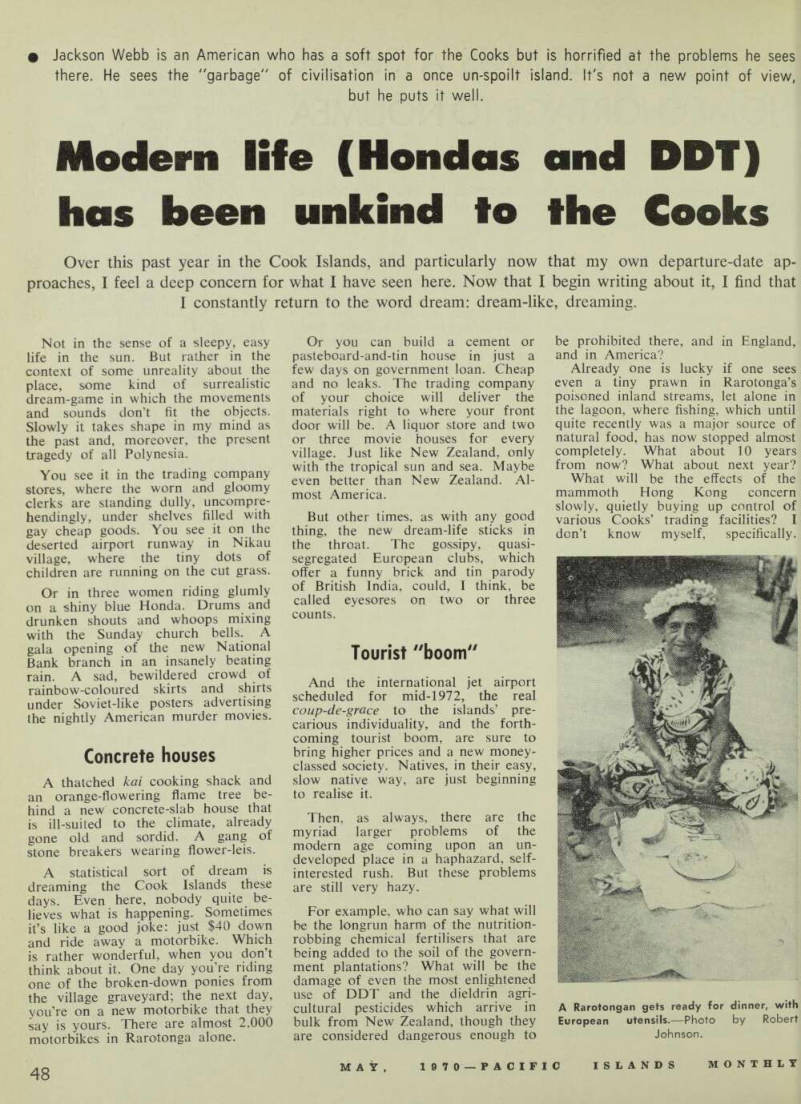
A Rarotongan gets ready for dinner, with European utensils. Photo by Robert Johnson.
Still more important, what is being done to keep the old Maori customs and language alive through this storm of questionable modernities? Where are the beautiful woven mats, wood carving and tapa-cloth making of even 20 years ago?
Are pearl shells, flashy professional island dancing teams and New Zealand-trained Maori policemen and clerk - politicians the only items deemed worthy of cultural exchange between the Cooks and the outside?
Who, in fact, is watching the over all future of the Cook Islands in any selfless sort of way? New Zealand? Australia? The United Nations? The childish new self government?
Or the hordes of international de velopers, speculators, draftsmen and engineers pouring in and out of the little white Hotel Otera? The soul of the place seems to be slipping through many busy fingers.
Ironically, it’s the outlying places of the world like the Cooks that seem to most violently register the good and bad currents of the time.
"A new torpor?"
Why? Because they are most easily persuaded that this empty, ulcer ridden age of ours is the maxima of all human achievement. They are persuaded that they now can and must hurry to catch up with the time, and they accept in blocks and wholes what they physically need to do it.
Here, the few long-time European residents say that much of the fault lies in the premature self-government, established in 1964. It may or may
not be true. They talk especially about a new torpor and hopelessness almost a self-mockery that has settled over the islands, despite their faster pace of life.
The fields lie fallow, either from the unfamiliarity or unwillingness of the new generation to work them.
There are actually shortages of bread fruit and coconuts. The population is now almost wholly dependent upon inflation-prone, imported tin goods.
The effects of this vastly poorer diet, which includes an upsetting amount of canned dog food, are just begin ning to be seen.
Wider-spread thef. of an almost eerie cleverness is prohibitive to owning much of anything. And lastly, perhaps most indicative of all of the future, it’s well-known that one’s fastest way out of the Cook Islands is to publicly come up against this
increasingly nepotic, little govern ment.
Again, I realise it’s a matter of outlook. To me, there are both large and small forces that shape a setting.
The little forces are more or less administrative, treating, o’- not treat ing, the hydra-head problems of everyday civil life. The larger forces have to do with the whole will of the time, what it values and what it’s prepared to discard.
Since the early 1800’s there’s been no looking back for Polynesia. The past has been annihilated by greed, disease and religious opportunism.
Today there are simply no precedents.
Culture broken
With the cultural backbone broken, with its rich artistic and ritualistic sources of life cut off at the quick, what can the South Sea peoples do but turn completely, desperately to the present?
This. I believe, is the key to under standing the real modern-day pathos of the Cook Islands, known too long as the last “unspoiled” place in the South Pncific. It is a baffled gullible child that needs protection.
There a r e few warm scenes of warm family life here. T hes.e people are simply taking what are fuven. irregard l ess. And unless there is some kind of conscientious super vision, harsh climate of this time wi l ! decide again and again what that will be.
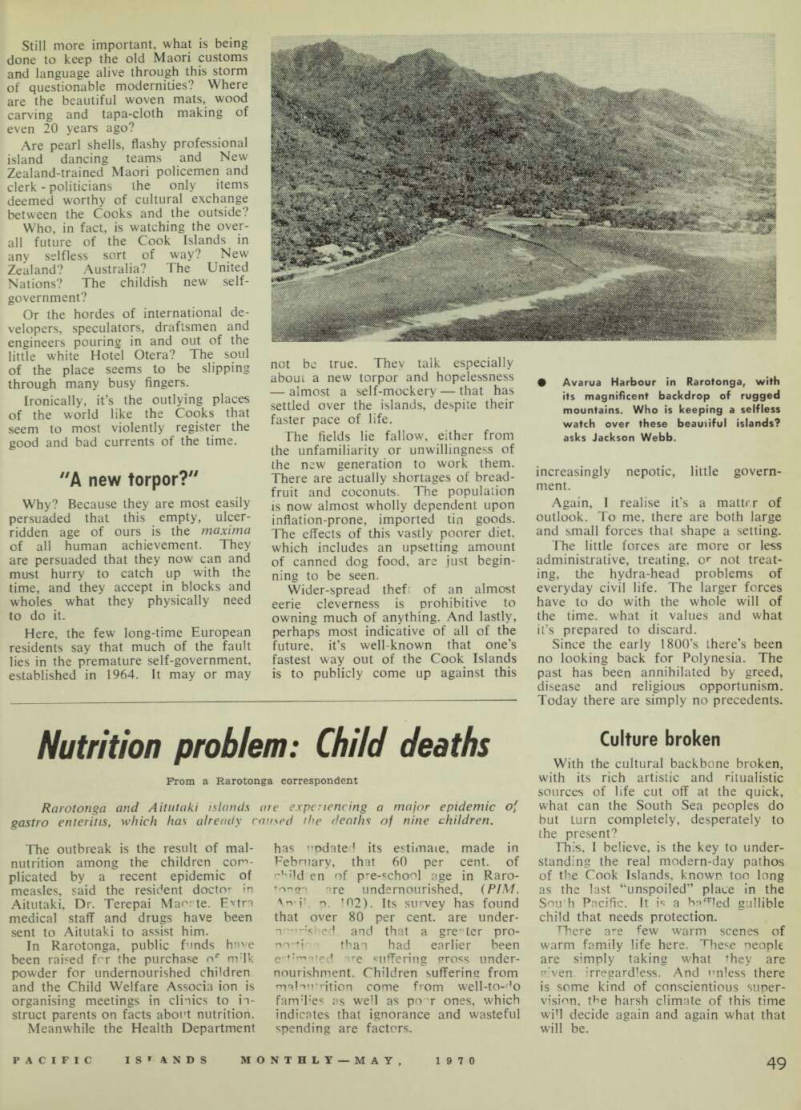
Avarua Harbour in Rarotonga, with its magnificent backdrop of rugged mountains. Who is keeping a selfless watch over these beauiiful islands? asks Jackson Webb.