like home—even after
pp. 46-48 · Read in the full issue
There's no place like home—even after a nuclear blasting
The beginning of a new era for the exiled Bikini Atoll people has arrived. They are now re turning to the atoll. This has been made possible by an announcement on August 12, 1968, that the atoll would no longer be needed for the nuclear weapons testing programme of the United States, and civilians could safely return there.
The Pacific Islanders had hoped and prayed for this day for over 20 years.
The announcement was the cul mination of a prolonged period of radiological and biological surveys by the Atomic Energy Commission, and a specific study in 1967 to deter mine whether the atoll was safe for human habitation.
The experts found that Bikini Island and Eneu Island, the largest in the atoll, are completely safe for human habitation and exploitation.
The other smaller islands can be visited, but are not yet safe for permanent habitation.
A survey visit to Bikini by ship was conducted in late August, 1968, headed by the High Commissioner, members of his staff and of the Marshalls District staff, and repre sentatives of the Bikini people.
Representatives of the Atomic Energy Commission, the Department of Defense, and the Department of Interior also participated in this inspection trip.
Intensive planning for clean-up
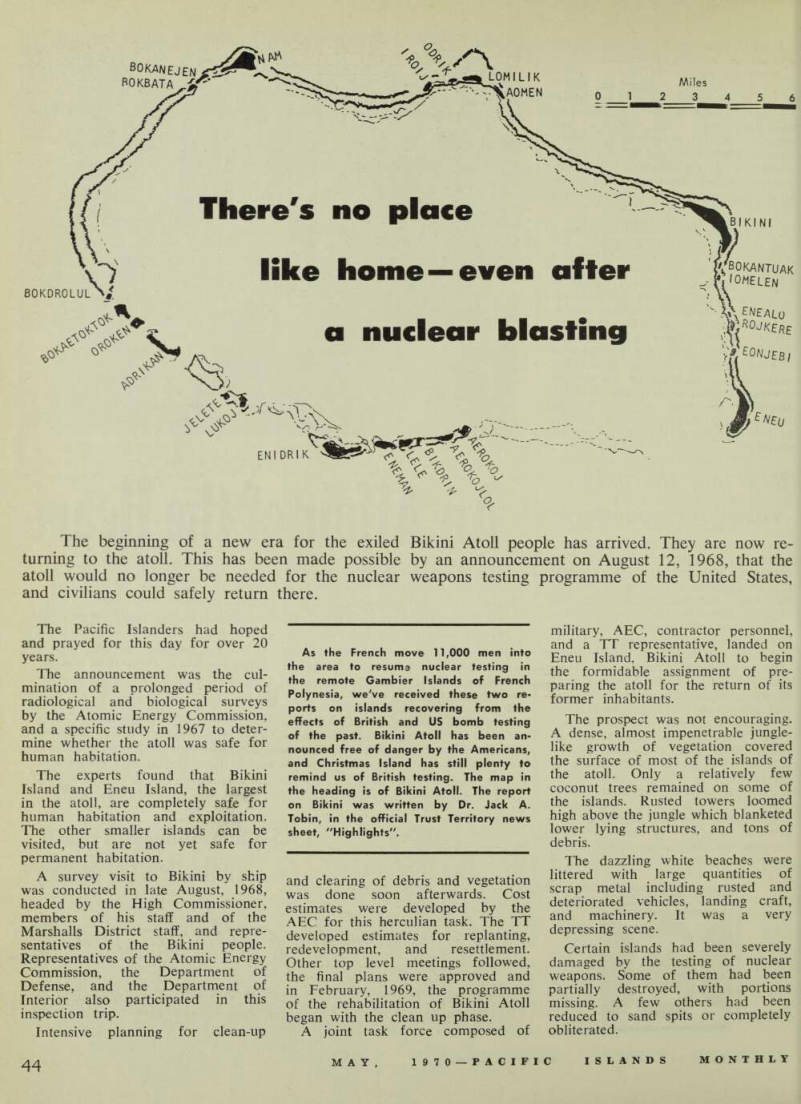
As the French move 11,000 men into the area to resume nuclear testing in the remote Gambier Islands of French Polynesia, we've received these two re ports on islands recovering from the effects of British and US bomb testing of the past. Bikini Atoll has been an nounced free of danger by the Americans, and Christmas Island has still plenty to remind us of British testing. The map in the heading is of Bikini Atoll. The report on Bikini was written by Dr. Jack A.
Tobin, in the official Trust Territory news sheet, "Highlights".
and clearing of debris and vegetation was done soon afterwards. Cost estimates were developed by the AEC for this herculian task. The TT developed estimates for replanting, redevelopment, and resettlement.
Other top level meetings followed, the final plans were approved and in February, 1969, the programme of the rehabilitation of Bikini Atoll began with the clean up phase.
A joint task force composed of
military, AEC, contractor personnel, and a TT representative, landed on Eneu Island, Bikini Atoll to begin the formidable assignment of pre paring the atoll for the return of its former inhabitants.
The prospect was not encouraging.
A dense, almost impenetrable jungle like growth of vegetation covered the surface of most of the islands of the atoll. Only a relatively few coconut trees remained on some of the islands. Rusted towers loomed high above the jungle which blanketed lower lying structures, and tons of debris.
The dazzling white beaches were littered with large quantities of scrap metal including rusted and deteriorated vehicles, landing craft, and machinery. It was a very depressing scene.
Certain islands had been severely damaged by the testing of nuclear weapons. Some of them had been partially destroyed, with portions missing. A few others had been reduced to sand spits or completely obliterated.
Arduous dean-up
The arduous task of cleanup began as soon as camp was set up. The gruelling work continued through the hot summer with its heavy rains, and was completed in September.
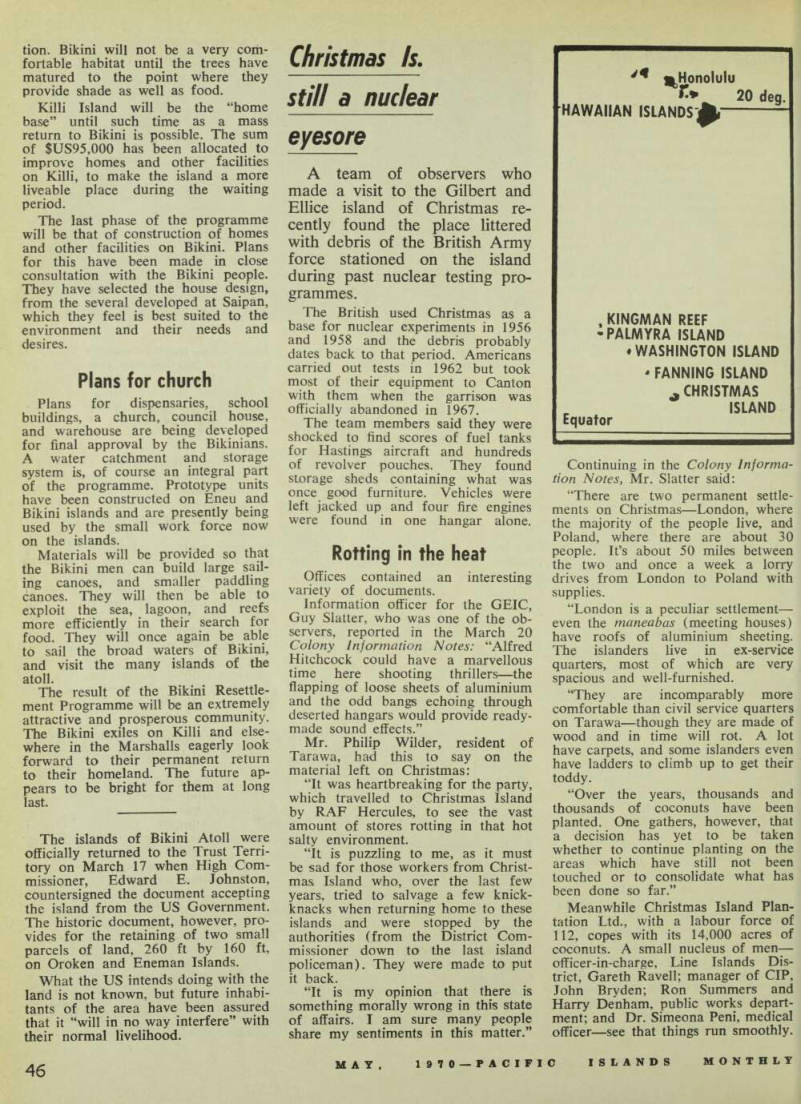
The rusted towers and other radio active or mechanically dangerous structures were removed, with dynamite where necessary, and dis posed of. Rusting equipment and other debris were cleared from the islands and reefs of the atoll. Large holes and culverts were filled and levelled. Roads were cut around the main islands, and also from lagoon to ocean where necessary.
The large islands of Eneu and Bikini were stripped in alternate rows in preparation for scientific planting of coconut trees.
The old airstrip on Eneu was cleared and prepared for the weekly supply plane which was to service the cleanup group, and for emergency air lifts in the future. The piers, which had badly deteriorated, were refurbished and made serviceable.
Bunkers and buildings that could be used by the returning islanders were cleaned up and repaired.
Representatives of the Bikini people, selected by the council on Killi Island, home of most of the exiles, also participated in the clean up operation. They assisted in the work and served in an advisory capacity as well.
Teem with life
These leaders expressed satisfaction with the work that had been done, realisation of the good potential of the atoll, and optimism for the future productivity of Bikini and its desira bility as a place in which to live.
The broad lagoon and adjacent ocean, and extensive reefs of Bikini teem with marine life of many kinds.
Seabirds abound, and large turtles frequent the beaches of the large atoll. All of the wildlife of Bikini is safe for human consumption ex cept for the coconut crabs. The condition of the marine life was an important factor in the optimistic attitude of the leaders. Tiny Killi, without a lagoon, and with a very limited ree: area, provides very little edible marine life.
The Agricultural Rehabilitation Phase began just prior to the departure of the Cleanup Task Force.
The Marshall Islands District Agri culturist, and staff members, assisted by Bikini representatives prepared a large coconut nursery on Eneu Island. Selected seed nuts were
planted and nurtured. These are to be transplanted when sprouted pro perly.
Thousands of nuts eventually will be planted. Copra production will be tremendously increased on Bikini due to scientific planting of selected seed nuts.
The second increment of seed nuts arrived on Bikini in mid-December.
They were brought up on a special field trip from the southern Marshall atolls of Jaluit and Namorik.
Twenty-three Bikini men boarded the ship at Killi and headed for their former Bikini home. These men will help replant the atoll.
Twelve members of the Killi (Bikini) Council also made the historically significant trip to their former home. Their task was to assist the district surveyors in
establishing the former boundaries of the lineage land holdings. Home and municipal building sites also were laid out.
The long range plan for agri cultural rehabilitation is to rotate workers, who have been selected by the Bikini leaders, from men who have land rights on Bikini. The workers will remain on Bikini approximately three months at a time. They will be paid by the gov ernment for the work that they do, and will be housed and fed as well.
The atoll will not be able to sup port the entire population until coco nut, breadfruit, pandanus, and other food plants have come into produc-
Roadways now encircle Bikini as well as running criss-cross the island.
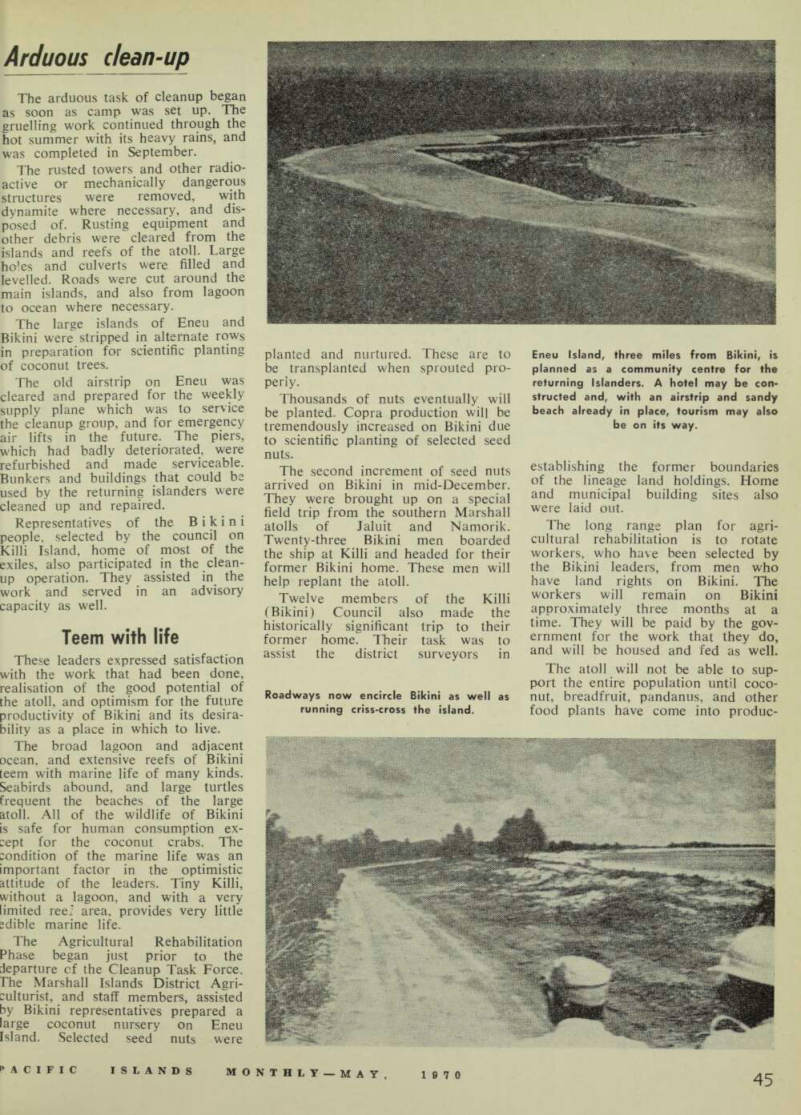
Eneu Island, three miles from Bikini, is planned as a community centre for the returning Islanders. A hotel may be con structed and, with an airstrip and sandy beach already in place, tourism may also be on its way.
tion. Bikini will not be a very com fortable habitat until the trees have matured to the point where they provide shade as well as food.
Killi Island will be the “home base” until such time as a mass return to Bikini is possible. The sum of $U595,000 has been allocated to improve homes and other facilities on Killi, to make the island a more liveable place during the waiting period.
The last phase of the programme will be that of construction of homes and other facilities on Bikini. Plans for this have been made in close consultation with the Bikini people.
They have selected the house design, from the several developed at Saipan, which they feel is best suited to the environment and their needs and desires.
Plans for church
Plans for dispensaries, school buildings, a church, council house, and warehouse are being developed for final approval by the Bikinians.
A water catchment and storage system is, of course an integral part of the programme. Prototype units have been constructed on Eneu and Bikini islands and are presently being used by the small work force now on the islands.
Materials will be provided so that the Bikini men can build large sail ing canoes, and smaller paddling canoes. They will then be able to exploit the sea, lagoon, and reefs more efficiently in their search for food. They will once again be able to sail the broad waters of Bikini, and visit the many islands of the atoll.
The result of the Bikini Resettle ment Programme will be an extremely attractive and prosperous community.
The Bikini exiles on Killi and else where in the Marshalls eagerly look forward to their permanent return to their homeland. The future ap pears to be bright for them at long last.
The islands of Bikini Atoll were officially returned to the Trust Terri tory on March 17 when High Com missioner, Edward E. Johnston, countersigned the document accepting the island from the US Government.
The historic document, however, pro vides for the retaining of two small parcels of land, 260 ft by 160 ft, on Oroken and Eneman Islands.
What the US intends doing with the land is not known, but future inhabi tants of the area have been assured that it “will in no way interfere” with their normal livelihood.
Christmas Is. still a nuclear eyesore
A team of observers who made a visit to the Gilbert and Ellice island of Christmas re cently found the place littered with debris of the British Army force stationed on the island
during past nuclear testing pro
grammes.
The British used Christmas as a base for nuclear experiments in 1956 and 1958 and the debris probably dates back to that period. Americans carried out tests in 1962 but took most of their equipment to Canton with them when the garrison was officially abandoned in 1967.
The team members said they were shocked to find scores of fuel tanks for Hastings aircraft and hundreds of revolver pouches. They found storage sheds containing what was once good furniture. Vehicles were left jacked up and four fire engines were found in one hangar alone.
Rotting in the heat
Offices contained an interesting variety of documents.
Information officer for the GEIC, Guy Slatter, who was one of the ob servers, reported in the March 20 Colony Information Notes: “Alfred Hitchcock could have a marvellous time here shooting thrillers—the flapping of loose sheets of aluminium and the odd bangs echoing through deserted hangars would provide ready made sound effects.”
Mr. Philip Wilder, resident of Tarawa, had this to say on the material left on Christmas: “It was heartbreaking for the party, which travelled to Christmas Island by RAF Hercules, to see the vast amount of stores rotting in that hot salty environment.
“It is puzzling to me, as it must be sad for those workers from Christ mas Island who, over the last few years, tried to salvage a few knick knacks when returning home to these islands and were stopped by the authorities (from the District Com missioner down to the last island policeman). They were made to put it back.
“It is my opinion that there is something morally wrong in this state of affairs. I am sure many people share my sentiments in this matter.”
Continuing in the Colony Informa tion Notes, Mr. Slatter said: “There are two permanent settle ments on Christmas—London, where the majority of the people live, and Poland, where there are about 30 people. It’s about 50 miles between the two and once a week a lorry drives from London to Poland with supplies.
“London is a peculiar settlement — even the maneabas (meeting houses) have roofs of aluminium sheeting.
The islanders live in ex-service quarters, most of which are very spacious and well-furnished.
“They are incomparably more comfortable than civil service quarters on Tarawa—though they are made of wood and in time will rot. A lot have carpets, and some islanders even have ladders to climb up to get their toddy.
“Over the years, thousands and thousands of coconuts have been planted. One gathers, however, that a decision has yet to be taken whether to continue planting on the areas which have still not been touched or to consolidate what has been done so far.”
Meanwhile Christmas Island Plan tation Ltd., with a labour force of 112, copes with its 14,000 acres of coconuts. A small nucleus of men— officer-in-charge, Line Islands Dis trict, Gareth Ravell; manager of CIP, John Bryden; Ron Summers and Harry Denham, public works depart ment; and Dr. Simeona Peni, medical officer—see that things run smoothly.