Become A Guardian Angel
pp. 34-35 · Read in the full issue
FROM FLEET ST. TO RARE - TO
From SUE WENDT in Suva “The Banabans don’t like the word ‘adviser’—they’ve had a succession of those. That’s why they’ve chosen to call me secretary.
I’ll be all sorts of things really, including publicity officer, a shoulder to cry on, writer of letters. . .”
Welshman, Mr. Bertram Jones, urbane product of the Fleet Street newspaper mill, has a rather unique new job. Now living on the island of Rabe, a long way from the Daily Express where he spent 18 years, he’s fulfilling the role of—even if the term isn’t popular—adviser and guide to the Banabans.
Mr. Jones first visited Rabe in March this year, having already made the decision to spend at least three years there. On that first oc casion he stayed for less than 24 hours (“It was enough to see that my wife and I would have a lot of adjusting to do”) before returning to Suva for the British Phosphate Com missioners’ talks concerning the price of Ocean Island phosphate. The Banabans’ share was not discussed at the meeting, he told PIM later.
“It wasn’t the time or the place.”
“However, the Banabans counted it as a historic occasion. For the first time, the chairman of the Rabe Island Council, Mr. Rotan Tito, was invited to air his views at the meeting of government representatives,” Mr.
Jones said.
“He spoke about the Banabans’ position and gave their views on the unfairness of the sharing out of phosphate proceeds from Ocean Island. The Banabans feel that the British, Australian and New Zealand Government representatives may now have a new understanding of their position.”
Sir Dingle
Also at the meeting in Suva was Sir Dingle Foot, who is legal adviser to the Banabans in London (legal counsel in Fiji comes from Mr. K. C.
Ramrakha, following the death of Mr. A. D. Patel). It will be Sir Dingle who will suggest the next move for the Banabans. So far, said Mr. Jones, there is nothing definite though they feel their their fight for a bigger share of the phosphate royalties has reached a critical stage.
“With the deposits running out in five or six years, they face a pretty
bleak future on Rabe unless they can find alternative means of earning money,” he said. “Ocean Island has been turned into a moon landscape —there’s no future for them there.
“They’re looking to copra growing and commercial fishing as revenue earners, but there’s a lot of finance needed. Tourism is a possibility too —but that has to be considered very carefully.
Modification of custom
“There’ll have to be a modification of custom on Rabe—custom plays a strong part in the lives of the people, but it can be a retarding influence.
The elected members of council have decided that progress MUST come to Rabe.”
Mr. Jones’ interest in the Rabe
people goes back to the early 1950’5, when he was based in Sydney. He was later posted to the Far East, but kept up with the Banabans and their fight for phosphate royalties through PIM, which he’s been reading regularly for 15 years.
“When the Rev. Tebuke Rotan,
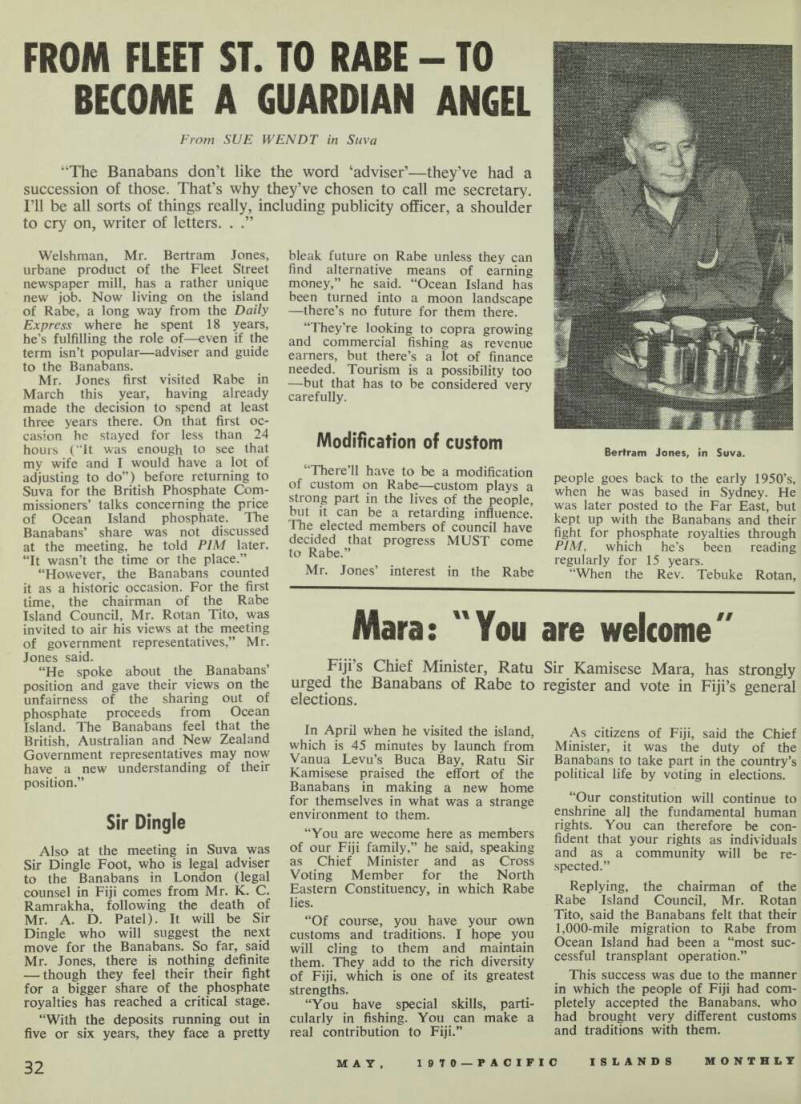
Bertram Jones, in Suva.
manager of the Rabe Island Council, and his father, Rotan Tito, were in London in October, 1968, presenting their case to Whitehall for indepen dence for Ocean Island, I contacted them,” Mr. Jones explained.
“I wrote a fairly lengthy article about the Banabans for my news paper—a great many English people had never heard of them, of course.
But the Rev. Tebuke and his father liked the article, saw that I was sympathetic to their cause, and recently asked me to become sec retary of the Rabe Island Council.”
Mr. Jones is earning a salary for the job—but it’s less than he was getting in Fleet Street. Why then is he doing it? “Not for altruistic reasons really—l just feel strongly that the Banabans had a pretty rotten deal in the first place and that some thing should be done about it before the phosphate runs out.
“Seventy years ago anything went and the Banabans were persuaded to give up their phosphate on quite ludicrous terms. In London they were asking that the entire income from phosphate be paid to them for the remaining life of deposits. If this should mean any lowering of standards in the Gilbert and Ellice Is. Colony, then the British Govern ment should make it up. It was Britain that decreed the share out between the GEIC and the Bana bans.”
The 2,000 Banabans, whose home was once Ocean Island, claim they are not truly Gilbertese and there fore have no obligations to share out the phosphate found on their island.
Last payment to them was $400,000, they say, which represented about 15 per cent, of royalties.
After his first brief visit to Rabe, Mr. Jones came away with the im pression of a well-ordered community.
“The people have built a small hospital from the royalties, neat homes and schools in the four villages. There is also a narrow road—but feeder roads will have to be built if copra production is to be expanded,” he said.
“My wife is a registered nurse, so she hopes to help in the hospital and with women’s activities.
“At times it all seems a bit daunting—and then we say to our selves, look what a marvellous op portunity to experience things hundreds of people in London would give their eye teeth to experience!
“As far as I’m concerned it’s an open-ended assignment. I’ve come to do anything the people of Rabe ask me to do.”
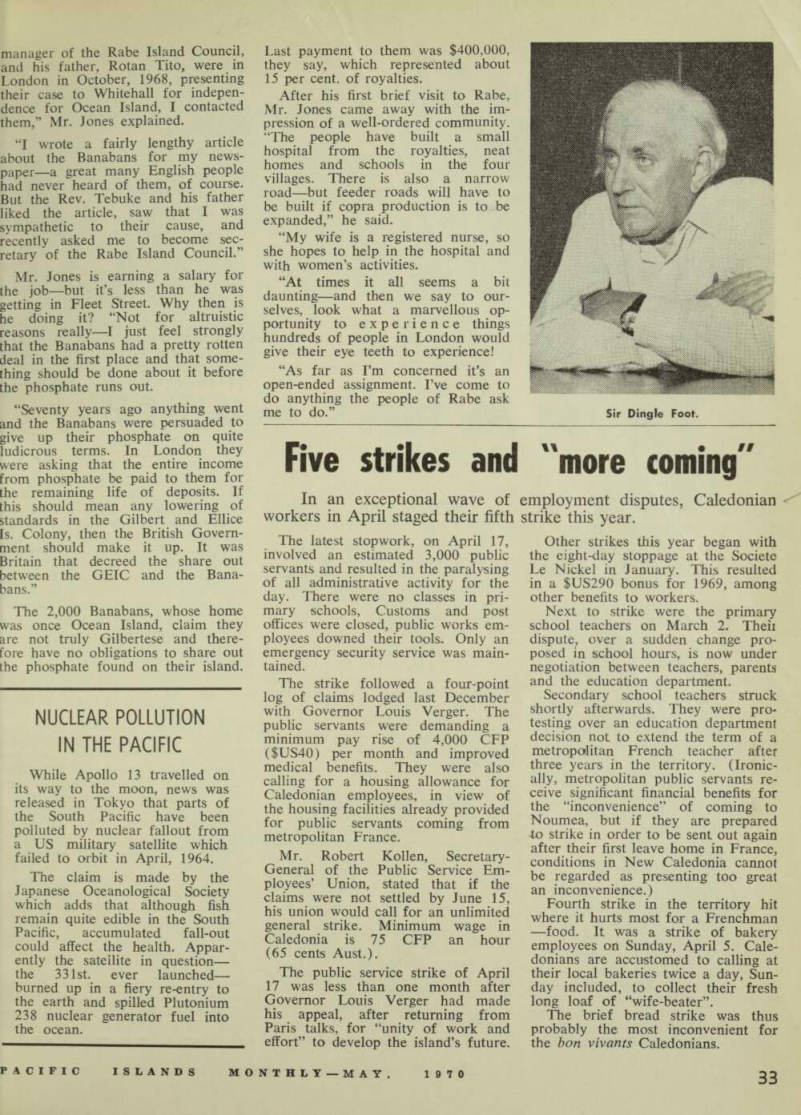
Sir Dingle Foot.