It's Moving In The Solomons
pp. 27-28 · Read in the full issue

Prom a Honiara correspondent Is the British Solomons localising or utilising? Is the protec torate truly localising its public service and its commerce, or is it simply utilising what local resources it has, so that the vast majority of Solomon Islanders are still being employed in, and still being trained for, jobs in which expatriates have never been used?
Most people have believed for years in the Solomons that the protectorate has had a localisation programme. Figures have shown the local civil service to be growing, and daily contacts in offices and shops have indicated that the com mercial world has not lagged behind.
And with three Melanesian bishops out of a total or six, the churches have undoubtedly been leaders in localisation.
But now people are not so sure, about the civil service, anyway.
There is vague dissatisfaction about the question, and it is growing.
“We hear about localisation on radio and in the news,” says Peter Kenilorea, the president of the Civil Service Association, “but we query the reality of it.”
His main concern is that the gov ernment in fact has no localisation
policy—no guide lines for depart mental heads to follow—no basis for future planning. Training schemes are meeting only the short term needs.
And now it seems that the govern ment itself has come to realise that “utilisation” does in fact better describe its programme than “localisa tion”. They are still training house boys, clerks, teachers, police con stables, agricultural assistants and nurses, just as the first missionaries and government officers started out to do.
What certainly is different is the quality of their training. The clerks are more efficient and the agri cultural assistants have better farm ing techniques, and in many cases the efficiency has been such that Solomon Islanders have been able to replace expatriates at the top.
But the percentage is small com pared with the total number of Solomon Islanders now employed by both government and private enter prise. And the number of expatriates employed has not declined notice ably.
This policy of utilisation, of pro gressive replacement, has not turned out administrators, or even the kind of clerks capable of becoming admin istrators in the future. The need now is for Solomon Islanders able to fill executive positions, and the stress is on the word now.
In "good time"
The present policy will allow the right Solomon Islanders to come along, “in time”, but that’s not good enough. One government officer has estimated that if the government follows its present non-programme, the Solomons Government might be localised “in about 145 years”.
Time, of course, is running out, and one of the difficulties in the Solomons is that little political steam has developed to push the need for urgency. Political steam pushed the need in Africa, but lessons of Africa are likely to be learned in the Solomons only the hard way, say some officers with African ex perience.
“The trouble is, people don‘t read enough about how localisation prob lems have been handled elsewhere,” says one officer who was closely involved with localisation in the Solomons. “People have to realise that progressive replacement is merely maintenance, and what the Solomons needs is reconstruction.
Reconstruction means planning, and the planning must be to train for the top.
“You train for the top, and you
use the fallout to fill the base positions. Local people have to fill the top jobs—they will want the naturaT ent r Now that there are men in the Solomons who think this, the Solomons may expect to see a true localisation programme begin to develop. It is, in fact, developing.
With the establishment last year of a Public Service Advisory Board, the government is now better able to assess past achievements and mistakes, and localisation policy is now being formulated which should have far reaching effects, both for the government and private enterprise.
Planning, to be intelligent, means the collection of facts and figures on population, school attendance, manpower use, etc. Before you can train for the top you have to know what your problems are, and organise your educational institutions to handle your requirements.
Some people feel that the Solomons has started so late on its localisation programme that it may not be able to achieve what is needed in the short time left, and a compromise plan may have to be adopted.
But the main thing is that something has started to happen.
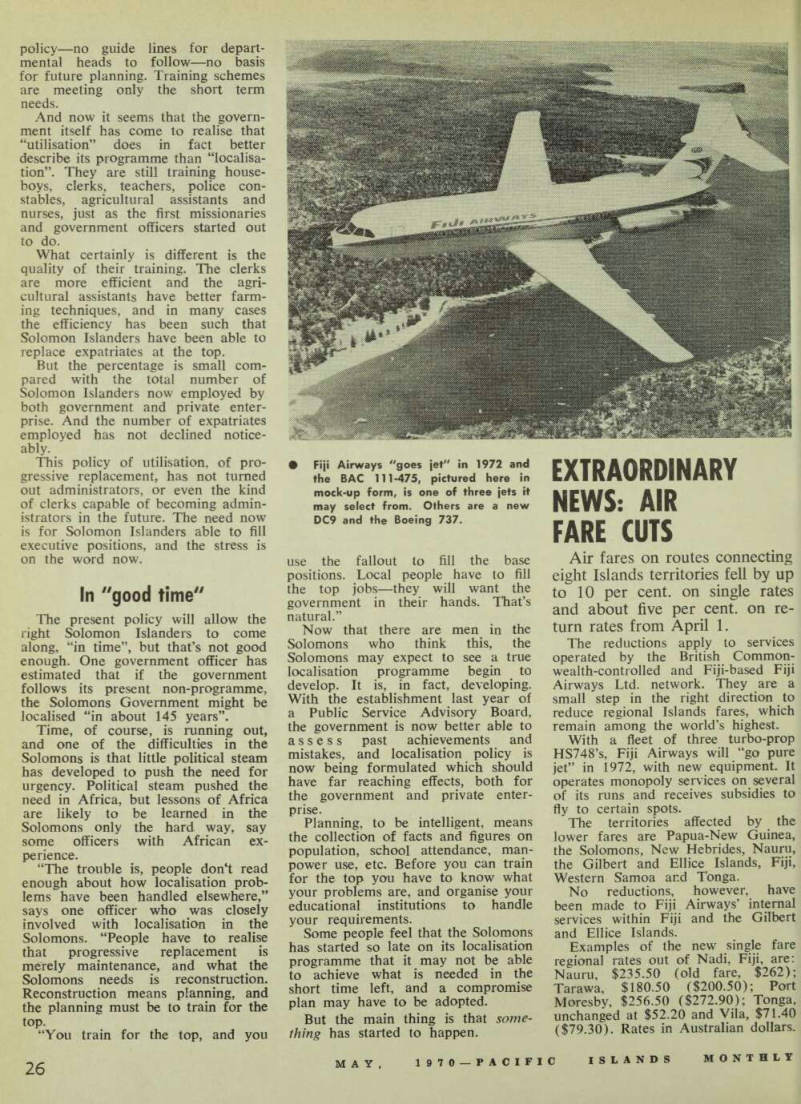
Fiji Airways "goes jet" in 1972 and the BAC 111-475, pictured here in mock-up form, is one of three jets it may select from. Others are a new DC9 and the Boeing 737.