The Practical Planter
pp. 143-147 · Read in the full issue


What Two Pounds Of Sulphur Will
Do For Some Coconut Palms
• The occurrence of widely scattered areas of debilitated and yellow coconut palms in many planta tions of Papua and New Guinea has been noted by agricultural workers and plantation managers for years. The late R. E. P. Dwyer, as long ago as 1937, referred to “chlorotic diseases’ in coconuts as being associated with soil deficiency. Investigations over the last decade, by officers of the Depart ment of Agriculture, have shown that there are few areas of the Territory not affected and that the cause is frequently lack of sulphur. The following is a condensation of an article written by P. J. SOUTHERN, for the P-NG Agricultural Journal
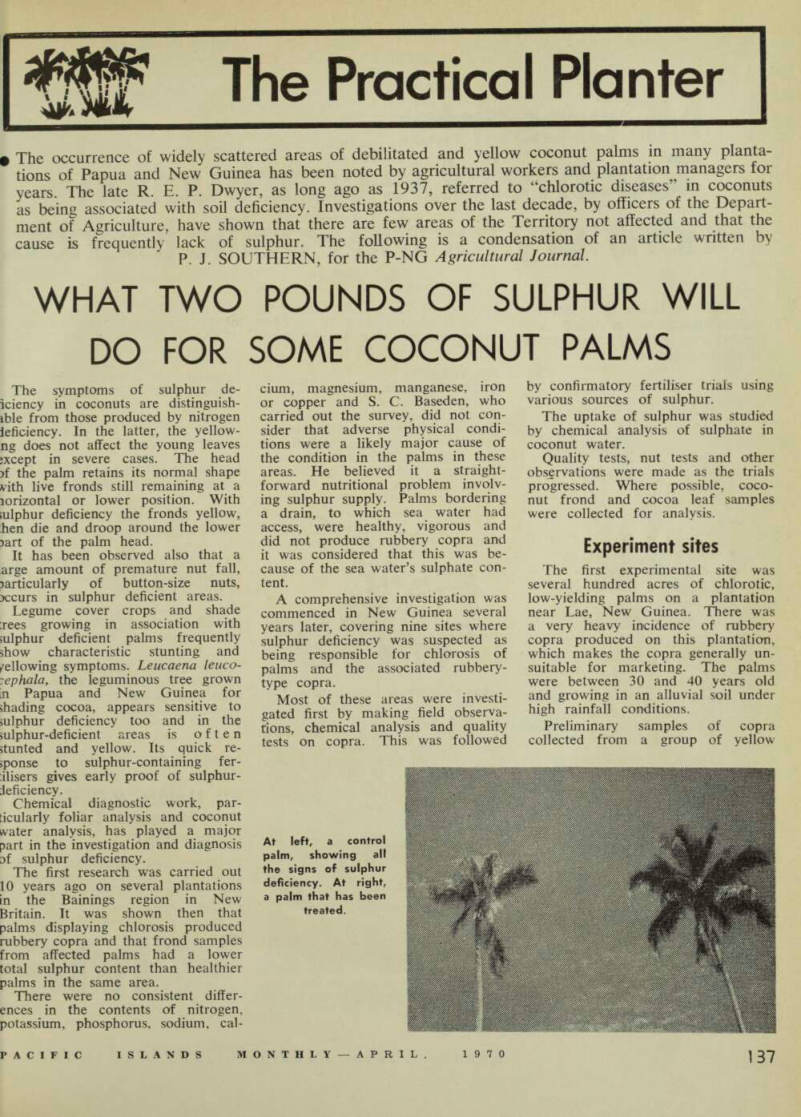
The symptoms of sulphur de iciency in coconuts are distinguish able from those produced by nitrogen leficiency. In the latter, the yellow ng does not affect the young leaves ;xcept in severe cases. The head )f the palm retains its normal shape vith live fronds still remaining at a lorizontal or lower position. With sulphur deficiency the fronds yellow, hen die and droop around the lower sart of the palm head.
It has been observed also that a arge amount of premature nut fall, jarticularly of button-size nuts, >ccurs in sulphur deficient areas.
Legume cover crops and shade :rees growing in association with sulphur deficient palms frequently show characteristic stunting and yellowing symptoms. Leucaena leuco :ephala, the leguminous tree grown in Papua and New Guinea for shading cocoa, appears sensitive to sulphur deficiency too and in the sulphur-deficient areas is often stunted and yellow. Its quick re sponse to sulphur-containing fer ilisers gives early proof of sulphur ieficiency.
Chemical diagnostic work, par ticularly foliar analysis and coconut water analysis, has played a major part in the investigation and diagnosis af sulphur deficiency.
The first research was carried out 10 years ago on several plantations in the Bainings region in New Britain. It was shown then that palms displaying chlorosis produced rubbery copra and that frond samples from affected palms had a lower total sulphur content than healthier palms in the same area.
There were no consistent differ ences in the contents of nitrogen, potassium, phosphorus, sodium, cal
cium, magnesium, manganese, iron or copper and S. C. Baseden, who carried out the survey, did not con sider that adverse physical condi tions were a likely major cause of the condition in the palms in these areas. He believed it a straight forward nutritional problem involv ing sulphur supply. Palms bordering a drain, to which sea water had access, were healthy, vigorous and did not produce rubbery copra and it was considered that this was be cause of the sea water’s sulphate con tent.
A comprehensive investigation was commenced in New Guinea several years later, covering nine sites where sulphur deficiency was suspected as being responsible for chlorosis of palms and the associated rubbery type copra.
Most of these areas were investi gated first by making field observa tions, chemical analysis and quality tests on copra. This was followed
by confirmatory fertiliser trials using various sources of sulphur.
The uptake of sulphur was studied by chemical analysis of sulphate in coconut water.
Quality tests, nut tests and other observations were made as the trials progressed. Where possible, coco nut frond and cocoa leaf samples were collected for analysis.
Experiment sites
The first experimental site was several hundred acres of chlorotic, low-yielding palms on a plantation near Lae, New Guinea. There was a very heavy incidence of rubbery copra produced on this plantation, which makes the copra generally un suitable for marketing. The palms were between 30 and 40 years old and growing in an alluvial soil under high rainfall conditions.
Preliminary samples of copra collected from a group of yellow
At left, a control palm, showing all the signs of sulphur deficiency. At right, a palm that has been treated.
reatment needed every 18 months
alms showed that they produced ibbery copra consistently jver a amber of months.
Initial experiments involving 5 lb of sulphate of ammonia reduced spectacular improvement in >liage colour of treated palms, so a imprehensive trial involving vari iis sulphur sources was laid down.
There were four treatments in this ial, as follows: — 1. Control; 2. Sulphur, 2 lb per tree; 3. Sulphate of ammonia, 8 lb per ee; and 4. Sulphate of potash, 11 lb per ee.
The amount of sulphur per treat lent was approximately the same, icept, of course, in the control trees hich got none.
The following field recordings ere made at intervals during the aurse of the trial:—(a) Foliage Dlour (according to a points astern); (b) Frond count of green •onds; (c) Frond count of dead •onds hanging from palms; and (d) hit count (above cricket ball size,
pproximately).
More nuts per palm
In addition, a large number of imples was collected at regular in ;rvals for quality testing and hemical analysis of copra and coco ut water. The copra quality grad ig was carried out on a points’ ystem.
There were outstanding responses n all counts, (a) to (d) on all treated rees, and these were obtained with ny source of sulphur. There did ot appear to be any long-term agro omic advantages in using a par icular source, so that the cheapest ource (sulphur), would normally give tie most economic results although lore soluble sources of sulphur ave the quickest results.
A further assessment of foliage olour made 16 months after treat lent showed that the effects of the reatments were wearing off and the lalms were becoming yellow again.
The average number of nuts per (aim at the beginning of the trial yas in the vicinity of 13. Significant ncreases in nut counts were obtained is early as six months after the ;ommencement of the trial. This arly response could only have been lue to a decrease in premature nut all, which appears to be a feature )f sulphur-deficient palms.
Fifteen months after the com
mencement of the trial the average treated palm was carrying 70 per cent, more nuts than the average control palm. There appeared to be a lag in the effects of the elemental sulphur treatment and there were large variations over the year in the nut count.
Nut counts taken during the course of the trial and effects of treatments show that, overall, sulphate of ammonia-treated trees bore the most nuts.
As mentioned earlier, nuts from poor palms in this area consistently produced rubbery-type copra. Samples of mature, fallen coconuts from all treatments were collected on 13 occasions during the course of the trial.
Six to eight months after treat ment, all copra from sulphur or
sulphate treated palms had improved
in quality. After a further six months there was further improve ment and the majority of the palms were producing normal copra.
Once again, effects from the elemental sulphur treatment were slower to appear than the effects of more soluble fertiliser treatments.
The cost of fertilising palms was
approximately as follows:—Sulphur
—l2 cents per palm; sulphate of ammonia—3o cents per palm; sul phate of potash—4B cents per palm.
This cost was based on the cost of fertilisers landed in bulk at Lae.
Obviously the elemental sulphur treatment is the most economic. A yield increase of about six nuts would pay for the fertiliser used and this was easily obtained in the course of the experiment. Residual effects are likely to be considerable and there would be a large improvement in copra quality.
As already pointed out, after the experiment had been in progress 16 months, yellowing of foliage was re occurring. It is likely then that applications of sulphur would have to be repeated after 18 months to maintain the response to treatment.
In all, nine experimental sites were used, some in New Britain only a few miles from an active volcano containing extensive sulphur de posits.
Nonetheless it was shown that sulphur deficiency existed in all of the nine areas of chlorotic palms.
It is known that a large number of other areas of coconuts, which show similar symptoms, exist in Papua and New Guinea. The wide occurrence of defective nuts produc ing rubbery copra gives support to the view that sulphur deficiency is a major limiting factor to the high production of good quality copra in this Territory and elsewhere in the Pacific.
It is worth noting also that many cases of sulphur deficiency have occurred in other crops throughout
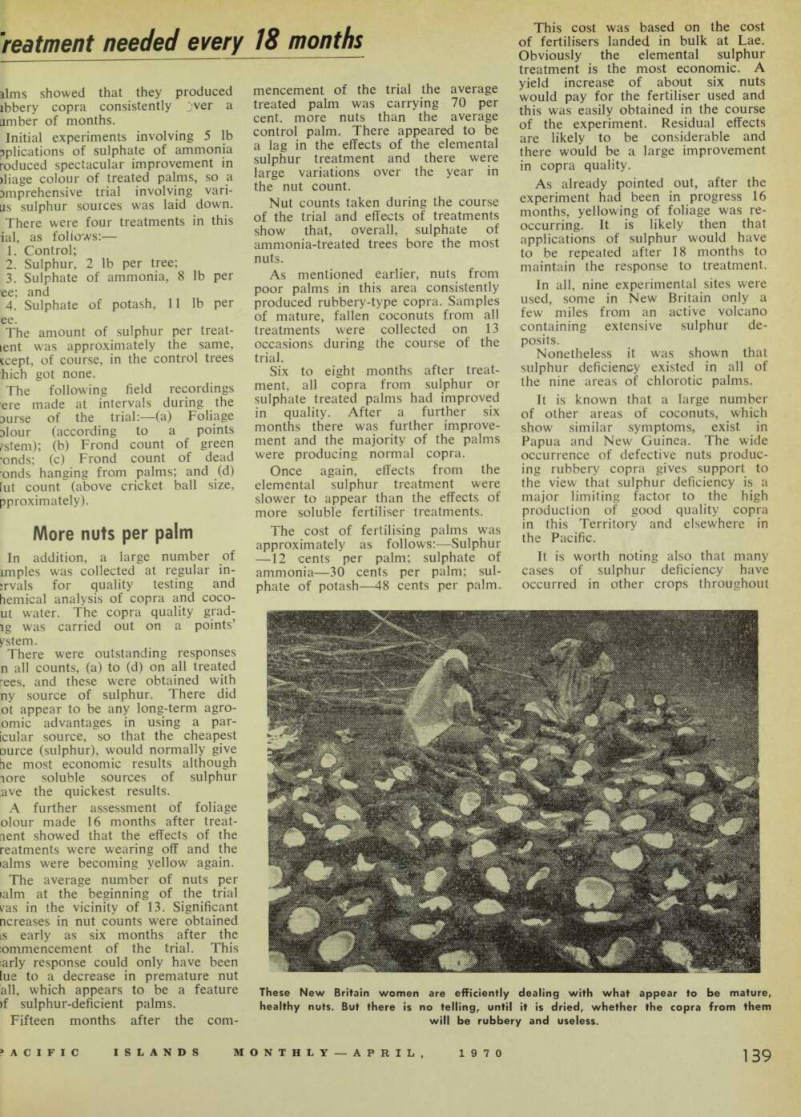
These New Britain women are efficiently dealing with what appear to be mature, healthy nuts. But there is no telling, until it is dried, whether the copra from them will be rubbery and useless.
Wide soil varieties
>-NG. Coffee, tea, tobacco and egumes have been affected both in owland and highland areas.
New Guinea has a wide variety >f soil types derived from volcanic ind sedimentary rocks; they vary rom deep, mature tropical latosols o immature volcanic and alluvial loils. Sulphur deficiency has been bund to exist in most types due jrobably to: (a) Extremely high rainfall and leavy leaching in most areas; (b) The practice of burning grass and and forests periodically. Much ailphur would be converted to gas ind lost to the atmosphere and sub sequently the sea; (c) The lack of industrialisation, contributing sulphur in waste gases;
Interplanted coconuts
(d) Only small use of fertilisers until recent years. There is now wider use of fertilisers, but many, such as urea and a large range of compound fertilisers, do not contain sulphur. It has been observed that use of fertilisers containing nitrogen but no sulphur will induce or aggra vate sulphur deficiencies in most tropical crops. (e) The competition of other plants have an effect on sulphur deficiency.
The wide practice in Papua and New Guinea of interplanting coconuts with cocoa would increase sulphur require ment.
It is likely that sulphur deficiency exists in many plantation areas in Papua and New Guinea and that ex tensive use of sulphur is warranted.
Large increases in production have been obtained on individual areas and quality improvement is an added benefit.
The author is of the opinion that sulphur might be the “forgotten” essential nutrient as far as coconuts are concerned. While more developed copra-producing countries like Ceylon, India and the Philippines have probably been using fertilisers con taining sulphur for many years there must be many other areas, par ticularly Indonesia and the Pacific Islands, where sulphur deficiency is occurring, perhaps causing some undiagnosed production problem. • A new experimental tea station is being established at Kuk in the Western Highlands of Papua- New Guinea at an estimated cost of $150,000. The Kuk station will even tually replace the Administration’s tea station at Garaina which has served its main purpose of proving tea a commercial crop in the territory.
The needs of the tea industry in the Highlands, such as research into clonal selection and agronomic, dis ease, pest and nutritional problems must be studied in the environment where the tea is grown and Garaina, which is at a lower altitude than the Wahgi Valley tea areas, was unsuited to this purpose. • Since vanilla has proved such an initial success in Vavau, Tonga’s Northern group, an attempt is now being made to grow the beans in the middle group, Haapai, where it is thought the clayey soil in certain parts should be most suitable for vanilla growing.
Added incentives are the high price paid for the dried beans and the satisfactory return that can be obtained from small areas of land.
One resident of Haapai has had vanilla growing in his town and tax allotments for nine years and, though only a small amount, it has done well.
Although the nuts in the top row are ap parently normal, they produced the rub bery copra shown in the bottom row. This is one result of sulphur deficiency in soil.