Pacific Shipping
pp. 111-117 · Read in the full issue
Port Moresby, Lae top ports by 1985?
Plans to make Port Moresby and Lae the Islands’ premier ports, at a cost of nearly SI3 million, by the mid-1980’s, are under consideration in New Guinea. The territory’s Harbours Board, which has received the proposals from two private consultants, was studying them in March before making its own feelings known to the P-NG Administration.
Maunsell and Partners have pro posed upgrading Moresby at a total cost of $7.8 million, and Netherlands Engineering Consultants propose up grading Lae at a cost of $5,080,000.
Briefly, these are the Moresby proposals: • Keep the port where it is at Moresby, and not move it to other nearby locations. • Expand between the Harbours Board office and the Marine base, and finally between the Marine base and Hanuabada village. • Spend $2.9 million for a 500 ft land-backed wharf, dredged to 36 ft, and designed to handle 300,000 tons of cargo per year mainly from unit load ships. The land area to be about eight acres and the cost to include sheds and ancillary facilities. • Limit existing wharves (after completion of this berth) to inter island traders and overseas ships with conventional cargo-handling facilities.
Second berth
• Spend $4.9 million for a second berth, adjacent to the first, 700 ft in length and dredged to 36 ft, with land backing, to be built in about 10 years time. Roll-on, roll-off facilities and a 25-ton crane would be included and Liberty Patch and nearby shoal patches removed. • Six berths, from the vicinity of the Marine base in the direction of Hanuabada, to be constructed “in conjunction with reclamation”.
The Lae proposals: • Spend $320,000 on additional covered storage space to be com pleted by March next year. • Spend $l.l million, to extend the existing wharf 400 ft east, to
eliminate approaches. Covered and open storage space included and completion date, January, 1972. • Spend $160,000 on a dolphin berth at the eastern extremity of the Harbours Board area, for bulk tankers. • Spend $3.5 million to dredge a tidal basin and provide a wharf complex off Milfordhaven, to be completed by mid-1973, with facili ties for overseas shipping and roll-on, roll-off traffic. • Scrap a current proposal to extend Lae’s existing wharf by 200 ft west. • Inter-island traders to berth at the main wharf until the sheltered facility in the tidal basin complex becomes available.
Wharf Reservation Scheme
Stays For Papua-New Guinea
After six months trial, the Papua- New Guinea Harbours Board has decided to continue permanently a berth reservation scheme, to en courage the use of unitised cargo.
The board is out to save money by not having to build as many wharves, and to help lower freight rates as an indirect result. Board chairman, Captain G. A. Hawley, said that the permanent scheme would come into operation from April 15 with some “necessary refinements”.
He said that during the trial period, ships were making reserva tions and amending them up to a week before they were due to berth.
This latitude would not be allowed in future.
The harbours covered by the scheme are Port Moresby, Lae, Rabaul, Madang, Kavieng and Samarai.
For a fee of $2OO, berths can be reserved, with $lOO returnable if the booking is not taken. Vessels can be six hours late, after which the booking is forfeited. • Vessels must arrive on the day they nominate one month in advance. • They have to carry at least 85 per cent, of unitised cargo, in either containers, flats or pallets only. o The net gang rate must be main tained at not less than 25 tons/hour. • A minimum of 50 per cent, of cargo will not require to be sorted in the shed.
Ships so far using the reservation
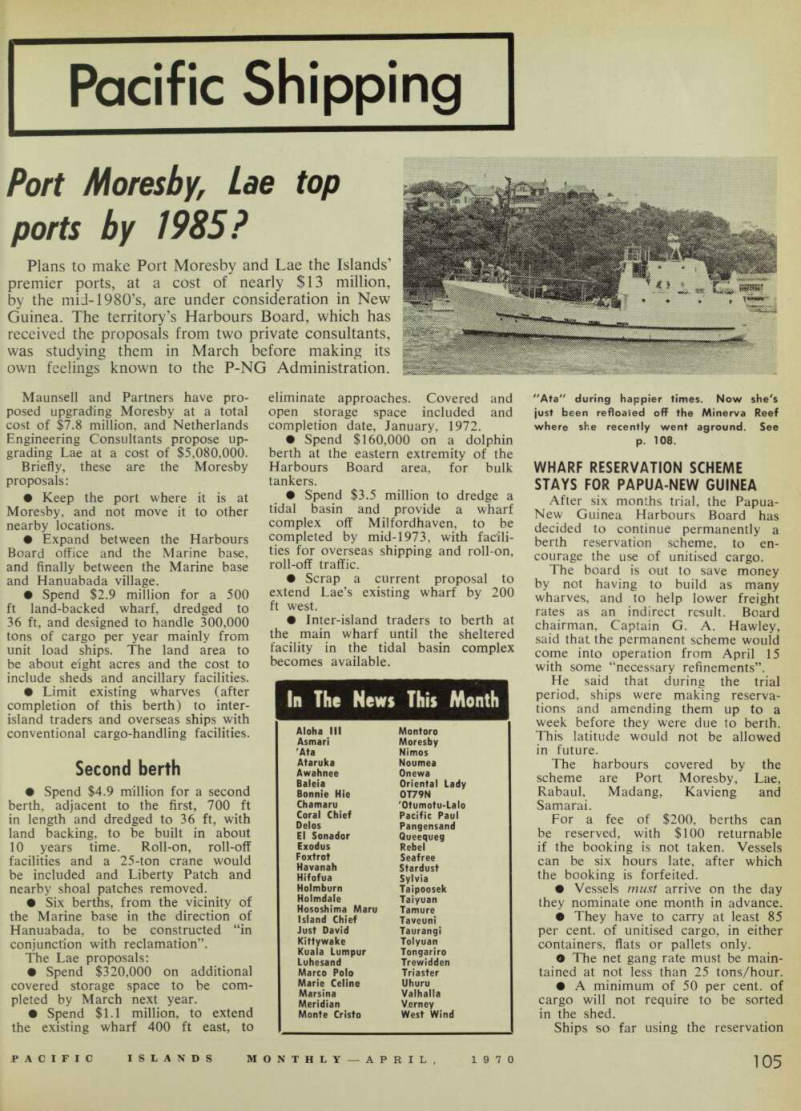
"Ata" during happier times. Now she's just been refloated off the Minerva Reef where she recently went aground. See p. 108.
scheme are Island Chief, Coral Chief, Moresby, Delos, Montoro, Marsina, and Nimos. They have not yet used the scheme at Kavieng and Samarai.
It’s understood the harbours board had considered the scheme’s introduc tion for some time, as a means of encouraging containerisation and the phasing out of conventional cargo carrying methods.
Bill Martin Claims
Lost Boat, // Ot79N //
The new 36-foot aluminium boat, OT79N, abandoned on its delivery voyage to Lord Howe Island last July, now lies moored in the Baie de la Moselle, Noumea.
The boat has been recovered from the Chesterfields, its upper cabin scraped off on the coral reef where the sea finally overturned and washed it up to a lonely destination.
After being reported drifting off Gladstone, Queensland, the OT79N was sighted last year by the French Navy, who were visiting their meteorological installations on the Chesterfields.
Australian, Bill Martin, with his men aboard the Onewa went to salvage the vessel and towed it back 500 miles to Noumea.
The aluminium craft, manufactured by De Havilland Marine of Sydney, was bought for $35,000 by Mr. Clive Wilson for ferrying flying boat passen gers and fishing parties on Lord Howe Island.
The vessel was abandoned on its delivery voyage from Sydney, 100 miles off Lord Howe, when it was re ported filling with water. The men aboard, Lance Wilson and George Bowtell, were rescued by the Kuala Lumpur {PIM, Oct., ’69, p. 108).
Actual cause of the mishap is still
unknown. Meanwhile Bill Martin in Noumea is awaiting settlement of a claim to ownership,
Noumea Gets A High
Powered Tugboat
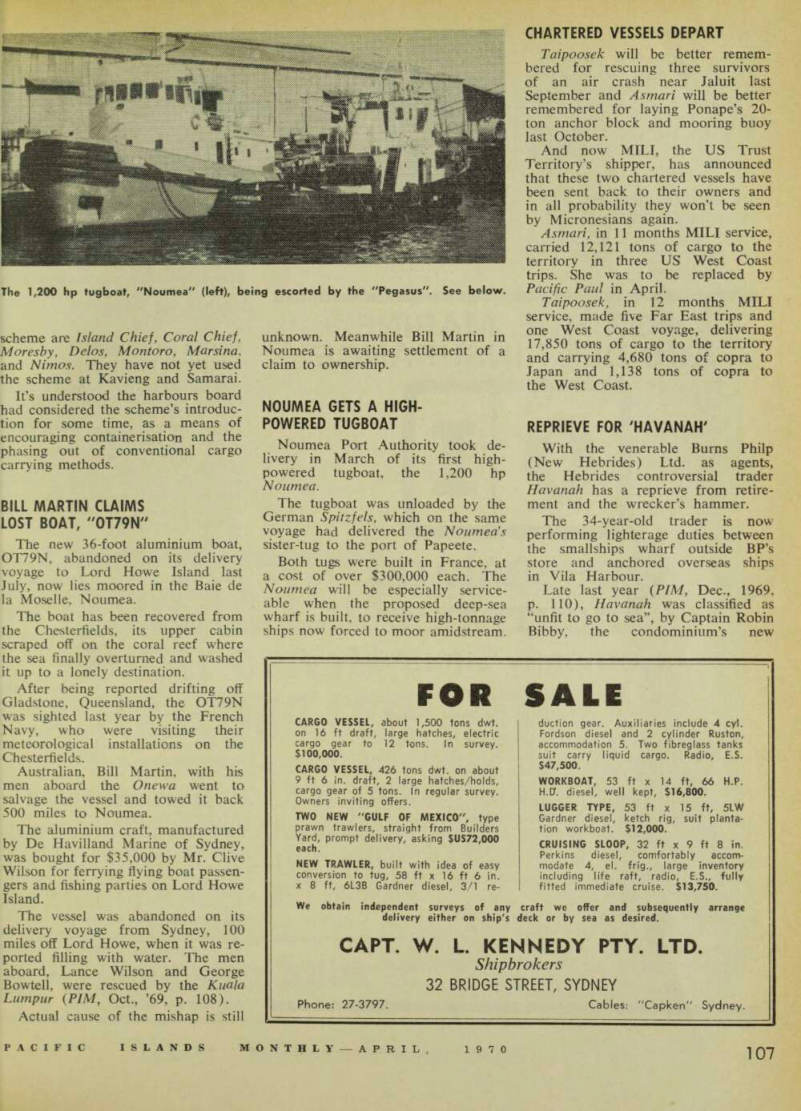
Noumea Port Authority took de livery in March of its first high powered tugboat, the 1,200 hp Noumea.
The tugboat was unloaded by the German Spitzfels, which on the same voyage had delivered the Noumea’s sister-tug to the port of Papeete.
Both tugs were built in France, at a cost of over $300,000 each. The Noumea will be especially service able when the proposed deep-sea wharf is built, to receive high-tonnage ships now forced to moor amidstream.
Chartered Vessels Depart
Taipoosek will be better remem bered for rescuing three survivors of an air crash near Jaluit last September and Asmari will be better remembered for laying Ponape’s 20ton anchor block and mooring buoy last October.
And now MILI, the US Trust Territory’s shipper, has announced that these two chartered vessels have been sent back to their owners and in all probability they won’t be seen by Micronesians again.
Asmari, in 11 months MILI service, carried 12,121 tons of cargo to the territory in three US West Coast trips. She was to be replaced by Pacific Paul in April.
Taipoosek, in 12 months MILI service, made five Far East trips and one West Coast voyage, delivering 17,850 tons of cargo to the territory and carrying 4,680 tons of copra to Japan and 1,138 tons of copra to the West Coast.
Reprieve For 'Havanah'
With the venerable Burns Philp (New Hebrides) Ltd. as agents, the Hebrides controversial trader Havanah has a reprieve from retire ment and the wrecker’s hammer.
The 34-year-old trader is now performing lighterage duties between the smallships wharf outside BP’s store and anchored overseas ships in Vila Harbour.
Late last year ( PIM, Dec., 1969, p. 110), Havanah was classified as “unfit to go to sea”, by Captain Robin Bibby, the condominium’s new
The 1,200 hp tugboat, "Noumea" (left), being escorted by the "Pegasus". See below.
British Marine Superintendent, formerly of the Gilbert and Ellice Islands.
The 104 ft ship’s Sydney owner, Mr. H. T. Doctor, protested at the ban on his ship and said he had paid $6,000 on improvements to her.
In March Mr. Doctor told PIM he was “happy” with the lighterage arrangement.
More Japanese Ships On
Noumea Nickel Run
Latest ship to join the Caledonian nickel run is the Hososhima Maru
from Japan. The 24,000-ton vessel will make regular calls for nickel ore, the voyage from Japan to New Cale donia taking 11 days.
According to the Noumea Port Authorities, 624 ships called at the island last year, against 549 in 1968.
The number of Japanese calls— principally ore carriers—jumped from 139 to 219.
Last year, 290,000 tons of merchan dise were handled through the port of Noumea. This excludes nickel loading, which is carried out at up country ports and the Societe Le Nickel’s own wharf at Doniambo smelting works, Noumea.
Scotland Yard Called In
To Ship Stabbing
Inspectors from Scotland Yard had traditionally only been television personalities to Caledonians, until. early March, when two arrived from.
London to investigate a fatal stabbing; aboard the Trewidden.
The British cargo vessel, under charter to the Messageries Maritimes,. was approaching Papeete from Christobal when the incident occurred among the crew. From reports reach ing Noumea, the suspect of the crime was held in Papeete, while the ship continued her voyage.
After interrogating the Trewidden crew in Noumea, the Scotland Yard men were to fly on to Papeete to> cominue their investigations.
Russian Officer Gets
Asylum In Tahiti
A Russian ship’s officer was granted political asylum in Tahiti in February after he fled from the Soviet oceano graphic research vessel Verney, which is based at Vladivostok.
The officer, 29-year-old Yuri Ivan chenko, was the Verney’s second mate. He slipped ashore from his ship in the early hours of the morn ing of February 25 and requested asylum at the Papeete police head quarters.
His request was granted after the local authorities sought instructions from the Ministry of Foreign Affairs in Paris. Ivanchenko was the first person ever to be given political asylum in Tahiti.
The local Press saw some grim humour in the fact that the Verney’i captain was named Rasputin.
Captain Rasputin himself was any thing but amused by the incident. He ueiayed the departure of his ship some 48 hours while he held van interviews with the French authori ties in an effort to get them to hand Ivanchenko back to him.
" 'Ata" Refloated
At Minerva Reef
’Ata, a 90-ton fishing vessel ownec by Sydney businessman Peter Warnei was inside the lagoon of Soutl Minerva Reef undergoing salvage operations in early March, after be ing driven on the rocks during hurri cane Dolly on February 16.
The 5100,000 crayfisher was tacklec by a team of public works engineer! from Tonga who welded the damagec portside, cut a channel with dyna mite through the reef and winchet her into the lagoon.
The ’Ata was expected later to b<
in a fit condition to return to Nukualofa. Mr. Warners other vessel, hwS e e^e V c a t fd W March that his other fisher Otumotu- Lah would It? ve as we I to assist
The oneraHon
the operation.
On board the when she went agr i°illT Were 20 T ° 8 nmncnipH hv a"us pIa 0 c n e 8 Co C rps W vo a |unteer, Lowell w/th B a grhmluira I°' °Jnd Thtrie!
rill, '
The ’Ata was grounded shortly aftl? she madTefforn to leave the after she made eltorts to leave me
fishirfg fL damT The Mr
Uiki ’Ofa, later described the hurricane as the fiercest he had seen. He had had the ’Ata drop anchor and kept the engine going against the wind but to no avail.
The ’Ata tried for several hours to call either Fiji or Tonga but was unsuccessful until the next morning.
She ran aground about 11.45 p.m. on February 16.
On learning the ’Afa’s fate, Nukualofa Harbourmaster, Capt. C. H.
Hill-Willis, dispatched the government vessel Hifofua to the rescue, and the New Zealand freighter
whichhad left Tonga the same morning was also diverted to ‘“Venn, found the men on the ’Ata all fit and well, but as she could not launch a lifeboat to collect them, she stood by until next day when the arrived.
" e men tran sferred to the Hifofua with their personal belongings and the ship’s navigational equip arrival back in Nukualofa. Mr.
Warner who had Bone on the said the all-Tongan rescue operation had been handled very well.
Hg WQl||d contact his lnsure rs to see *ould be done regarding the
Ala •
tuadtcd x/cccci NtW LMAKItK VcddcL
For Holm
Wellington-based NZ shipper Holm expected a chartered vessel Luhesand to arrive in NZ by March to upgrade the company’s three-weekly runs from NZ to Rarotonga and Tahiti.
Luhesand, a faster sister ship to the company’s 1,947-ton Pagensand , which currently plies this route, is expected to improve exports from NZ to Tahiti.
Taveuni The only backloading hope Holm has ,s H^ n^J r ro “ n ,h a %f r °° t ks N Z°
Sew WL
burn, is improving and managing director. Captain J F. Holm, told PIM a second vessel could be put on Hifofua calls extended to the New Hebrides.
This could happen within two or three months. of Holm’s other runs include a regular S2S and early servicing of Raoul Island Hifofua jn the Kermadecs and Campbell Island in the Sub -Antarctic. china Navigation Company wffl begin in late August a 21-day run carrying up to 3,500 tons of cargo and 86 first class P assen B ers out of Sydney to Brisbane, Noumea, Lautoka and Suva. The company’s 6,160-ton vessel Taiyuan, currently under modification m Hong. Kong, will operate the run, first icported in January (TIM, Jan., p. RMj.
Taiyuan will offer unit loading to shippers and “Islands ports on an Islands ship” to people after a cruise different to that sold by the major cruisers, such as P and O and Shaw Savill.
Shipping Briefs
• The biggest cargo shipment for Pitcairn Island for 30 months left Auckland in early March aboard the NZ Shipping Company vessel Tonga riro. Organised by Wellington’s Pit cairn Island Society, the cargo included foods, motor-cycles, a crate of spare parts, timber and meat. • At a total cost of about $1.9 million, the United Nations is financing a pilot project with seven fishing vessels out of Sorong, north west West Irian, to investigate prospects for skipjack and tuna, and another project, demonstrations and training in new techniques of fish production in excavated ponds and natural inland waters. • In late February and early March a team of Public Works men, led by Mr. Tei Shepherd, was busily blasting out coral heads from the main reef passage at Pukapuka Atoll in the northern Cooks. The passage is the main one which serves Yato village.
The islanders had complained that, due to coral growth, the passage had become almost unworkable at low tides. The big cargo outrigger canoes had to be dragged over the reef and into the ocean before they could be loaded. This slowed down the dis charging and loading of cargo from inter-island vessels.
An American scientific expedition which had arrived at Pukapuka some years ago had widened and deepened the passage, but since then the coral heads had grown again. In spite of rough weather, the Public Works team from Rarotonga reported that work was going well. 9 A magnificent sailing ship, which Le Journal de Tahiti described as “a phantom of the 18th century”, spent a week in Papeete at the end of February en route to Australia for the Captain Cook bi-centenary celebrations.
Named Monte Cristo, the ship is 130 feet long and carries more than 3,000 square yards of canvas. She was built in 1968, reportedly for $500,000, and is the property of a young Canadian businessman, Ronald Craig. Her skipper is Jeff Berry.
Tahitians were somwhat piqued that Mr. Craig charged 100 francs (about $1) for visitors to board his ship, this being an imposition com pletely foreign to the usual free-and easy ways of visiting yachtsmen. • The Nauru Local Government Council has bought its second ship— the 15-year-old 9,993-ton Triaster—
from the British Phosphate Commis sioners for an undisclosed sum. She’ll be delivered to the Nauruans in Japan in mid-April and put on a yet-to-be determined route. Her register will be changed from Britain to Nauru. • Polynesian Food Packers Ltd., a Suva food-processing compnay, is to start a fish-canning operation using mackerel caught in Tongan waters.
The company will also investigate the possibility of catching the fish in Fiji.
Mr. Host Ockinga, the company’s managing director, said the fish would be caught from six 29-ft trawlers operating in Tonga for Fathom
Fisheries. Managing director of Fathom Fisheries, Mr. Peter Warner, is the finance director of Polynesian Food Packers, which —formerly called Continental Meats Ltd—now produces corned beef, corned mutton, palusami and seafood soups.
O New Guinea Australia Line will extend its service to Samarai, Papua, from May.
Coral Chief will call at Samarai every second voyage offering a regular unit load service from Sydney and Brisbane. Her first voyage will leave Sydney on April 24 and reach Samarai on May 4, via Brisbane and Port Moresby.