Spreading The
pp. 97-99 · Read in the full issue
Fame Of
La Perouse
In these days when the study of Pacific history is becoming in
creasingly popular in universities,
a demand has naturally grown up for new editions of the long out-of-print accounts of the early European explorers as well as
other notable, but hard-to-get
books on the South Seas.
Four or five reprint organisations, one of which has its headquarters in the European principality of Liechten stein, appear to have been doing very nicely, thank you, in meeting this demand.
Now, somewhat belatedly, the University of Hawaii Press seems to be making an effcrt to join in this publishing bonanza.
Among its first titles are Omai ; First Polynesian Ambassador to Eng land (reviewed in these columns last month) and Voyages and Adventures of La Perouse, translated from the French by Julius S. Gassner.
An English translation of the Voyages and Adventures of La Perouse is a curious book for an academic publisher to add to his list.
It is not a translation of La Perouse’s own account of his voyages
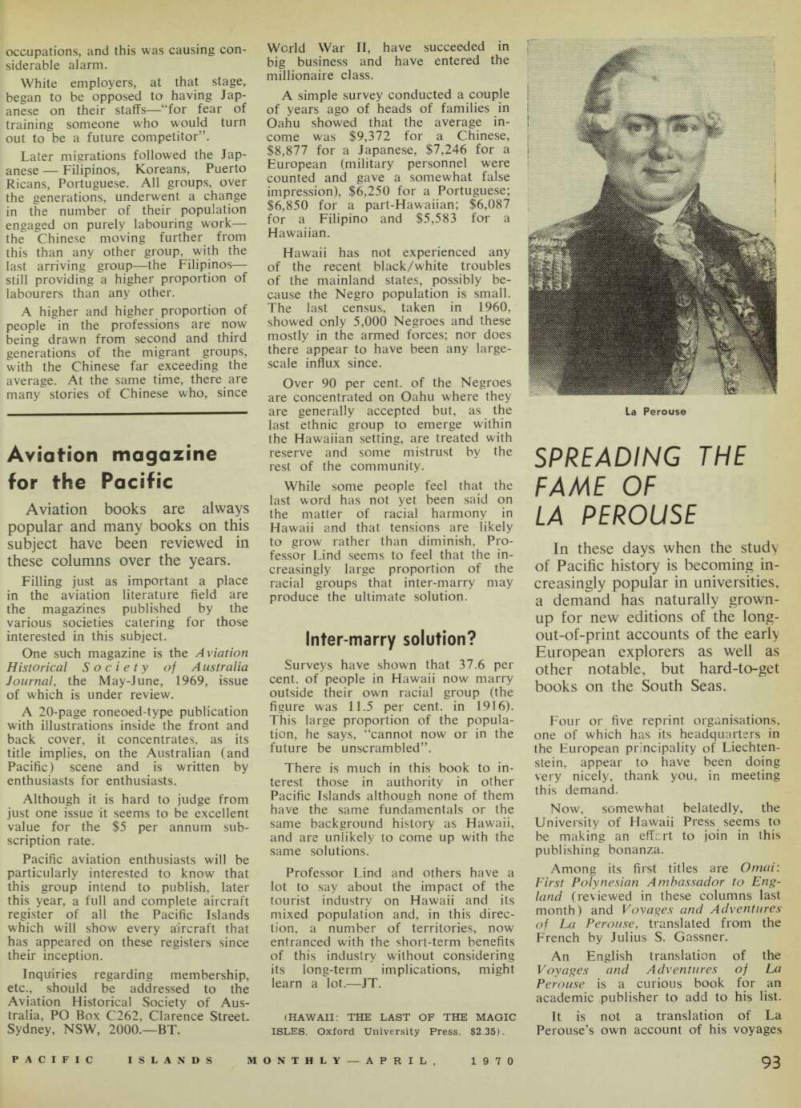
La Perouse
and adventures in the Pacific in 1785- 88, but a translation of the 14th edition of an abridgement of his account, made by one, F. Valentin.
This was originally published in Tours in 1875.
The 14th edition was chosen rather than the first edition of 1840 because it contains an appendix describing the various efforts made to solve the mystery of La Perouse’s disappearance after he sailed from Botany Bay in January, 1788.
The translator, who is Associate Professor of History at the University of Albuquerque, New Mexico, says in an introduction that he made the translation because he believes that La Perouse’s fame “has been unduly eclipsed by that of Captain James Cook, R.N.”
He says also that although La Perouse was second only to Cook as an 18th century Pacific explorer, he is “virtually unknown in the United States outside of esoteric circles”.
Gassner’s translation, therefore, appears to have been made in the hope that it will restore to La Perouse some of the glory that Cook has acquired, and that it will make La Perouse better known in the United States.
Leaves out facts
It will be something of a miracle if Gassner’s work manages to achieve these objectives as the abridged version omits or shortens the very things that did place La Perouse a rung or two above most other Pacific explorers, and which would now be useful to scholars—to wit, his long descriptions of the coasts and islands he visited and the people who lived there.
In short, what La Perouse needs, if he is to be paraded in all his glory before United States and other English-speaking readers, is a scholar of the calibre of Cook’s editor J. C.
Beaglehole, to bring out a thoroughly annotated edition of a complete English translation of his Voyage.
This would have an appendix con taining a complete account of the efforts made to solve the mystery of his disappearance, and not one ending at 1875.
The appendix, needless to say, would include details of the dis coveries of PlM’s good friend Reece Discombe, of Vila, who uncovered the remains of La Perouse’s ship Boussole at Vanikoro eight or nine years ago.—RL.
(Voyages And Adventures Op
LA PEROUSE. University of Hawaii Press.